On May 8th and 9th, 2024, the North American Nyéléni Coordination Committee hosted two virtual consultation sessions as part of the global Nyéléni process.
Overall a success, with broad participation, together the sessions brought together approximately 125 participants from the United States, Canada, and sovereign indigenous nations of North America/Turtle Island to provide regional perspectives on the food sovereignty movement.
The North America Nyéléni Coordination Committee is a new and informal partnership, focused on advancing the Nyéléni process in the North America region, consisting of the National Black Food Justice Alliance, Food Chain Workers Alliance, National Farmers Union (Canada), and the U.S. Food Sovereignty Alliance.
The North America region is a distinct and integral part the food sovereignty movement and the global Nyéléni process, and home to long-standing communities and movements fighting for justice in the region and globally. Key insights on the challenges, opportunities, forms of resistance and resilience, and visions for the future of the food sovereignty movement from the region can be found in the North America Regional report below.
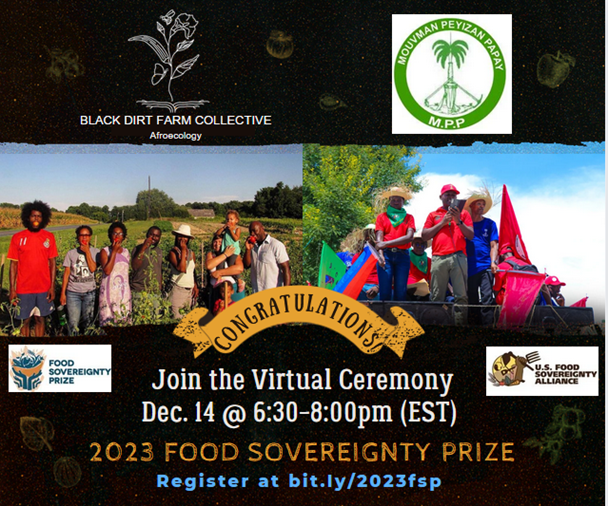
Black Dirt Farm Collective & Mouvman Peyizan Papay-MPP of Haiti
Join the virtual 2023 Food Sovereignty Prize Ceremony on Thursday, December 14 at 3:30pm (PST), 4:30pm (MST), 5:30pm (CST), 6:30pm (EST and Haiti time)
Register here for the virtual event emceed by Darnella Winston of the Federation of Southern Cooperatives
Now in its 15th year, the Food Sovereignty Prize is given annually near World Food Day to a domestic and international organization advancing food sovereignty – the right of all peoples to healthy and culturally appropriate food produced through ecologically sound and sustainable methods, and their right to define their food, fishery, and farming systems. It stands in contrast to the corporate-funded World Food Prize, which perpetuates the myth that society can produce its way out of hunger and the climate crisis with biotechnology and synthetic inputs.
The US Food Sovereignty Alliance has awarded the Food Sovereignty Prize to two outstanding organizations, the Black Dirt Farm Collective, located in Maryland, and Mouvman Peyizan Papay (MPP), based in Haiti. This award is particularly meaningful for MPP at this time, which just celebrated its 50th anniversary amid ongoing political strife, economic depression, and violence in Haiti, prompting an announcement by the UN Security Council to send armed forces into the country.
The Black Dirt Farm Collective is a collective of farmers, educators and organizers that arose from the need to support and protect Black agrarian knowledge in the US mid-Atlantic region. The Collective fights for a just transition using “Afroecology” – the connection between Black agrarianism and agroecology – to build systemic solutions to global food and farm crises. Racial discrimination led to the systematic removal of US Black farmers from the land. Between 1910 and 1997, Black farmers lost roughly 90% of the farmland they collectively owned, and the US Department of Agriculture now reports that fewer than 1% of US farmers are Black. The Black Dirt Farm Collective is committed to reclaiming Black agrarian history, lost generational wealth, and returning to the land.
Shakara Tyler, a returning-generation farmer, educator and organizer and Collective co-founder, summarized one of its essential tenets: “If we are not feeding ourselves our culture, who will?”
Mouvman Peyizan Papay (MPP, or Papaye Peasant Movement)was established in 1973, aligned with the international peasant movement La Via Campesina from the 1990s onward, and has grown to represent more than 60,000 members. The movement empowers rural agricultural workers and focuses on food sovereignty to reclaim Haiti’s independence from global food imports. The Prize committee recognizes MPP’s work combating the ongoing environmental, humanitarian, and hunger crisis in Haiti, worsened by entrenched legacies of colonization, land grabbing, climate change, and foreign exploitation at the expense of local food systems. MPP works directly with local farmers to bolster local food economies through agroecology and build environmental resiliency through planting tens of millions of trees. This inspiring grassroots strategy rejects Haiti’s continued reliance on sporadic international aid in favor of local community control.
“When we received word of this honor during our Food Sovereignty Camp, 450 young peasant leaders let out a thunderous cry of joy,” said MPP leader Jusléne Tyresias. “Through MPP’s 50-year history, Haiti’s peasants have persisted, not only confronting multiple crises head-on, but planting seeds – literally and figuratively – for our people to live with dignity, safety, and sovereignty.”
Join us to hear their stories and to celebrate their efforts to realize food sovereignty!
Honorees will be recognized at the virtual 2023 Food Sovereignty Prize Ceremony on Thursday, December 14 at 3:30pm (PST), 4:30pm (MST), 5:30pm (CST), 6:30pm (EST and Haiti time)
The US Food Sovereignty Alliance (USFSA) is a US-based alliance of food justice, anti-hunger, labor, environmental, faith-based and food producer groups that upholds the right to food as a basic human right and works to connect our local and national struggles to the international movement for food sovereignty. The Alliance works to end poverty, rebuild local food economies and assert democratic control over the food system, believing that all people have the right to healthy, culturally appropriate food produced in an ecologically sound manner. Learn more at usfoodsovereigntyalliance.org
La Alianza por la Soberanía Alimentaria de los Estados Unidos (USFSA)Anuncia los ganadores del Premio a la Soberanía Alimentaria 2023 y Ceremonia Virtual
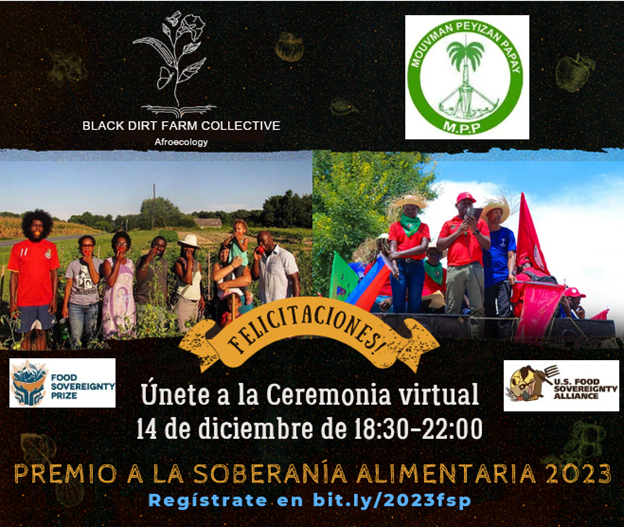
Colectivo Black Dirt Farm & Mouvman Peyizan Papay-MPP de Haití
Únete a la Ceremonia virtual del Premio Soberanía Alimentaria 2023 el jueves 14 de diciembre a las 3:30pm (PST), 4:30pm (MST), 5:30pm (CST), 6:30pm (EST y hora de Haití)
En su 15ª edición, el Premio a la Soberanía Alimentaria se concede anualmente cerca del Día Mundial de la Alimentación a una organización nacional e internacional que promueva la soberanía alimentaria: el derecho de todos los pueblos a alimentos sanos y culturalmente apropiados producidos mediante métodos ecológicamente racionales y sostenibles, y su derecho a definir sus sistemas alimentarios, pesqueros y agrícolas. Contrasta con el Premio Mundial de la Alimentación, financiado por las grandes empresas, que perpetúa el mito de que la sociedad puede salir del hambre y de la crisis climática mediante la biotecnología y los insumos sintéticos.
La Alianza por la Soberanía Alimentaria de Estados Unidos ha concedido el Premio a la Soberanía Alimentaria a dos organizaciones destacadas: Black Dirt Farm Collective, de Maryland, y Mouvman Peyizan Papay (MPP), de Haití. Este premio es especialmente significativo para MPP en este momento, en el que acaba de celebrar su 50 aniversario en medio de continuos conflictos políticos, depresión económica y violencia en Haití, que han llevado al Consejo de Seguridad de la ONU a anunciar el envío de fuerzas armadas al país.
La Granja Colectiva de Tierra Negra es un colectivo de agricultores, educadores y organizadores que surgió de la necesidad de apoyar y proteger el conocimiento agrario negro en la región del Atlántico Medio estadounidense. El Colectivo lucha por una transición justa utilizando la “Afroecología” -la conexión entre el agrarismo negro y la agroecología- para construir soluciones sistémicas a la alimentación mundial.
El Mouvman Peyizan Papay (MPP, o Movimiento Campesino Papaye) se creó en 1973, se alineó con el movimiento campesino internacional La Vía Campesina a partir de la década de 1990 y ha crecido hasta representar a más de 60.000 miembros. El movimiento empodera a los trabajadores agrícolas rurales y se centra en la soberanía alimentaria para reclamar la independencia de Haití de las importaciones mundiales de alimentos. El comité del Premio reconoce la labor del MPP en la lucha contra la actual crisis medioambiental, humanitaria y del hambre en Haití, agravada por el arraigado legado de la colonización, el acaparamiento de tierras, el cambio climático y la explotación extranjera a expensas de los sistemas alimentarios locales. El MPP trabaja directamente con los agricultores locales para reforzar las economías alimentarias locales a través de la agroecología y crear resiliencia medioambiental mediante la plantación de decenas de millones de árboles. Esta inspiradora estrategia de base rechaza la continua dependencia de Haití de la ayuda internacional esporádica en favor de la cooperación de la comunidad local.
“Cuando recibimos la noticia de este honor durante nuestro Campamento por la Soberanía Alimentaria, 450 jóvenes líderes campesinos lanzaron un estruendoso grito de alegría”, declaró Jusléne Tyresias, líder del MPP. “A lo largo de los 50 años de historia del MPP, los campesinos de Haití han persistido, no sólo haciendo frente a múltiples crisis de frente, sino plantando semillas -literal y figurativamente- para que nuestro pueblo viva con dignidad, seguridad y soberanía”.
Únase a nosotros para escuchar sus historias y celebrar sus esfuerzos por alcanzar la soberanía alimentaria.
Los galardonados recibirán su reconocimiento en la ceremonia virtual del Premio Soberanía Alimentaria 2023, que tendrá lugar el jueves 14 de diciembre a las 15:30 (PST), 16:30 (MST), 17:30 (CST) y 18:30 (EST y hora de Haití).
Acerca de la Alianza por la Soberanía Alimentaria de EEUU
La Alianza por la Soberanía Alimentaria de Estados Unidos (USFSA, por sus siglas en inglés) es una alianza estadounidense de grupos de justicia alimentaria, contra el hambre, sindicales, ecologistas, religiosos y de productores de alimentos que defiende el derecho a la alimentación como un derecho humano básico y trabaja para conectar nuestras luchas locales y nacionales con el movimiento internacional por la soberanía alimentaria. La Alianza trabaja para acabar con la pobreza, reconstruir las economías alimentarias locales y afirmar el control democrático sobre el sistema alimentario, convencida de que todas las personas tienen derecho a alimentos sanos, culturalmente apropiados y producidos de forma ecológicamente racional.
Sid yo Kounye a nan 15yèm ane li, Pri Souverènte Manje a bay chak ane tou pre Jounen Mondyal Manje a yon òganizasyon domestik ak entènasyonal k ap avanse souverènte alimantè – dwa tout pèp pou manje ki an sante ak kiltirèl ki apwopriye ki pwodui atravè metòd ekolojik ki bon ak dirab, ak dwa yo genyen pou defini sistèm manje, lapèch, ak agrikilti yo. Li kanpe kontrèman ak World Food Prize ki finanse ak antrepriz la, ki perpétuer mit ke sosyete a ka pwodui fason li soti nan grangou ak kriz klimatik la ak bioteknoloji ak entrain sentetik.
US Food Sovereignty Alliance te bay pri souverènte alimantè a bay de òganizasyon eksepsyonèl, Black Dirt Farm Collective, ki sitiye nan Maryland, ak Mouvman Peyizan Papay (MPP), ki baze ann Ayiti. Prim sa a patikilyèman enpòtan pou MPP nan moman sa a, ki fèk selebre 50yèm anivèsè li nan mitan konfli politik kontinyèl, depresyon ekonomik, ak vyolans ann Ayiti, sa ki pouse yon anons Konsèy Sekirite Nasyonzini an pou voye fòs lame nan peyi a.
Fèm Kolektif nan Pousyè Tè Nwa se yon kolektif kiltivatè, edikatè ak òganizatè ki soti nan bezwen pou sipòte ak pwoteje konesans agrè Nwa nan rejyon Mid-Atlantik Etazini an. Kolektif la goumen pou yon tranzisyon jis lè l sèvi avèk “Afwoekoloji” – koneksyon ki genyen ant agrè Nwa ak agwoekoloji – pou bati solisyon sistemik nan manje mondyal ak kriz agrikòl. Diskriminasyon rasyal te mennen nan retire sistematik kiltivatè Nwa Ameriken yo nan peyi a. Ant 1910 ak 1997, kiltivatè Nwa yo te pèdi apeprè 90% nan tè agrikòl yo te posede ansanm, e Depatman Agrikilti Ameriken an kounye a rapòte ke mwens pase 1% nan kiltivatè ameriken yo se Nwa. Black Dirt Farm Collective pran angajman pou reprann istwa agrè Nwa yo, pèdi richès jenerasyon yo, epi retounen nan peyi a.
Shakara Tyler, yon kiltivatè jenerasyon retounen, edikatè ak òganizatè ak ko-fondatè Kolektif, te rezime youn nan prensip esansyèl li yo: “Si nou pa nouri kilti nou an, ki moun ki pral?”
Mouvman Peyizan Papay (MPP, oswa Mouvman Peyizan Papaye) te etabli an 1973, ann amoni ak mouvman peyizan entènasyonal La Via Campesina depi ane 1990 yo, e li te grandi pou reprezante plis pase 60,000 manm. Mouvman an otorize travayè agrikòl nan zòn riral yo epi li konsantre sou souverènte alimantè pou reprann endepandans Ayiti kont enpòtasyon manje mondyal. Komite Prize a rekonèt travay MPP ap konbat kriz anviwònman an, imanitè ak grangou k ap kontinye ann Ayiti, ki vin pi mal ak eritaj kolonizasyon anrasinen yo, afèkte tè, chanjman klimatik, ak eksplwatasyon etranje sou kont sistèm manje lokal yo. MPP travay dirèkteman ak kiltivatè lokal yo pou ranfòse ekonomi manje lokal yo grasa agwoekoloji epi pou devlope rezistans anviwònman an atravè plante plizyè dizèn milyon pye bwa. Estrateji debaz enspire sa a rejte depandans kontinyèl Ayiti sou èd entènasyonal detanzantan an favè kontwòl kominote lokal yo.
Lidè MPP Jusléne Tyresias di: “Lè nou te resevwa pawòl onè sa a pandan Kan Souverènte Alimantè nou an, 450 jèn lidè peyizan te lanse yon gwo rèl lajwa. “Atravè 50 ane istwa MPP a, peyizan Ayiti yo te pèsiste, non sèlman fè fas ak plizyè kriz tèt-sou, men plante grenn – literalman ak senbolikman – pou pèp nou an viv ak diyite, sekirite, ak souverènte.”
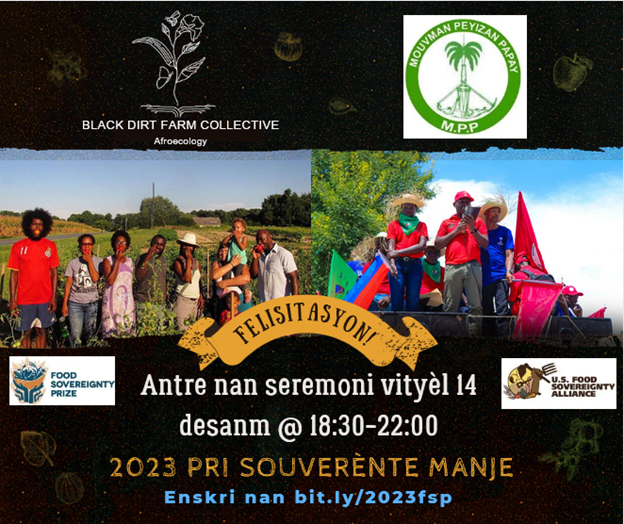
Join nou pou tande istwa yo epi selebre efò yo pou reyalize souverènte manje! Yo pral rekonèt moun ki onore yo nan seremoni pri vityèl souverènte alimantè 2023 Jedi 14 desanm a 3:30 pm (PST), 4:30 pm (MST), 5:30 pm (CST), 6:30 pm (EST ak lè Ayiti).
US Food Sovereignty Alliance (USFSA) se yon alyans ki baze Ozetazini nan gwoup jistis manje, anti-grangou, travay, anviwònman, ki baze sou lafwa ak pwodiktè manje ki defann dwa a manje kòm yon dwa imen debaz epi travay pou konekte lokal nou an. ak lit nasyonal nan mouvman entènasyonal la pou souverènte manje. Alliance lan travay pou mete fen nan povrete, rekonstwi ekonomi manje lokal yo ak revandike kontwòl demokratik sou sistèm alimantè a, kwè ke tout moun gen dwa a manje ki an sante, ki apwopriye pou kiltirèl pwodui nan yon fason ekolojik ki bon. Aprann plis sou www.usfoodsovereigntyalliance.org
The small-scale food producers and their allies in the US Food Sovereignty Alliance (USFSA) – family farmers, rural workers, fishermen, peasants, farmworkers, and food justice advocates – call for a democratic transformation of our food systems based on human rights and social, ecological, economic, and cultural justice principles of Food Sovereignty. We make our demand just after the historical week of World Food Day 2023, and we will continue to work and organize in the United States, and with our allies in North America and globally, in the face of on-going systemic challenges, including the crises of climate change and corporate power. We draw strength from our united alliance across the food system, and collective power at the grassroots base of our movements, as we strive for the transformative vision articulated by our global food sovereignty movement for decades.
As humanity faces a crucial point in its history to move away from the extractive and destructive economic model that has brought about this climate crisis, we oppose the industrial, corporate agrifoods model that is privatizing, commodifying, and financializing public services, land, nature, and data, increasing inequality, and accelerating environmental damage. We fight for human rights of all people and work to promote agroecology, food sovereignty, biodiversity, climate justice, and gender and racial equality, aiming to achieve the well-being of all people to and guarantee the future for humanity and Mother Earth. As we advance with vision, we call on our allies in, and outside, of the food and agriculture movement to join USFSA and others in the global Nyeleni process for Food Sovereignty.
The US Food Sovereignty Alliance
Family farmers, food and farm workers, urban gardeners and food justice communities, fishing communities, non-profit organizations, food-systems research networks, youth and people of color have been organizing with the US Food Sovereignty Alliance since 2010, working to bring about food systems that produce healthy food, take care of nature, and ensure that food producers and communities are at the center of decision-making around food systems. We have fought especially the intense corporate concentration and consolidation in food and agriculture, and the more general corporate domination over rural life, in the US, as well as the complicity of our government in handing over more and more power to transnational corporations. We have fought against a system that sees 1 in 5 children in the U.S. and more than 700 million people going hungry around the world as acceptable. We have fought against a system that is destroying and wasting our natural resources and polluting our air and water. And we have fought a system that sees rural workers and their labor as disposable and exploitable.
Why We Are Called to Act
Food insecurity, in many ways, is present in the US and globally, because the rights of food producers and their communities are being ignored, in favor of the interests of transnational corporations and the private sector. Opaque, unaccountable multistakeholder networks are taking the place of transparent, democratic, and multilateral processes in decision-making and policy development. We cannot stand by as governments abandon commitments to ensuring the right to food and a dignified life for rural peoples.
Moving Forward for Food Sovereignty and Agroecology
We continue our efforts to organize people who want a better world and who are done with destructive and extractive economies and corporate control of our lives. We renew our commitment to a better world, in the face of the climate crisis that is a catastrophe of unimaginable magnitude, through the vision of the food sovereignty movement and welcome you to join us.
WASHINGTON, DC, October 10, 2023 — In advance of the annual celebration of World Food Day by the UN Food and Agriculture Organization, the US Food Sovereignty Alliance has awarded the annual Food Sovereignty Prize to two outstanding organizations, the Black Dirt Farm Collective, located in Maryland, and Mouvman Peyizan Papay (MPP), based in Haiti. This award is particularly meaningful for MPP at this time, which just celebrated its 50th anniversary amid ongoing political strife, economic depression, and violence in Haiti, prompting an announcement by the UN Security Council to send armed forces into the country.
Recognized internationally, the Food Sovereignty Prize serves as a counterweight to the World Food Prize initiated by Norman Borlaug, the controversial “father of the Green Revolution.” “The World Food Prize typically focuses on expanding production of single crops through expensive, large-scale technology,” said Heather Day, executive director of Community Alliance for Global Justice, a USFSA coordinating member and 2009 recipient of a Food Sovereignty Prize Honorable Mention. “In contrast, the Food Sovereignty Prize champions grassroots, agroecological solutions from the people most harmed by the injustices of the global food system. Mouvman Peyizan Papay and Black Dirt Farm Collective demonstrate community-led farming systems that work toward Black and Indigenous liberation while nourishing humanity and the Earth.”
The Black Dirt Farm Collective is a collective of farmers, educators and organizers that arose from the need to support and protect Black agrarian knowledge in the US mid-Atlantic region. The Collective fights for a just transition using “Afroecology” – the connection between Black agrarianism and agroecology – to build systemic solutions to global food and farm crises. Racial discrimination led to the systematic removal of US Black farmers from the land. Between 1910 and 1997, Black farmers lost roughly 90% of the farmland they collectively owned, and the US Department of Agriculture now reports that fewer than 1% of US farmers are Black. The Black Dirt Farm Collective is committed to reclaiming Black agrarian history, lost generational wealth, and returning to the land.
Shakara Tyler, a returning-generation farmer, educator and organizer and Collective co-founder, summarized one of its essential tenets: “If we are not feeding ourselves our culture, who will?”
Mouvman Peyizan Papay (MPP, or Papaye Peasant Movement) was established in 1973, aligned with the international peasant movement La Via Campesina from the 1990s onward, and has grown to represent more than 60,000 members. The movement empowers rural agricultural workers and focuses on food sovereignty to reclaim Haiti’s independence from global food imports. The Prize committee recognizes MPP’s work combating the ongoing environmental, humanitarian, and hunger crisis in Haiti, worsened by entrenched legacies of colonization, land grabbing, climate change, and foreign exploitation at the expense of local food systems. MPP works directly with local farmers to bolster local food economies through agroecology and build environmental resiliency through planting tens of millions of trees. This inspiring grassroots strategy rejects Haiti’s continued reliance on sporadic international aid in favor of local community control.
“When we received word of this honor during our Food Sovereignty Camp, 450 young peasant leaders let out a thunderous cry of joy,” said MPP leader Jusléne Tyresias. “Through MPP’s 50-year history, Haiti’s peasants have persisted, not only confronting multiple crises head-on, but planting seeds – literally and figuratively – for our people to live with dignity, safety, and sovereignty.”
The Black Dirt Farm Collective and Mouvman Peyizan Papay will be recognized at a virtual ceremony, date and time to be announced soon. The ceremony is free and open to the public. Further information will be made available at www.usfoodsovereigntyalliance.org and www.facebook.com/USFoodSovAlliance.
### The US Food Sovereignty Alliance (USFSA) is comprised of food justice, anti-hunger, labor, environmental, faith-based and food producer groups that work to connect our local and national struggles to the international movement for food sovereignty. The Alliance strives to end poverty, rebuild local food economies and assert democratic control over the food system, believing that all people have the right to healthy, culturally appropriate food produced in an ecologically sound manner.