We uplift a call from La Via Campesina and other global movement organizations to carry out global weeks of fasting between May 19 and 30, 2025, in solidarity with the people of Palestine.
Since March 2, 2025, the Israeli government imposed a total blockade on Gaza engineering one of the worst famines in recent history. As a result, Gaza’s infrastructure is near total collapse, 93% of population faces acute food insecurity, bringing Gaza to IPC Phase 5 — extermination by starvation — the highest level of food insecurity, which indicates widespread death due to starvation, extremely critical acute malnutrition, and collapse of livelihood systems. Bread has disappeared from markets; Palestinians are dying from dehydration and untreated wounds; all bakeries and flour mills have been destroyed; fuel, water, electricity, and medical supplies remain blockaded. As a result of the deliberate actions carried out by the Israeli occupation of Palestine, over two million Palestinians in Gaza are living in famine.
In the current context in which an entire population is suffering from starvation, we call upon the people of the world to join us and carry out, on a date of your choice, a Global Day of Fasting in solidarity with Gaza between May 19th and 30th, 2025.
As part of these weeks of fasting, the US Food Sovereignty Alliance invites members and allies to collectively fast together onSunday, May 25th. We also invite those who can to plant seeds, seedlings, or a tree on that day as a symbol of our solidarity with Palestine — especially with movements there that are saving lives, feeding communities, and defending the Earth.
Show your support by fasting in solidarity with the people of Gaza and donate the money not spent on food to our Palestine Emergency Fund, or to another organization working on the ground to fight the deliberate use by Israel of starvation as a tool of genocide and to provide food directly to people in Gaza.
Together, we can send a powerful message from every corner of the earth condemning the use by Israel and its accomplices of starvation as a weapon of war.
In addition, let’s all unite in street mobilizations, call-in campaigns, strikes, and boycotts until Israel’s assaults on the Palestinian people cease and Gaza borders are opened!
For the Black Mesa Water Coalition, food sovereignty is one part of a broader effort to transform Navajo and Hopi communities and their economies by drawing on traditional knowledge to build sustainable alternatives to fossil fuel dependence.
“The just transition for us really came from the need to transition away from a fossil fuel-based economy, which our tribe is heavily dependent on, with royalties from the exploitation of coal, gas, and other resources,” said Black Mesa Water Coalition member Robert Nutlouis during the US Food Sovereignty Alliance Assembly in Bellingham, Washington, in October 2018. “Our call for the Nation is to move away from that type of development towards a more sustainable, regenerative economy.”
The organization, based in Arizona, formed in 2001 to confront the impacts of coal mining in Navajo and Hopi communities and tackle issues around water, natural resources exploitation, and health. Among other work, its projects have included regenerative water catchment systems, leadership development initiatives, and a “Food Sovereignty Project” using dry land agricultural techniques to produce food on a five-acre community farm.
“Food sovereignty for our community is really looking at our own traditional knowledge and the wisdom that our ancestors had developed and left for us and is still carried by our elders,” said Robert. “Really going back and seeing what this knowledge and wisdom say to us about how to revive and rebuild our food system.”
The organization also works to build cultural awareness, including language preservation efforts and education around traditional seeds.
“There has to be a cultural shift from how we see things to how we interact with our environment,” Robert continued. “The land is sacred, the elements are sacred, and we have to understand it in that way.”
Sheldon Natoni, a youth member of the Black Mesa Water Coalition, added: “It kind of gives me comfort that I’m going through the right path and I’m not being part of the extractive economy. It’s a healing property for me to become more grounded in who I am as a Dene.”
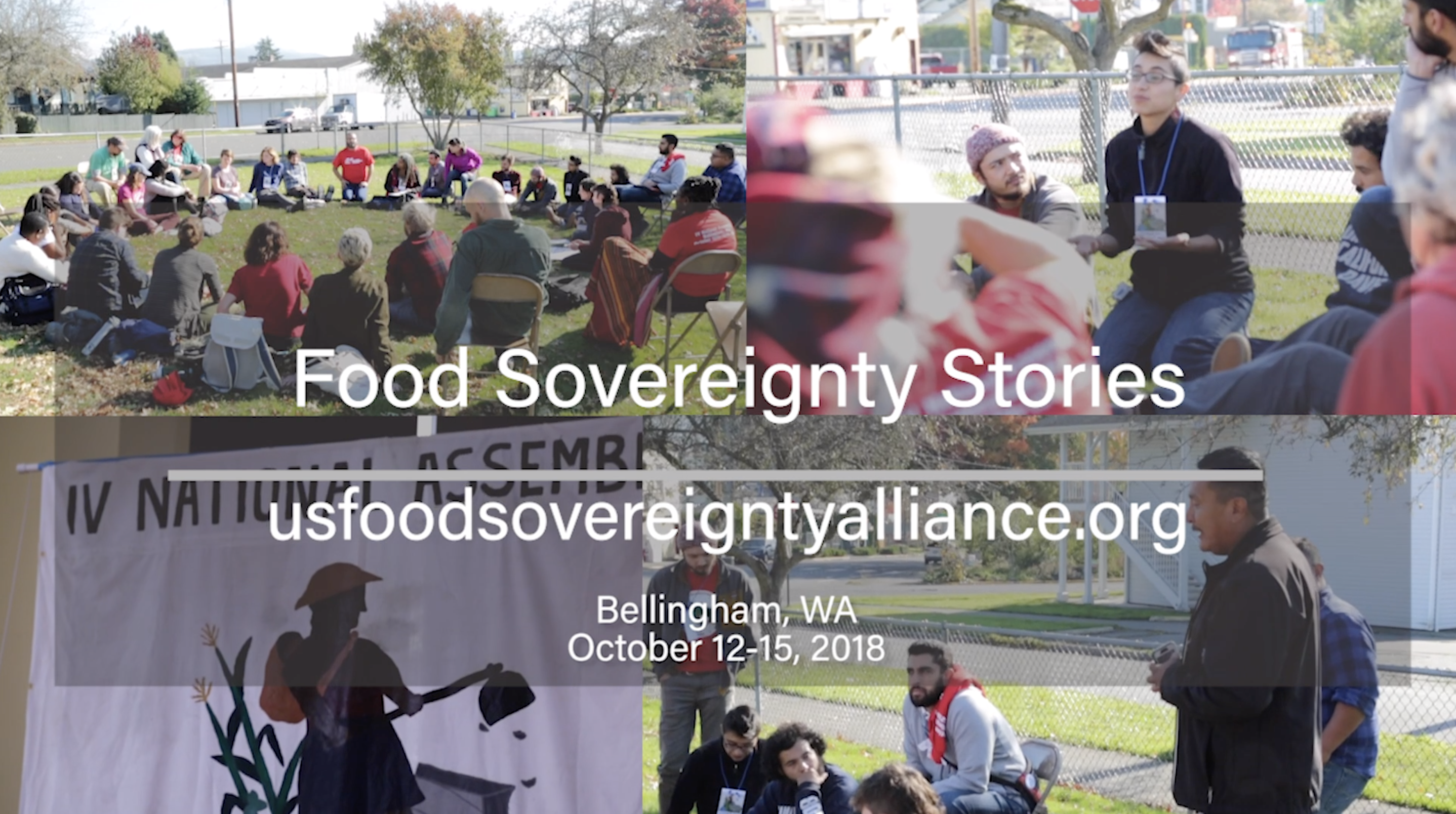
Black Mesa Water Coalition received the US Food Sovereignty Alliance’s 2018 Food Sovereignty Prize in the domestic category, recognizing its work in reclaiming Indigenous food sovereignty. Food Sovereignty Stories is a video series exploring what food sovereignty can look like for diverse social movements across the United States. Share this video and follow USFSA for updates!
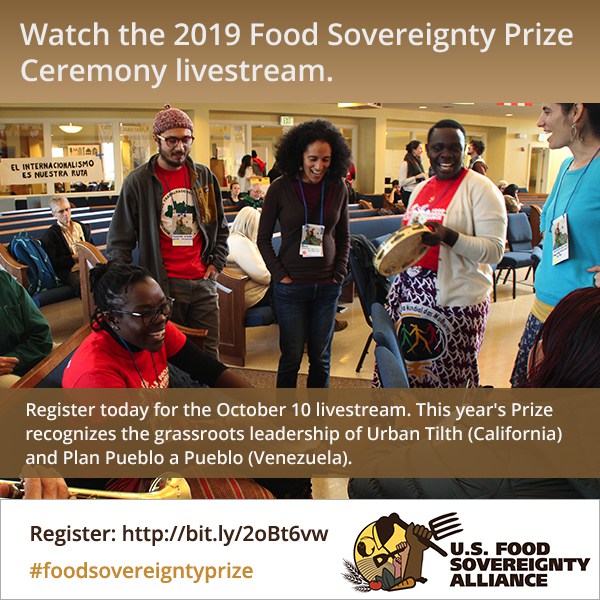
The 2019 Food Sovereignty Prize (FSP) Ceremony will occur on October 10 as part of the USFSA’s Midwest region’s membership assembly in Ferguson, Missouri. This year’s awardees,Urban Tilth (Richmond, CA) and Plan Pueblo a Pueblo (Venezuela), demonstrate the values and principles of food sovereignty through visionary, collective action to transform food production and distribution systems.
The narrative strategy collective of the USFSA aims to raise awareness and center our food sovereignty discourse around the critical perspectives and oppositional actions of our communities’ struggles against the extractive economy and false solutions promoted by corporations which claim to be raising people out of poverty, feeding the world, and addressing the global climate crisis. Aligned with the USFSA’s commitment to prioritize the leadership of grassroots member organizations, our communications collective intends to focus on the real, community-led solutions for a Just Transition toward a regenerative economy. We recognize that grassroots organizers – not corporations – are best positioned to know and eliminate social and environmental problems, and we affirm our belief that those most affected by poverty, hunger, and ecological collapse have the rights to self-determine their future, to tell their stories along the way, and fully participate in policy processes from the local to global levels.
This blog post republishes an onlinenewsletter sent by Urban Tilth at the end of August 2019, in which they overview their work and extensively define food sovereignty. We encourage you to additionally read the 2019 FSPannouncementand view the fourth Food Sovereignty Storiesfilmthat featured Urban Tilth’s Executive Director, Doria Robinson.
Urban Tilth opened their August newsletter by expressing gratitude to the USFSA for honoring the organization with the 2019 Food Sovereignty Prize in recognition of their efforts to build a more sustainable, healthy, and just food system in Richmond and elsewhere. They continued by writing:
What is Food Sovereignty?
Food is part of the lives of every living being on Earth. It sustains us, nurtures or harms us. Food defines our cultures, shapes our identities. It can be a powerful catalyst for transforming our relationships to one another and to the planet. For Urban Tilth, access to healthy food also means that what we eat comes from whole ecosystems, from healthy soils, healthy water and healthy air, from the love of the earth, and from the precious life energy of people that grow it, distribute it and prepare it for our plates.
For Urban Tilth Food Sovereignty is having control over what goes into our bodies starting from the soil, water and air. Food Sovereignty means having the right to demand that the soil that grew our food was not stripped of life, then soaked in chemicals that drained to the rivers and bays killing the fish; that the air was not polluted with greenhouse gases by the machines that moved food thousands of miles across the globe so that we can have summer produce in winter.
Food Sovereignty means being able to determine that the food that sustains our lives will be produced without destroying the Earth we depend on, by people who will be treated with dignity, paid a fair wage for their labor or fair price for their produce and will not be poisoned in the process.
Food Sovereignty also means that even if you are poor, or even if you live in a city, you have the right to this kind of healthy, righteous food; that you do not have to be quiet and take whatever food-like-products end up in your corner store, or big box grocery – that is most likely also destroying your local economy, while barely employing people at a living wage.
Food Sovereignty means that we have the right, even as Landless peoples, to have a relationship with the land we come from; that we have the right to belong to a place; the right to admit interdependence; the right to be in relationship with land; the right to care deeply and the duty to protect the people, land, water and air that nurtures us.
Since Urban Tilth was founded in 2005, our goal has been to transform the food system, especially how the current system impacts low income communities of color in Richmond and San Pablo, California. We are committed to intentionally hiring and training local residents, especially (but not exclusively) youth who struggle with food insecurity, housing insecurity, the criminal justice system, unemployment, and poor access to quality education, to lead in this transformative work. We believe we must liberate ourselves, no one can come into our community and do this kind of work for us. With home grown experts leading in every Urban Tilth initiative, we work together with our partners, allies and neighbors using many different strategies to create a healthy, just and sustainable food system, within a healthier and more self-sufficient community.”
Our most exciting project so far is theNorth Richmond Farm. We are transforming a neglected, publicly-owned property into a vibrant urban farm, Agricultural Park and Watershed Learning Center!The Future Farm will be a working urban farm with a greenhouse, shadehouse, hoop houses, a permanent farm stand where North Richmond residents can access fresh produce every day, a wash and pack facility, a community commercial kitchen, cooperative cafe, outdoor classrooms, amphitheater and meeting spaces. The farm is already slowly becoming a place for the community to come together to celebrate, learn and, of course, grow and eat healthy food. AtThe Farm Today, we host community build volunteer days, educational exchanges, organize community events, grow crops, build the soil, and pack our CSA boxes with love.
Along with the work happening at our five community gardens and urban farms we also serve over 400 students from West Contra Costa School District by conducting educational programs and managing learning gardens at theVerde Elementary Partnership Garden,Richmond High School Urban Agriculture Academy, as well as host 40 youth each summer in ourSummer Youth Apprentice Program, a 6 week intensive urban agriculture employment and training program that has run for the past 10 years.
Five years ago with inspiration from Brock Dolman at the Water Institute at Occidental Arts and Ecology Center we designed and launched ourThe Basins of Relations Watershed Restoration Technician Training Program where we train and employ young people from West Contra Costa County to become stewards of their watersheds, communities, and the creeks that run through them.
We are also leading theWildcat Visioning Project, a campaign to create awareness about the need to improve the North Richmond Wildcat Creek trail to help reconnect the people who live in North Richmond with this vital waterway.
Our CSA provides chemical and pesticide free nutritious produce to low income families, seniors, disabled people, artists, and those reentering the community from incarceration through community subsidized memberships. Our aim is to use this project as an organizing strategy to begin forming a San Francisco Bay Area small farmers distribution cooperative.
We also provide our produce through Free Farm Stands and Pop-up Farm Stands. Our next step will be a Farmer’s Market at Unity Park.
At Urban Tilth we are proud of what we have accomplished so far. We appreciate our founder, Park Guthrie, our amazing staff and boards past and present, our allies (Movement Generation, Occidental Arts and Ecology Center, Supervisor John Gioia, the North Richmond MAC, Rich City Rides, Spiral Gardens, Cooperation Richmond, the Our Power Richmond Coalition, the Climate Justice Alliance, Community to Community, APEN, Annie’s Annuals, all our family in Kentucky, Alaska and Buffalo, CASFA, UC Extension, Noll and Tam, Kanchan, Josh, Sarick, Katie and Adele Ho and so many others), all our donors who understand the importance of funding the grassroots people directly so they can uplift their own communities and our many, many, many community volunteers, who make the continuation of our work possible. This honor is your honor and would not have been possible without your courageous and visionary hard work and loving support.
For Jonathan Roberts, a member of the Detroit Food Policy Council, food issues are inseparable from the labor that goes into producing, distributing, and preparing and serving food. That’s why he believes that any conversation around food sovereignty must integrate food worker rights and the perspectives of the people—often poor people and people of color—working throughout the food chain.
“Our system doesn’t work without human labor. And it’s a labor of love, but it’s also a labor of pain and oppression and slavery,” Jonathan said during the U.S. Food Sovereignty Alliance Assembly in Bellingham, Washington, in October 2018.
“My entire family was born into the food economy through slavery,” he continued, sharing the story of one of his ancestors, named Sarah Snider. “When she was three years old she was incorporated onto a plantation. She had to work 12-15 hour days getting scraps from the person who happened to own the land.”
Jonathan sees clear ties between that history of enslavement and the ongoing exploitation of U.S. food workers.
“And now today, in cities like Detroit, you have working women who share a very similar fate. They work 12-15 hours to get tips, and to get these pittances from owners and bosses that are really just extending this legacy of economic subjugation to so many working people,” he said.
As a labor organizer, Jonathan has organized restaurant workers to fight for better wages and conditions. That’s the perspective that he brings to the Detroit Food Policy Council, an organization that promotes food justice, food sovereignty, and building a sustainable food system in Detroit through education, advocacy, and policy initiatives.
Jonathan finds food sovereignty a useful framework for approaching food workers’ rights because it helps demystify the food system by asking probing questions about where food comes from, how it was produced, and what conditions farmers, farmworkers, and other food chain workers experienced in getting the food to our grocery stores, restaurants, and kitchen tables.
“So food sovereignty can’t exist when we have overproduction, and at the same time food workers like servers and bartenders and cooks, can’t even afford the food that they are preparing and serving to customers,” Jonathan said. “I think that contradiction in and of itself is enough to think about why food sovereignty demands a labor analysis.”
Food Sovereignty Stories is a video series exploring what food sovereignty can look like for diverse social movements across the United States. Share this video and follow USFSA for updates!