By Eric Holt-Giménez, Ph.D., Social Scientist and Executive Director of Food
First/Institute for Food and Development Policy. The real causes of the 2008 and 2011 food price crises were numerous, but the fact that our global agricultural system is dominated by corporations, free trade, and speculation was neglected by most media outlets.
By Eric Holt-Giménez, Ph.D., Social Scientist and Executive Director of Food First/Institute for Food and Development Policy.The food and financial crises of 2008 ignited a massive round of “land grabbing” in the Global South, with foreign agribusinesses leasing and buying large tracts of land to produce both food and fuel crops for export.
“The report therefore calls States for a fundamental shift towards agro-ecology as a way for countries to feed themselves while addressing climate and poverty challenges.”
“We, more than 500 representatives from more than 80 countries, of organizations of peasants/family farmers, artisanal fisherfolk, indigenous peoples, landless peoples, rural workers, migrants, pastoralists, forest communities, women, youth, consumers and environmental and urban movements have gathered together in the village of Nyéléni in Sélingué, Mali to strengthen a global movement for food sovereignty…”
Our global food system is terribly broken. Together, we can fix it! In the Curriculum you will find modules, factsheets, and other materials to learn about food sovereignty from the perspectives of consumers, anti-hunger organizations, environmentalists, and Small Farmers and farmworkers.
Short reflection on food sovereignty by Werner Fuchs, Lutheran pastor and translator, member of the CONSEA (National Council for Food Security of Brazil).
Taken from a presentation at the International Conference on Global Land Grabbing, Eric Holt-Gimenez of Food First and Annie Shattuck and Yi Wang explain how land grabs are affecting urban areas in the Global North, in addition to the rural land grabs in the Global South. This shared, universal threat requires immediate action and global solidarity
Eric Holt-Gimenez, Annie Shattuck, and Yi Wang explain how food retail corporations are behind the urban and northern land grab in this Food First backgrounder.
From The Applied Research Center, “The Color of Food” reveals that racism and exploitation that exist in our food system and suggests ways to transform our food system into a vehicle of justice.
Our food is being used as a weapon, and we are living in a political moment that demands coordinated action.
Currently, we are seeing how political borders are being used to attack workers and families. Whether it’s the more than 500,000 people who were cut from the food stamp program over the last 3 years, the fact that four of the six largest agribusiness corporations have merged, or that farmers across the country are losing their lands while food chain workers are working under exploitative and dangerous conditions, and often fear deportation.
We must continue to dream of a better world and work to build a new food system. We need a system that respects communities and human rights and nourishes rather than ravages the land. That system is based on food sovereignty, the human right to food, and the rights of Mother Earth.
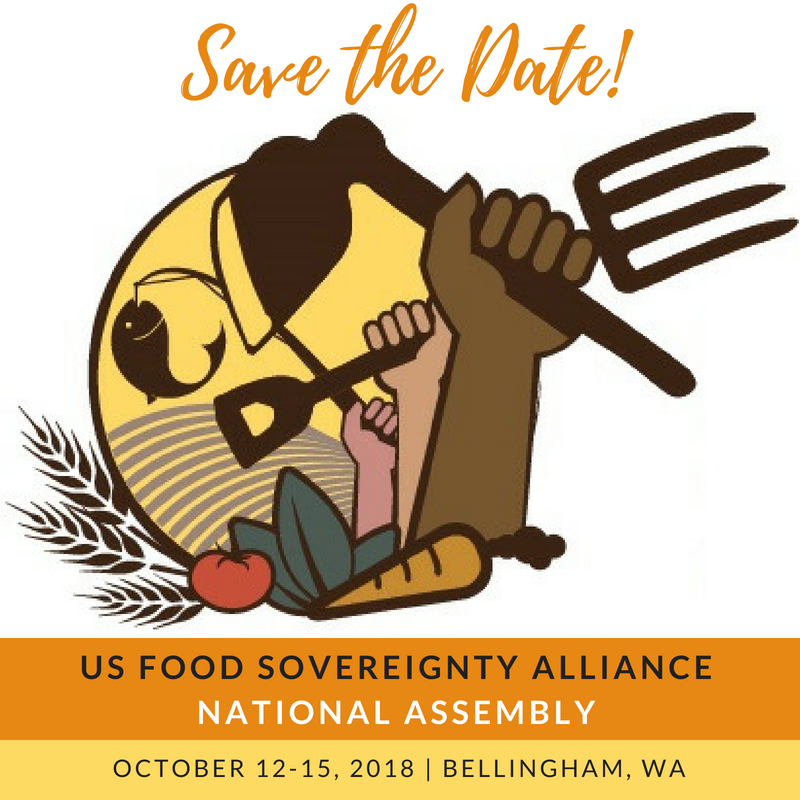
On October 12 – 15, 2018, grassroots organizations, activists, faith-based community, scholars, union members, farmers and fisherfolk, and other food chain workers from around the US and the world will converge on Bellingham, WA, for the IV National Assembly of the US Food Sovereignty Alliance (USFSA). The Assembly will provide a space to learn about food sovereignty, share struggles and collective wins, and build solidarity.
The USFSA has a goal of bringing together as many people as possible in a World Social Forum style gathering that will encompass a range of panels, political education, arts and other cultural exchanges to pave the way for stronger political action in the United States. The space will be an opportunity for mutual learning. Please stay tuned for information on how to submit a proposal for a panel, registration, and more. Together, we’ll deepen relationships across sectors and geographies to build a path for community liberation and reclaim our food system.
The Assembly will also include the 2018 Food Sovereignty Prize awards ceremony honoring movements in the US and internationally. Lauded as an alternative to the World Food Prize, the Food Sovereignty Prize champions real solutions to hunger and is recognized by social movements, activists and community-based organizations around the world.
Please save the date and sign up (or follow us on Facebook or Twitter) to get the latest updates on the organizing and registration process. If you are interested in participating in the planning of the Assembly, please email info (at) usfoodsovereigntyalliance (dot) org.
Food Week of Action – Sunday Oct. 11 through Sunday Oct. 18 – includes World Food Day (October 16) as well as the International Day for Rural Women (October 15) and the International Day for the Eradication of Poverty (October 17).
Let the US Food Sovereignty Alliance and people near and far know what you have planned for October, the Food Week or World Food Day! Fill out the easy form below to get on the map.
People in the U.S. and worldwide are taking back their food systems – fighting for their land and waterways, reclaiming vacant lots, teaching others how to grow food, and developing local distribution systems – while simultaneously creating jobs, providing fresh food, preserving the environment, building rural-urban connections, advocating for just policies, and revitalizing their communities. Local control of seeds—by farmers, gardeners and seed keeping groups—is crucial for food security and food sovereignty.
2015 Priority Actions
1) With Farmworkers! Begin by Boycotting Sakuma Berries! Support Familias Unidas por la Justicia in their struggle for a union contract. boycottsakumaberries.com. 2) With Family Farmers! The Trans-Pacific Partnership will likely hurt small-scale family farmers, the environment and democracy. Learn more and stay tuned for actions. 3) With Food Workers! Watch for workers organizing in your area and support them. UCC has a great list of groups and ways to ‘Stand with Workers’. 4) 2015’s Climate Negotiations are critical to the health of the planet and the livelihoods of tens of millions of people. Learn about climate & food/farm connections and join with communities united for a just transition. Learn here 1 2 3 4 and take action here.
Join the Zero Hunger Challenge Individuals and groups can join ZHC, an initiative of the United Nations to raise awareness and build a movement around eliminating hunger.
Share your food story with a captioned photo, video or written social media post (e.g. YouTube, Twitter, Instagram and Facebook), using the hashtag #myfoodstory via @e_alliance and @presbyhunger.
Get your hands in the dirt: Plan a trip to your nearest farm to meet (and help!) the farmer and learn more about the challenges and joys of food production. Consider joining or starting a community garden. How-to and other ideas here: bit.ly/phpfoodfaith
Celebrate local foods and knowledge: Organize a community fair that showcases local food producers and shares the stories of farmers and people involved in food justice.
To extend the Food Week of Action, join with others focusing on U.S. food issues on October 24.
Ecumenical Advocacy Alliance – Nourishing the World Sustainably: Scaling Up Agro-ecology
This draft discussion document presents the Ecumenical Advocacy Alliance’s views and recommendations for Rio +20 on the need for further recognition of the full range of benefits of agro-ecological methods of food production and the support that is needed to use them on a wider scale.
Food Chain Avengers: A Food Justice & Worker Justice Comic Book 20 million people work in the food system in the U.S., joining millions around the world who labor on farms and in meat, poultry and food processing facilities, warehouses, grocery stores and restaurants. The food system is the largest employer in the U.S. and the majority of frontline food workers earn poverty wages. In the U.S., a third of food workers suffer from food insecurity and hunger.
Climate and Food Center Spread from the PHP Post (Presbyterian Hunger Program Justice Journal) -Infographic on how climate change impacts hunger and poverty.
International Assessment of Agricultural Knowledge, Science, and Technology for Development (IAASTD) Fact Sheet
The IAASTD, a major international scientific report, concludes that in order to feed 9 billion people in 2050, we urgently need to adopt the most effective and sustainable farming systems, and recommends a shift towards agro-ecology as a means of sustainably boosting food production and improving the situation of the poorest people and communities.