Category: Immigrants

  • Reading Lists

    Food Crisis

    From Food Rebellions to Food Sovereignty: Urgent call to fix a broken food system

    By Eric Holt-Giménez, Ph.D., Social Scientist and Executive Director of Food
    First/Institute for Food and Development Policy. The real causes of the 2008 and 2011 food price crises were numerous, but the fact that our global agricultural system is dominated by corporations, free trade, and speculation was neglected by most media outlets.

    Harvesting Money – The Global Land Grab

    By Eric Holt-Giménez, Ph.D., Social Scientist and Executive Director of Food First/Institute for Food and Development Policy.The food and financial crises of 2008 ignited a massive round of “land grabbing” in the Global South, with foreign agribusinesses leasing and buying large tracts of land to produce both food and fuel crops for export.

    The World Food Crisis: What’s behind it and What we can do about it

    By Eric Holt-Giménez, Ph.D., Social Scientist and Executive Director of Food
    First/Institute for Food and Development Policy.

    Agroecology

    Can Sustainable Agriculture Feed the World?

    Sustainable Agriculture CAN feed the world, and it can protect the planet and end hunger and poverty.

    Agroecology and the Right to Food

    “The report therefore calls States for a fundamental shift towards agro-ecology as a way for countries to feed themselves while addressing climate and poverty challenges.”

    Food Sovereignty

    Declaration of Nyeleni

    “We, more than 500 representatives from more than 80 countries, of organizations of peasants/family farmers, artisanal fisherfolk, indigenous peoples, landless peoples, rural workers, migrants, pastoralists, forest communities, women, youth, consumers and environmental and urban movements have gathered together in the village of Nyéléni in Sélingué, Mali to strengthen a global movement for food sovereignty…”

    Food Sovereignty Booklet

    An accessible description of what food sovereignty is, who is affected, and why it is more important than ever. From the National Family Farm Coalition and Grassroots International.

    Food for Thought and Action: A Food Sovereignty Curriculum

    Our global food system is terribly broken. Together, we can fix it! In the Curriculum you will find modules, factsheets, and other materials to learn about food sovereignty from the perspectives of consumers, anti-hunger organizations, environmentalists, and Small Farmers and farmworkers.

    Theological

    The Daily Bread

    Short reflection on food sovereignty by Werner Fuchs, Lutheran pastor and translator, member of the CONSEA (National Council for Food Security of Brazil).

    Turning the Tables: People First

    One-page reflection on food sovereignty by Roberto Malvezzi, Pastoral Land Commission (Brazil).

    Corporate Control

    “Foodopoly”

    Watch the trailer to Foodopoly, the film and book from Wenonah Hauter of Food and Water Watch.

    The Urban and Northern Face of Global Land Grabs

    Taken from a presentation at the International Conference on Global Land Grabbing, Eric Holt-Gimenez of Food First and Annie Shattuck and Yi Wang explain how land grabs are affecting urban areas in the Global North, in addition to the rural land grabs in the Global South. This shared, universal threat requires immediate action and global solidarity

    Grabbing the Food Deserts: Large-scale land acquisitions and the expansion of retail monopolies

    Eric Holt-Gimenez, Annie Shattuck, and Yi Wang explain how food retail corporations are behind the urban and northern land grab in this Food First backgrounder.

    Anti-Racism

    The Color of Food

    From The Applied Research Center, “The Color of Food” reveals that racism and exploitation that exist in our food system and suggests ways to transform our food system into a vehicle of justice.

    Youth and Food Justice: Lessons from the Civil Rights Movement

    “Youth and Food Justice: Lessons from the Civil Rights Movement,” by Anim Steel Food First Backgrounder, 2010.

  • 2018 USFSA Bellingham Declaration

    2018 USFSA Bellingham Declaration

    The IV National Assembly of the US Food Sovereignty Alliance was held in Bellingham, Washington, and the following declaration and statement of solidarity was created. The Food Sovereignty Prize ceremony also took place during the Assembly. The press release can be found below.

    The Bellingham Declaration
    US Food Sovereignty Alliance
    October 2018

    PDF of Bellingham Declaration |  PDF de Declaración en Español

    The US Food Sovereignty Alliance (USFSA) held its IV National Assembly from October 12th thru 14th in Bellingham, Washington with the participation of 117 members, allies, and individuals from 71 organizations and 7 countries.  The theme “Defending Mother Earth for an Agroecological Life:  No Walls, No Capitalism” was enacted through art, drama, music, dance, organizing, debate, analysis, healthy locally-sourced food, and spirited “mística” ceremonies.

    Anchored by the farmworker-led organization Community to Community Development (C2C), the assembly overflowed with a joyous, intelligent, and diverse rainbow of origins, identities, and organizers of all ages from various sectors of the food system, including farmworkers, food chain workers, fishers, family farmers, urban agriculturalists, food providers, and social justice advocates fighting for their livelihoods, freedom, and dignity through food sovereignty, and an end to patriarchal, capitalist, and colonial ways of thinking and acting.  Building on regional assemblies in the Northeast, the South, the Midwest and the West, the IV National Assembly vibrated with an expanding and deepening energy!

    Challenged by the current political and ecological moment—characterized by the rise of right-wing, racist populism allied with neoliberal, corporate economics, coupled with massive impoverishment and oppression of peoples, and the threat of climate catastrophe—our motivation intensified.  Those assembled discussed and the Alliance’s national coordination proclaims the following solidarity positions of the USFSA:

    * In solidarity with La Via Campesina, we call on the United States and other members states to support the Declaration of Peasants Rights being pushed forward at the U.N.  The struggle for Food Sovereignty depends on the protection of the rights of peasants and small- and medium-sized family farmers.

    * We oppose the expansion of the H2A visa guest worker program, particularly when used as a means of displacing farmworkers organizing themselves into unions.  H2A workers tied to a single employer have not been able to unionize themselves, and are often subject to wage theft, extortion by labor contractors and foremen, and other abuses.  We denounce in the strongest terms efforts to expand and weaken existing safeguards and housing provisions in guest worker programs by establishing a proposed H2C visa, which would spread and intensify the defects of H2A to food processing industries.  We also support the boycott of Reynolds American Tobacco VUSE e-cigarettes until that corporation signs an agreement to guarantee the right to organize without retaliation to all farmworkers in the tobacco fields, whether H2A or undocumented.
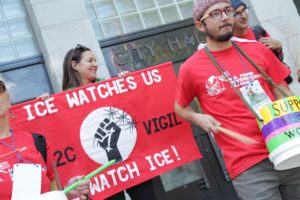
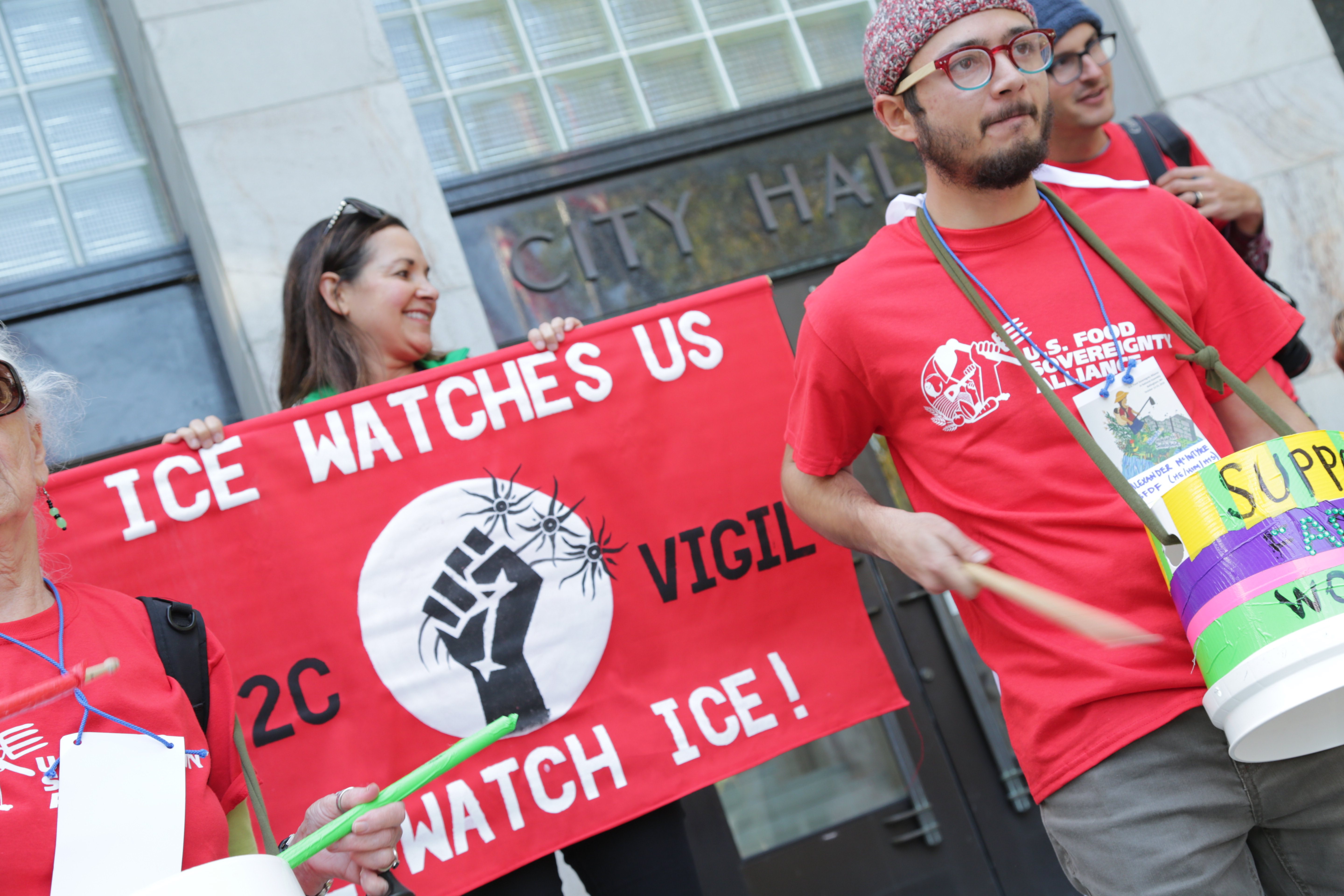
    * We denounce the actions of Immigration and Customs Enforcement (ICE) in implementing the racist policies of mass detention and deportation, and stand in solidarity with immigrant and refugee peoples currently residing and working in the U.S.

    * We add our collective voice to the Call to Protect Food Systems from Genetic Extinction Technology and call for a global moratorium on any release of engineered gene drives, which could contaminate ecological systems, species, and food webs with genetic traits designed to create species extinction.

    We denounce proposals in the Farm Bill that would increase work requirements for SNAP eligibility, end the Double Up Bucks farmers market program, defund critical conservation programs, and reduce support for beginning and socially challenged farmer programs.

    * We reject the King amendment in the House Farm Bill, which would give agribusinesses greater control and restrict state and local governments from regulating agricultural products, and could nullify the Food Sovereignty Ordinances passed in Maine, as well as laws that curb pesticide use, regulate farmworker safety, prevent cruel livestock practices, and label GMO foods.

    * We call for an expansion of agroecological practices and the protection of our agroecological biodiversity in food, fiber, forest and aquatic systems across the planet, as one of the essential solutions to the climate catastrophes humanity faces.  We know that small farmers, family fishers and foresters all cool the planet.  Agroecology cools the planet!

    * Lastly, the USFSA stands in solidarity with our global allies, particularly members of La Via Campesina, suffering the overthrow or threat of overthrow of popular, democratic governments.  Whether in Honduras, Paraguay, Colombia, Brazil, Nicaragua, Venezuela or elsewhere, these “soft coups” are a threat to democratic processes and to food sovereignty everywhere.
    ____________

    The IV Assembly debated and affirmed the formation of the following national Collectives:  Political Education, Agroecology: Land and Water, Narrative Strategy, International Relationships, and Youth.   These collectives together with the regional bodies will carry forward the work of USFSA, coordinated by representatives from grassroots organizations from the regions, with the help of grassroots support organizers.

    With our collective strength, we shout “No!” to injustices in the food system everywhere and “Yes!” to the people rising up to radically transform unjust systems and practices, for the betterment and survival of humanity and defense of Mother Earth.   And to the inspiring sister movements across the planet working for food sovereignty, we sing out a resounding ¡VIVA!  WE STAND WITH YOU!  WE ARE PART OF YOU! 


    During the Assembly, the winners of the Food Sovereignty Prize were acknowledged for their powerful work to promote food sovereignty. Here is the release:

    Grassroots Movements Celebrated for Building Solutions to Food and Climate Crises

    Black Mesa Water Coalition, Organización Boricuá de Agricultura Ecológica de Puerto Rico Win the Food Sovereignty Prize
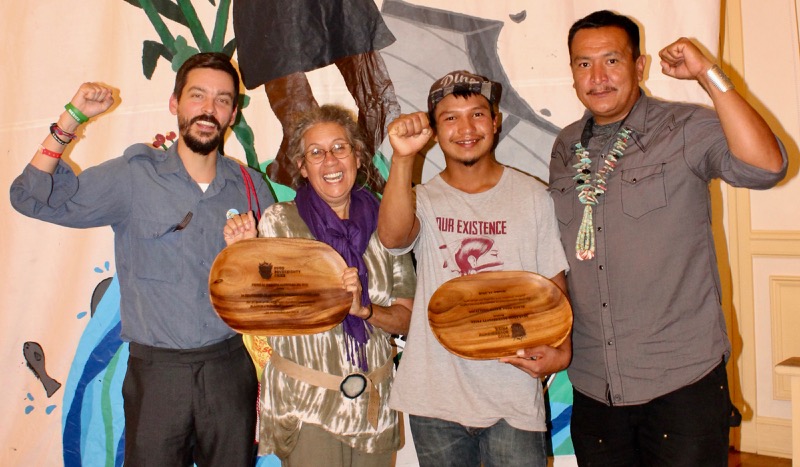
    FSP winnersJesus Vázquez and Dalma Colón from Organización Boricuá; Sheldon Natoni and Roberto Nutlouis from Black Mesa Water Coalition

    October 14, 2018 (Bellingham, Washington) – The U.S. Food Sovereignty Alliance (USFSA) honored Black Mesa Water Coalition and Organización Boricuá de Agricultura Ecológica de Puerto Rico on Sunday at the tenth annual Food Sovereignty Prize ceremony on Lummi and Nooksack land in Coast Salish Territory, in the city now called Bellingham, Washington.

    Black Mesa Water Coalition, the domestic honoree, was awarded the prize for restoring indigenous food sovereignty and uplifting youth leaders among Navajo and Hopi communities. Organización Boricuá de Agricultura Ecológica de Puerto Rico, the international honoree, was recognized particularly for mobilizing Food Sovereignty Brigades to assist farmers recover in the aftermath of Hurricane Maria.

    Presented as an alternative to the World Food Prize, the Food Sovereignty Prize honors steadfast commitment of food sovereignty. Social movements, community organizations, and activists around the world recognize the importance of the prize.

    “These grassroots organizations demonstrate how frontline communities most affected by social and ecological crises are the ones with solutions to society’s most pressing problems.” -Doria Robinson, Urban Tilth (coordinator of the Western Region of the US Food Sovereignty Alliance)

    Black Mesa Water Coalition utilizes green economic development and other diverse strategies, rooted in indigenous knowledge, to address issues of poverty, hunger, and environmental injustices driven by extractive industries and centuries of colonialism. “We need to notify humanity that we need to drastically change the way we do things, especially getting away from fossil fuels, and the food system is one way to begin that transition.” -Roberto Nutlouis, Black Mesa Water Coalition

    Organización Boricuá organizes farmers to transition to sustainable agriculture and sovereignty in Puerto Rico. “Agroecology as Puerto Ricans, coming from a colonial context, has given us a space to organize and deepen our struggles. This work is a vehicle of transformation for a sovereign, free, and just Puerto Rico.” -Jesus Vázquez, Organización Boricuá

    Media contacts:

    Liz Darrow (360) 220-9065, c2cmedia@foodjustice.org
    Ahna Kruzic, (510) 927-5379, ahna@panna.org

    www.usfoodsovereigntyalliance.org
  • USFSA organizing its IV National Assembly

    USFSA organizing its IV National Assembly

    Our food is being used as a weapon, and we are living in a political moment that demands coordinated action.

    Currently, we are seeing how political borders are being used to attack workers and families. Whether it’s the more than 500,000 people who were cut from the food stamp program over the last 3 years, the fact that four of the six largest agribusiness corporations have merged, or that farmers across the country are losing their lands while food chain workers are working under exploitative and dangerous conditions, and often fear deportation.

    We must continue to dream of a better world and work to build a new food system. We need a system that respects communities and human rights and nourishes rather than ravages the land. That system is based on food sovereignty, the human right to food, and the rights of Mother Earth.

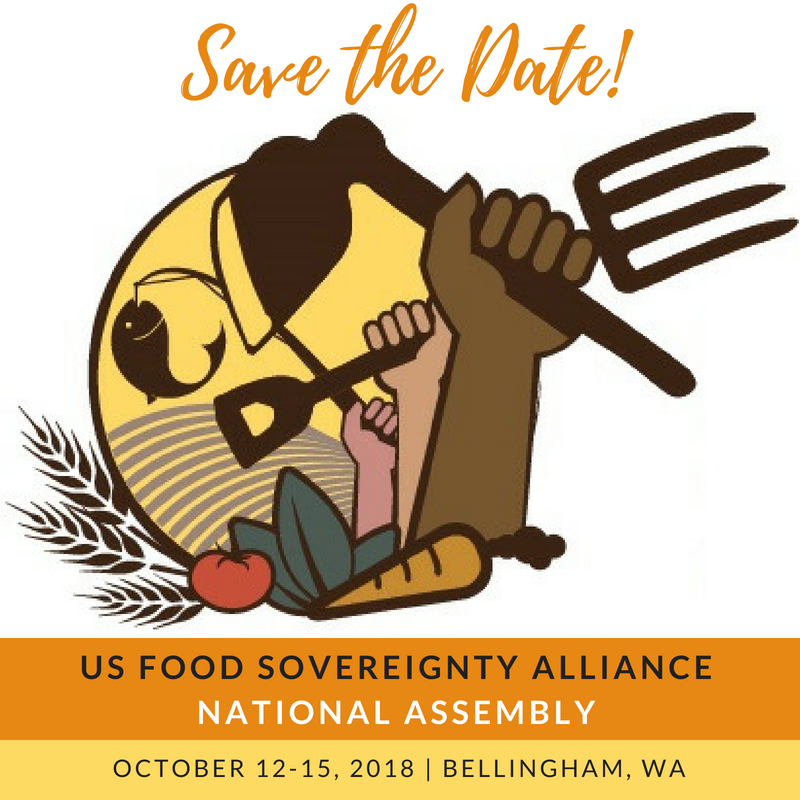
    On October 12 – 15, 2018, grassroots organizations, activists, faith-based community, scholars, union members, farmers and fisherfolk, and other food chain workers from around the US and the world will converge on Bellingham, WA, for the IV National Assembly of the US Food Sovereignty Alliance (USFSA). The Assembly will provide a space to learn about food sovereignty, share struggles and collective wins, and build solidarity.

    The USFSA has a goal of bringing together as many people as possible in a World Social Forum style gathering that will encompass a range of panels, political education, arts and other cultural exchanges to pave the way for stronger political action in the United States. The space will be an opportunity for mutual learning. Please stay tuned for information on how to submit a proposal for a panel, registration, and more. Together, we’ll deepen relationships across sectors and geographies to build a path for community liberation and reclaim our food system.

    The Assembly will also include the 2018 Food Sovereignty Prize awards ceremony honoring movements in the US and internationally. Lauded as an alternative to the World Food Prize, the Food Sovereignty Prize champions real solutions to hunger and is recognized by social movements, activists and community-based organizations around the world.

    Please save the date and sign up (or follow us on Facebook or Twitter) to get the latest updates on the organizing and registration process. If you are interested in participating in the planning of the Assembly, please email info (at) usfoodsovereigntyalliance (dot) org.

  • Call to Action

    Call to Action

    The following Call to Action is adapted from the Call to Action to End the Food Crisis issued by the US Working Group on the Food Crisis in 2008 and endorsed by several thousand organizations and individuals. It is included here as a springboard for future action of the Alliance, with the understanding that it will evolve to reflect new ideas, voices, and perspectives as the Alliance develops.

    We call on people across the United States to use our political power and actions to fight poverty by rebuilding local food economies, and specifically for food system changes that:

    1) Stabilize prices for farmers and consumers locally, nationally and globally by:

    • Ending rampant financial speculation in food;
    • Establishing and strengthening publicly-owned domestic, regional, and international strategic food reserves;
    • Suspending international trade and investments in industrial-scale biofuels (a.k.a. agrofuels);
    • Transforming corporate-oriented food aid;
    • Ensuring fair prices to farmers, fishers, pastoralists and other food providers;
    • Establishing equitable regional and global trade arrangements that enable countries, communities, and all farmers, fishers, pastoralists and other food providers to meet food and livelihood needs.

    2) Balance power in the food system by:

    • Reducing the political influence of agrifood corporations on public policy, e.g., by strengthening antitrust enforcement on those corporations and reducing their unregulated market power;
    • Convening multi-stakeholder, representative food policy councils at state and local levels.

    3) Make agriculture environmentally sustainable by:

    • Supporting family farms’ transition to agroecological practices through incentives, purchasing and procurement;
    • Halting expansion of government-supported agrofuels (biofuels) and transgenic seeds programs, mandates, and tax incentives and other subsidies
    • Directing state and national farm policy, R&D, education and investment toward agroecological farming and sustainable food businesses.

    4) Guarantee the right to healthy food by building local and regional food systems and fostering social, ecological and economic justice by:

    • Calling on the US to join the community of nations to support the human right to food;
    • Supporting domestic food production and independent, community-based food cooperatives and businesses in the United States and around the world;
    • Establishing living wages, so that everyone can afford healthy food;
    • Implementing full workers’ rights for farm workers and other food system workers;
    • Implementing agrarian reform that takes land out of the hands of large corporations and puts it in the hands of communities for local food production.
    • Strengthening the social safety net for low-income people across the US;
    • Creating a solidarity economy that puts people before corporate profit in the US and around the world.

    Through food sovereignty, the Earth can feed all living things.