Category: Land & Resource Grabs

  • USFSA Statement in Defense of Agroecology and the Right to Food

    Read and Download PDF


    Ambassador Kip Tom,

    On behalf of the U.S. Food Sovereignty Alliance (USFSA), we write to express our firm opposition to the content of your speech, titled “Innovation Imperative,” delivered during the USDA’s Agricultural Outlook Forum in February of this year.

    Once again, we call on the U.S. government to immediately end such perverse hostility toward global governance spaces and stop imposing red lines within policy discussions dedicated to agroecology and the collective rights of peasants, farmers, and other people working in rural areas. We assert that, due to fervent support for corporate interests, the U.S. government’s representation to the UN Food and Agriculture Organization and the Committee on World Food Security neglects the needs and betrays the rights of workers and smallholder farmers in the U.S.

    U.S. Food Sovereignty Alliance & the Right to Food

    The USFSA organizes in the U.S. and internationally to achieve people’s food sovereignty: the right to democratically define and control our agri-food systems. Food sovereignty is our right to healthy, culturally appropriate food produced through socially just and ecologically sound methods. Grassroots and grassroots-support organizations in the USFSA include small- and medium-scale farmers, farmworkers, urban food chain workers, fishers, hunter-gatherers, urban gardeners, and supportive allies from academia and progressive policy institutions as well as anti-hunger, faith-based, and environmental NGOs.

    Food sovereignty requires the democratization of society, genuine agrarian reform, and re-localization of agri-food systems. The USFSA promotes agroecology as a true solution that centers the rights of people and Mother Earth in just transitions away from extractive economics toward regenerative and solidarity economies of life characterized by ecological harmony and the social values of cooperation, caring, respect for cultural diversity, and deep democratic decision-making.

    We advocate for realization of the basic human rights to food and water as recognized by Article 25 of the Universal Declaration on Human Rights and Article 11 of the International Covenant on Economic, Social, and Cultural Rights, which the U.S. signed decades ago but has yet to ratify. Since the development of the UDHR, the U.S. government has consistently ignored basic human rights and standards in the U.S., including the Right to Food and Right to Water. We denounce the U.S. government’s weaponization of food access abroad and undermining of international policy efforts to address global hunger and protect ecosystems on which the livelihoods of all people, particularly peasants and other people working in rural areas, depend.

    Farmers Denounce U.S. Government Agri-Food Approach

    The USFSA strongly denounces the U.S. government’s efforts over recent years to dismiss, co-opt, depoliticize, demonize, and actively discredit agroecology. We specifically contest the racist, imperialist attacks against agroecology and peasant communities in Africa featured in your speech delivered at the USDA Agricultural Outlook Forum.

    Jennifer Taylor, a family farmer and Associate Professor at the Florida Agricultural and Mechanical University, owns and operates an organic farm in Georgia, and serves in leadership

    positions within the USFSA. Named in honor of her grandmother who started farming as a sharecropper, Taylor’s farm produces USDA-certified organic fruits and vegetables for household consumption and local market sale. Reflecting on your speech, Taylor draws attention to how smallholder agroecology entails numerous alternatives to the extreme dependence on agrotoxins, labor exploitation, territorial expansion, and post-production processing of agribusiness. From her perspective, “Agroecological farming systems promote soil fertility, soil and water conservation, biodiversity, healthy environments, mitigate pest damage and climate change. Agroecological practices develop sustainable farming systems that benefit our communities by generating employment, providing essential services, and distributing healthy produce.”

    Taylor notes what organic farmers reject, stating, “We support the avoidance of synthetic hormones and antibiotics, and we oppose the use of sewage sludge, irradiation, GMO/genetic engineering materials, and GMO agricultural strategies.” For social and ecological wellbeing, she explains, “Some of our key practices include: growing a healthy farm through gaining knowledge to support what grows best in our farm environment; building healthy soils, selecting organic seeds and transplants, integrating mulches, crop rotations, cover crops; compost use; enabling pollinator and beneficial insect habitats; selecting viable locally adapted varieties; and seed saving.” Taylor emphasizes, “Our agroecology practices and strategies are supported by the Organic Initiative of the Environmental Quality Incentives Program and other USDA programs, particularly through the Natural Resources Conservation Service.”

    Jim Goodman, a retired dairy farmer from Wisconsin who currently serves as President of the National Family Farm Coalition, points out that in your speech to the USDA, which entailed several incorrect and misleading statements, you criticized practitioners and promoters of agroecology for “completely disavowing science” and allegedly being anti-capitalist, anti-trade, and disapproving of mechanization. Goodman also underscores that your alternative, the Green Revolution, “has shown to have played havoc with people’s lives and environment across the world.” Practitioners of agroecology believe that science and technology serve us best when research and development involve participatory, collaborative, and community-based processes that result in greater social equity, the restoration of ecosystems, and more sustainable food systems and trade.

    He identifies one of your statements as highly significant. You claimed, “We believe that technologies need to include and be inclusive of all forms of agriculture, from organic to commercial, making sure that farmers are making the choices best matching their local context, their diets, their nutrition, and the resources they have available to them.” However, Goodman argues, “Most farmers in the world do not farm 20,000 acres like Mr. Tom, nor would they want to. They want to farm within their means, matching their local context and diets – like he said, but insincerely.”

    Patti Naylor, who farms in Iowa alongside her partner George, attended the 46th Plenary Session of the Committee on World Food Security (CFS) last year, which included the kick-off of the UN Decade of Family Farming. She represented the USFSA and North American region of the Civil Society Mechanism. Reflecting on her interactions with you in Rome during your meeting with North American civil society organizations as well as your speech to the USDA this past February, Naylor indicates, “The​ conflict between the corporate model of agriculture – based solely

    on profits – and agroecology – based on the human rights, the rights of peasants, the protection of nature, and food sovereignty – will determine the kind of world we will leave the next generations.” She contends, “Agroecology is the only choice that can support farmer livelihoods and meet the challenges of climate change, food insecurity, and environmental collapse.”

    Moreover, Naylor argues, “Ambassador Tom’s disdain for agroecology reveals that he indeed has a minimal understanding of the concept of agroecology. It is not simply a set of farming practices but instead comes out of a people’s movement, one in which social commitments and political education make agroecology the pathway to food sovereignty. All of this is a threat to the power and influence of a global agrifood industry which demands that the Ambassador’s role at the FAO defend and expand its dominance. His task is becoming more and more difficult as the global health pandemic has revealed a fragile food supply chain, dependent on the exploitation of people and their labor as well as on the exploitation of nature.”

    Conclusion and Demands

    The USFSA strongly repudiates the USDA’s decades-long support for extractive, fencerow-to-fencerow agriculture under a get-big-or-get-out policy framework. We call your attention to research indicating that globally, smallholder farmers produce around 75% of the global food supply on less than 25% of arable land. Worryingly, small farms around the world continue to decrease in amount and size. The expansion of highly mechanized, input-dependent, and corporate-controlled plantation and contract agriculture gravely threatens the ability of rural communities to produce food for their households and local and regional markets.

    Farmer bankruptcies, evictions, land grabs, and the hyper-exploitation of agricultural workers must end. As producer, civil society, and worker organizations, we urgently call for systemic changes to U.S. food and agriculture policy frameworks. We demand a Green New Deal,​ especially to combat the intensification of anthropogenic climate catastrophes which disproportionately affect poor people and racialized minorities living in sacrifice zones.

    Blatant attacks on agroecology and democratic policy-making on this topic signal only the latest chapter in the U.S. government’s long history of selling out America’s rural and urban communities. We demand an end to U.S. domestic and foreign policy regimes that serve the profit-driven interests of powerful transnational corporations, as well as misinformation campaigns aimed at undermining the work of agroecology practitioners in educating the general public in favor of disseminating false data to continue to drive up profit margins for corporate agribusiness.. Human rights, social peace, environmental restoration, and the dramatic strengthening of community-based organizations should be fundamental to the political and economic goals of the U.S. government.

    In conclusion, as previously expressed in our letter to you in October 2019 that was signed by almost 50 organizations, the U.S. government, a charter member of the UN, must use its standing in the world to support, not obstruct, agroecology policy processes in the CFS. Given the extreme urgency of the present moment which is defined by intersecting crises at the global level – absurd wealth inequalities, forced migration, anthropogenic climate catastrophes, the COVID-19 pandemic, and shocks within domestic economies and the world market – we sincerely urge you to promptly open lines of communication with civil society organizations involved in the CFS. We have the right to fully participate in processes that shape agri-food policy. The future of smallholder farming, food security, social justice, ecological resilience, and rural community wellbeing is truly at stake.
  • A Just Transition Calls for Indigenous Food Sovereignty 

    A Just Transition Calls for Indigenous Food Sovereignty 

    For the Black Mesa Water Coalition, food sovereignty is one part of a broader effort to transform Navajo and Hopi communities and their economies by drawing on traditional knowledge to build sustainable alternatives to fossil fuel dependence.

    “The just transition for us really came from the need to transition away from a fossil fuel-based economy, which our tribe is heavily dependent on, with royalties from the exploitation of coal, gas, and other resources,” said Black Mesa Water Coalition member Robert Nutlouis during the US Food Sovereignty Alliance Assembly in Bellingham, Washington, in October 2018. “Our call for the Nation is to move away from that type of development towards a more sustainable, regenerative economy.” 

    The organization, based in Arizona, formed in 2001 to confront the impacts of coal mining in Navajo and Hopi communities and tackle issues around water, natural resources exploitation, and health. Among other work, its projects have included regenerative water catchment systems, leadership development initiatives, and a “Food Sovereignty Project” using dry land agricultural techniques to produce food on a five-acre community farm. 

    “Food sovereignty for our community is really looking at our own traditional knowledge and the wisdom that our ancestors had developed and left for us and is still carried by our elders,” said Robert. “Really going back and seeing what this knowledge and wisdom say to us about how to revive and rebuild our food system.”

    The organization also works to build cultural awareness, including language preservation efforts and education around traditional seeds. 

    “There has to be a cultural shift from how we see things to how we interact with our environment,” Robert continued. “The land is sacred, the elements are sacred, and we have to understand it in that way.”

    Sheldon Natoni, a youth member of the Black Mesa Water Coalition, added: “It kind of gives me comfort that I’m going through the right path and I’m not being part of the extractive economy. It’s a healing property for me to become more grounded in who I am as a Dene.” 

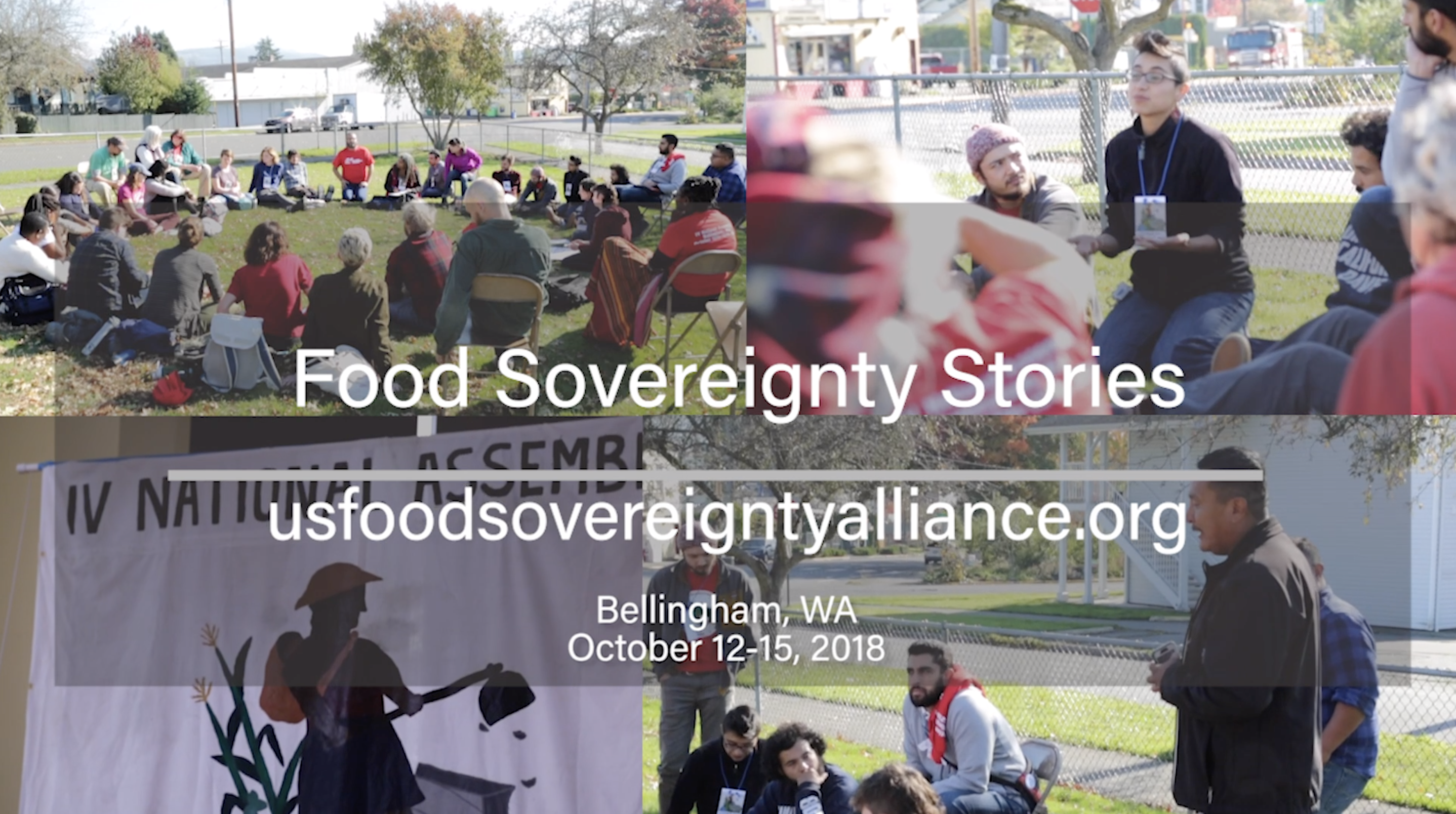
    Black Mesa Water Coalition received the US Food Sovereignty Alliance’s 2018 Food Sovereignty Prize in the domestic category, recognizing its work in reclaiming Indigenous food sovereignty. Food Sovereignty Stories is a video series exploring what food sovereignty can look like for diverse social movements across the United States. Share this video and follow USFSA for updates! 

  • Reading Lists

    Food Crisis

    From Food Rebellions to Food Sovereignty: Urgent call to fix a broken food system

    By Eric Holt-Giménez, Ph.D., Social Scientist and Executive Director of Food
    First/Institute for Food and Development Policy. The real causes of the 2008 and 2011 food price crises were numerous, but the fact that our global agricultural system is dominated by corporations, free trade, and speculation was neglected by most media outlets.

    Harvesting Money – The Global Land Grab

    By Eric Holt-Giménez, Ph.D., Social Scientist and Executive Director of Food First/Institute for Food and Development Policy.The food and financial crises of 2008 ignited a massive round of “land grabbing” in the Global South, with foreign agribusinesses leasing and buying large tracts of land to produce both food and fuel crops for export.

    The World Food Crisis: What’s behind it and What we can do about it

    By Eric Holt-Giménez, Ph.D., Social Scientist and Executive Director of Food
    First/Institute for Food and Development Policy.

    Agroecology

    Can Sustainable Agriculture Feed the World?

    Sustainable Agriculture CAN feed the world, and it can protect the planet and end hunger and poverty.

    Agroecology and the Right to Food

    “The report therefore calls States for a fundamental shift towards agro-ecology as a way for countries to feed themselves while addressing climate and poverty challenges.”

    Food Sovereignty

    Declaration of Nyeleni

    “We, more than 500 representatives from more than 80 countries, of organizations of peasants/family farmers, artisanal fisherfolk, indigenous peoples, landless peoples, rural workers, migrants, pastoralists, forest communities, women, youth, consumers and environmental and urban movements have gathered together in the village of Nyéléni in Sélingué, Mali to strengthen a global movement for food sovereignty…”

    Food Sovereignty Booklet

    An accessible description of what food sovereignty is, who is affected, and why it is more important than ever. From the National Family Farm Coalition and Grassroots International.

    Food for Thought and Action: A Food Sovereignty Curriculum

    Our global food system is terribly broken. Together, we can fix it! In the Curriculum you will find modules, factsheets, and other materials to learn about food sovereignty from the perspectives of consumers, anti-hunger organizations, environmentalists, and Small Farmers and farmworkers.

    Theological

    The Daily Bread

    Short reflection on food sovereignty by Werner Fuchs, Lutheran pastor and translator, member of the CONSEA (National Council for Food Security of Brazil).

    Turning the Tables: People First

    One-page reflection on food sovereignty by Roberto Malvezzi, Pastoral Land Commission (Brazil).

    Corporate Control

    “Foodopoly”

    Watch the trailer to Foodopoly, the film and book from Wenonah Hauter of Food and Water Watch.

    The Urban and Northern Face of Global Land Grabs

    Taken from a presentation at the International Conference on Global Land Grabbing, Eric Holt-Gimenez of Food First and Annie Shattuck and Yi Wang explain how land grabs are affecting urban areas in the Global North, in addition to the rural land grabs in the Global South. This shared, universal threat requires immediate action and global solidarity

    Grabbing the Food Deserts: Large-scale land acquisitions and the expansion of retail monopolies

    Eric Holt-Gimenez, Annie Shattuck, and Yi Wang explain how food retail corporations are behind the urban and northern land grab in this Food First backgrounder.

    Anti-Racism

    The Color of Food

    From The Applied Research Center, “The Color of Food” reveals that racism and exploitation that exist in our food system and suggests ways to transform our food system into a vehicle of justice.

    Youth and Food Justice: Lessons from the Civil Rights Movement

    “Youth and Food Justice: Lessons from the Civil Rights Movement,” by Anim Steel Food First Backgrounder, 2010.

  • 2018 USFSA Bellingham Declaration

    2018 USFSA Bellingham Declaration

    The IV National Assembly of the US Food Sovereignty Alliance was held in Bellingham, Washington, and the following declaration and statement of solidarity was created. The Food Sovereignty Prize ceremony also took place during the Assembly. The press release can be found below.

    The Bellingham Declaration
    US Food Sovereignty Alliance
    October 2018

    PDF of Bellingham Declaration |  PDF de Declaración en Español

    The US Food Sovereignty Alliance (USFSA) held its IV National Assembly from October 12th thru 14th in Bellingham, Washington with the participation of 117 members, allies, and individuals from 71 organizations and 7 countries.  The theme “Defending Mother Earth for an Agroecological Life:  No Walls, No Capitalism” was enacted through art, drama, music, dance, organizing, debate, analysis, healthy locally-sourced food, and spirited “mística” ceremonies.

    Anchored by the farmworker-led organization Community to Community Development (C2C), the assembly overflowed with a joyous, intelligent, and diverse rainbow of origins, identities, and organizers of all ages from various sectors of the food system, including farmworkers, food chain workers, fishers, family farmers, urban agriculturalists, food providers, and social justice advocates fighting for their livelihoods, freedom, and dignity through food sovereignty, and an end to patriarchal, capitalist, and colonial ways of thinking and acting.  Building on regional assemblies in the Northeast, the South, the Midwest and the West, the IV National Assembly vibrated with an expanding and deepening energy!

    Challenged by the current political and ecological moment—characterized by the rise of right-wing, racist populism allied with neoliberal, corporate economics, coupled with massive impoverishment and oppression of peoples, and the threat of climate catastrophe—our motivation intensified.  Those assembled discussed and the Alliance’s national coordination proclaims the following solidarity positions of the USFSA:

    * In solidarity with La Via Campesina, we call on the United States and other members states to support the Declaration of Peasants Rights being pushed forward at the U.N.  The struggle for Food Sovereignty depends on the protection of the rights of peasants and small- and medium-sized family farmers.

    * We oppose the expansion of the H2A visa guest worker program, particularly when used as a means of displacing farmworkers organizing themselves into unions.  H2A workers tied to a single employer have not been able to unionize themselves, and are often subject to wage theft, extortion by labor contractors and foremen, and other abuses.  We denounce in the strongest terms efforts to expand and weaken existing safeguards and housing provisions in guest worker programs by establishing a proposed H2C visa, which would spread and intensify the defects of H2A to food processing industries.  We also support the boycott of Reynolds American Tobacco VUSE e-cigarettes until that corporation signs an agreement to guarantee the right to organize without retaliation to all farmworkers in the tobacco fields, whether H2A or undocumented.

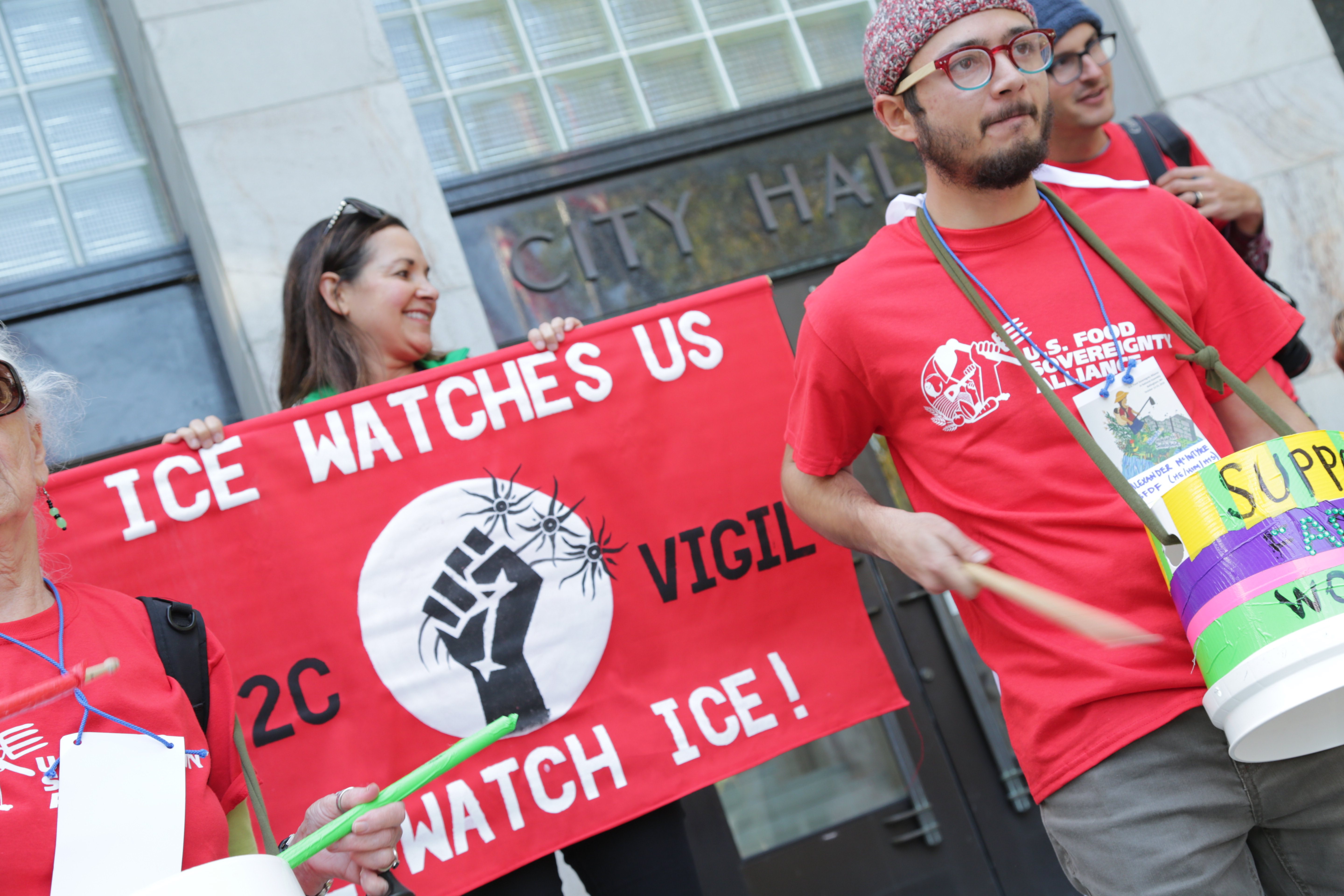
    * We denounce the actions of Immigration and Customs Enforcement (ICE) in implementing the racist policies of mass detention and deportation, and stand in solidarity with immigrant and refugee peoples currently residing and working in the U.S.

    * We add our collective voice to the Call to Protect Food Systems from Genetic Extinction Technology and call for a global moratorium on any release of engineered gene drives, which could contaminate ecological systems, species, and food webs with genetic traits designed to create species extinction.

    We denounce proposals in the Farm Bill that would increase work requirements for SNAP eligibility, end the Double Up Bucks farmers market program, defund critical conservation programs, and reduce support for beginning and socially challenged farmer programs.

    * We reject the King amendment in the House Farm Bill, which would give agribusinesses greater control and restrict state and local governments from regulating agricultural products, and could nullify the Food Sovereignty Ordinances passed in Maine, as well as laws that curb pesticide use, regulate farmworker safety, prevent cruel livestock practices, and label GMO foods.

    * We call for an expansion of agroecological practices and the protection of our agroecological biodiversity in food, fiber, forest and aquatic systems across the planet, as one of the essential solutions to the climate catastrophes humanity faces.  We know that small farmers, family fishers and foresters all cool the planet.  Agroecology cools the planet!

    * Lastly, the USFSA stands in solidarity with our global allies, particularly members of La Via Campesina, suffering the overthrow or threat of overthrow of popular, democratic governments.  Whether in Honduras, Paraguay, Colombia, Brazil, Nicaragua, Venezuela or elsewhere, these “soft coups” are a threat to democratic processes and to food sovereignty everywhere.
    ____________

    The IV Assembly debated and affirmed the formation of the following national Collectives:  Political Education, Agroecology: Land and Water, Narrative Strategy, International Relationships, and Youth.   These collectives together with the regional bodies will carry forward the work of USFSA, coordinated by representatives from grassroots organizations from the regions, with the help of grassroots support organizers.

    With our collective strength, we shout “No!” to injustices in the food system everywhere and “Yes!” to the people rising up to radically transform unjust systems and practices, for the betterment and survival of humanity and defense of Mother Earth.   And to the inspiring sister movements across the planet working for food sovereignty, we sing out a resounding ¡VIVA!  WE STAND WITH YOU!  WE ARE PART OF YOU! 


    During the Assembly, the winners of the Food Sovereignty Prize were acknowledged for their powerful work to promote food sovereignty. Here is the release:

    Grassroots Movements Celebrated for Building Solutions to Food and Climate Crises

    Black Mesa Water Coalition, Organización Boricuá de Agricultura Ecológica de Puerto Rico Win the Food Sovereignty Prize

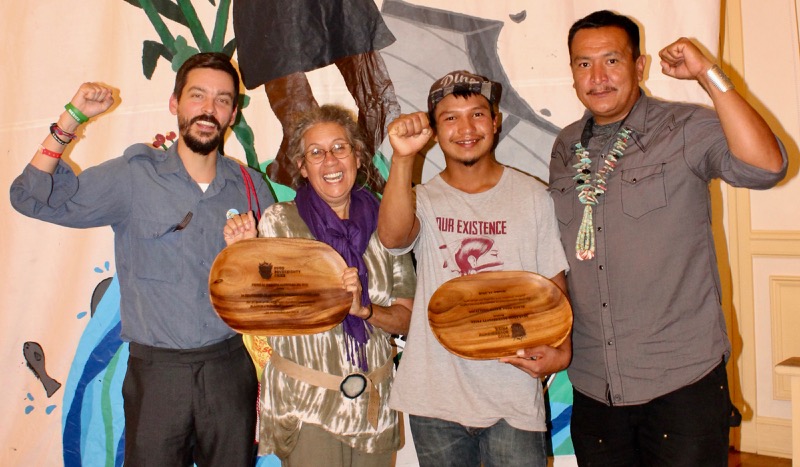
    FSP winnersJesus Vázquez and Dalma Colón from Organización Boricuá; Sheldon Natoni and Roberto Nutlouis from Black Mesa Water Coalition

    October 14, 2018 (Bellingham, Washington) – The U.S. Food Sovereignty Alliance (USFSA) honored Black Mesa Water Coalition and Organización Boricuá de Agricultura Ecológica de Puerto Rico on Sunday at the tenth annual Food Sovereignty Prize ceremony on Lummi and Nooksack land in Coast Salish Territory, in the city now called Bellingham, Washington.

    Black Mesa Water Coalition, the domestic honoree, was awarded the prize for restoring indigenous food sovereignty and uplifting youth leaders among Navajo and Hopi communities. Organización Boricuá de Agricultura Ecológica de Puerto Rico, the international honoree, was recognized particularly for mobilizing Food Sovereignty Brigades to assist farmers recover in the aftermath of Hurricane Maria.

    Presented as an alternative to the World Food Prize, the Food Sovereignty Prize honors steadfast commitment of food sovereignty. Social movements, community organizations, and activists around the world recognize the importance of the prize.

    “These grassroots organizations demonstrate how frontline communities most affected by social and ecological crises are the ones with solutions to society’s most pressing problems.” -Doria Robinson, Urban Tilth (coordinator of the Western Region of the US Food Sovereignty Alliance)

    Black Mesa Water Coalition utilizes green economic development and other diverse strategies, rooted in indigenous knowledge, to address issues of poverty, hunger, and environmental injustices driven by extractive industries and centuries of colonialism. “We need to notify humanity that we need to drastically change the way we do things, especially getting away from fossil fuels, and the food system is one way to begin that transition.” -Roberto Nutlouis, Black Mesa Water Coalition

    Organización Boricuá organizes farmers to transition to sustainable agriculture and sovereignty in Puerto Rico. “Agroecology as Puerto Ricans, coming from a colonial context, has given us a space to organize and deepen our struggles. This work is a vehicle of transformation for a sovereign, free, and just Puerto Rico.” -Jesus Vázquez, Organización Boricuá

    Media contacts:

    Liz Darrow (360) 220-9065, c2cmedia@foodjustice.org
    Ahna Kruzic, (510) 927-5379, ahna@panna.org

    www.usfoodsovereigntyalliance.org