Category: Events

Any posts added to this category will appear as an event in the Event Calendar widget.

  • Join the Virtual 2023 Food Sovereignty Prize Ceremony on Dec. 14!

    Join the Virtual 2023 Food Sovereignty Prize Ceremony on Dec. 14!

    Español abajo | Kreyol ayisyen anbao

    US Food Sovereignty Alliance (USFSA)
    Announces 2023 Food Sovereignty Prize Winners & Virtual Ceremony

    Black Dirt Farm Collective &
    Mouvman Peyizan Papay-MPP of Haiti

    Join the virtual 2023 Food Sovereignty Prize Ceremony on Thursday, December 14 at 3:30pm (PST), 4:30pm (MST), 5:30pm (CST), 6:30pm (EST and Haiti time)
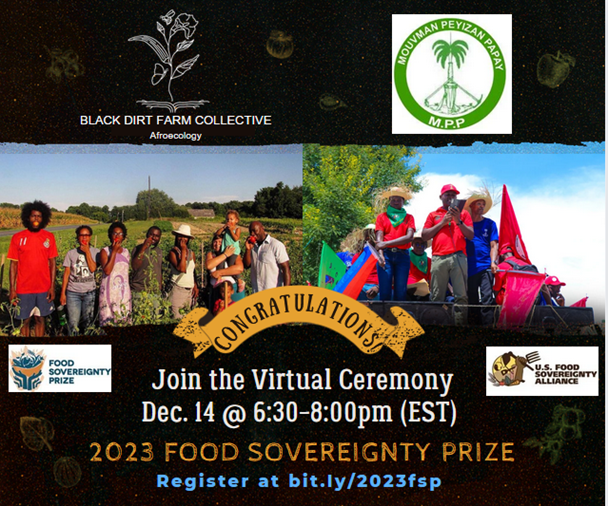
    Register here
    for the virtual event emceed by Darnella Winston
    of the Federation of Southern Cooperatives

    Now in its 15th year, the Food Sovereignty Prize is given annually near World Food Day to a domestic and international organization advancing food sovereignty – the right of all peoples to healthy and culturally appropriate food produced through ecologically sound and sustainable methods, and their right to define their food, fishery, and farming systems. It stands in contrast to the corporate-funded World Food Prize, which perpetuates the myth that society can produce its way out of hunger and the climate crisis with biotechnology and synthetic inputs.

    The US Food Sovereignty Alliance has awarded the Food Sovereignty Prize to two outstanding organizations, the Black Dirt Farm Collective, located in Maryland, and Mouvman Peyizan Papay (MPP), based in Haiti. This award is particularly meaningful for MPP at this time, which just celebrated its 50th anniversary amid ongoing political strife, economic depression, and violence in Haiti, prompting an announcement by the UN Security Council to send armed forces into the country.

    The Black Dirt Farm Collective is a collective of farmers, educators and organizers that arose from the need to support and protect Black agrarian knowledge in the US mid-Atlantic region. The Collective fights for a just transition using “Afroecology” – the connection between Black agrarianism and agroecology – to build systemic solutions to global food and farm crises. Racial discrimination led to the systematic removal of US Black farmers from the land. Between 1910 and 1997, Black farmers lost roughly 90% of the farmland they collectively owned, and the US Department of Agriculture now reports that fewer than 1% of US farmers are Black. The Black Dirt Farm Collective is committed to reclaiming Black agrarian history, lost generational wealth, and returning to the land.

    Shakara Tyler, a returning-generation farmer, educator and organizer and Collective co-founder, summarized one of its essential tenets: “If we are not feeding ourselves our culture, who will?”

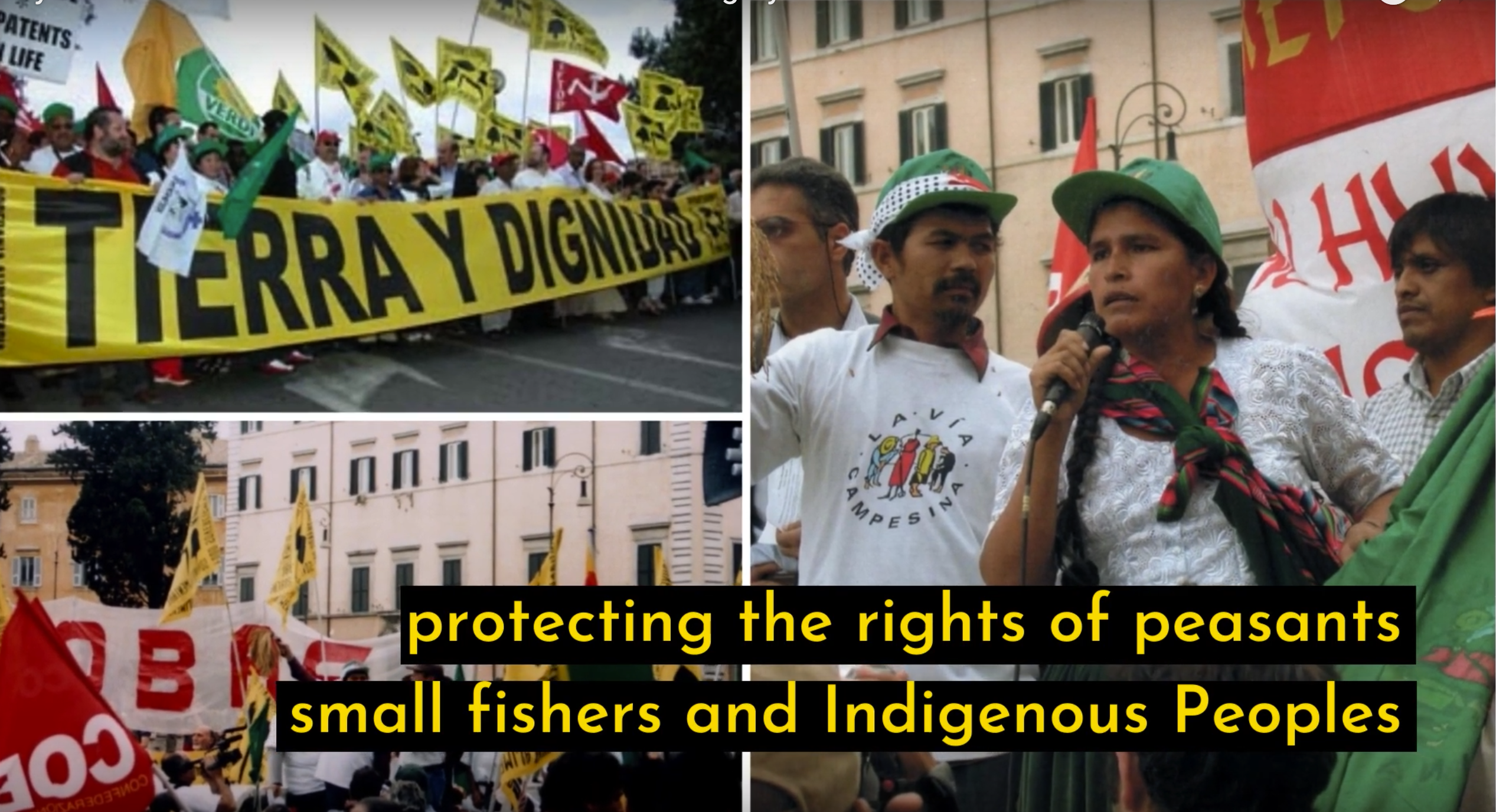
    Mouvman Peyizan Papay (MPP, or Papaye Peasant Movement) was established in 1973, aligned with the international peasant movement La Via Campesina from the 1990s onward, and has grown to represent more than 60,000 members. The movement empowers rural agricultural workers and focuses on food sovereignty to reclaim Haiti’s independence from global food imports. The Prize committee recognizes MPP’s work combating the ongoing environmental, humanitarian, and hunger crisis in Haiti, worsened by entrenched legacies of colonization, land grabbing, climate change, and foreign exploitation at the expense of local food systems. MPP works directly with local farmers to bolster local food economies through agroecology and build environmental resiliency through planting tens of millions of trees. This inspiring grassroots strategy rejects Haiti’s continued reliance on sporadic international aid in favor of local community control.

    “When we received word of this honor during our Food Sovereignty Camp, 450 young peasant leaders let out a thunderous cry of joy,” said MPP leader Jusléne Tyresias. “Through MPP’s 50-year history, Haiti’s peasants have persisted, not only confronting multiple crises head-on, but planting seeds – literally and figuratively – for our people to live with dignity, safety, and sovereignty.”

    Join us to hear their stories and to celebrate their efforts to realize food sovereignty!

    Honorees will be recognized at the virtual 2023 Food Sovereignty Prize Ceremony on Thursday, December 14 at 3:30pm (PST), 4:30pm (MST), 5:30pm (CST), 6:30pm (EST and Haiti time)

    Free registration here

    About the US Food Sovereignty Alliance

    The US Food Sovereignty Alliance (USFSA) is a US-based alliance of food justice, anti-hunger, labor, environmental, faith-based and food producer groups that upholds the right to food as a basic human right and works to connect our local and national struggles to the international movement for food sovereignty. The Alliance works to end poverty, rebuild local food economies and assert democratic control over the food system, believing that all people have the right to healthy, culturally appropriate food produced in an ecologically sound manner.
    Learn more at usfoodsovereigntyalliance.org


    La Alianza por la Soberanía Alimentaria de los Estados Unidos (USFSA) Anuncia los ganadores del Premio a la Soberanía Alimentaria 2023 y Ceremonia Virtual

    Colectivo Black Dirt Farm & Mouvman Peyizan Papay-MPP de Haití

    Únete a la Ceremonia virtual del Premio Soberanía Alimentaria 2023 el jueves 14 de diciembre a las 3:30pm (PST), 4:30pm (MST), 5:30pm (CST), 6:30pm (EST y hora de Haití)
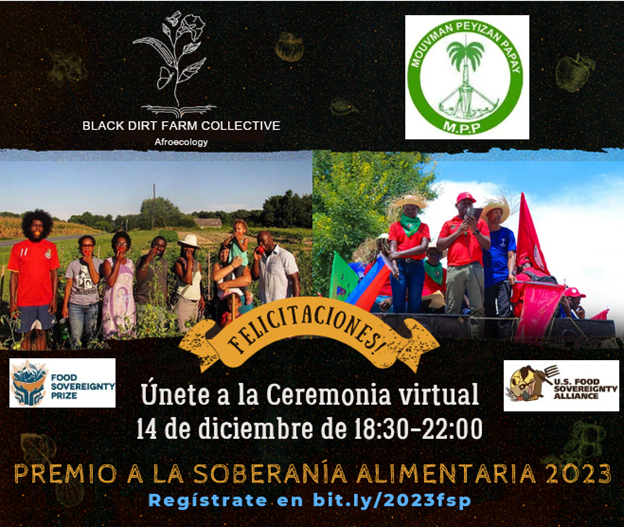
    Inscríbase aquí para asistir al acto virtual presentado por Darnella Winston, de la Federación de Cooperativas del Sur

    En su 15ª edición, el Premio a la Soberanía Alimentaria se concede anualmente cerca del Día Mundial de la Alimentación a una organización nacional e internacional que promueva la soberanía alimentaria: el derecho de todos los pueblos a alimentos sanos y culturalmente apropiados producidos mediante métodos ecológicamente racionales y sostenibles, y su derecho a definir sus sistemas alimentarios, pesqueros y agrícolas. Contrasta con el Premio Mundial de la Alimentación, financiado por las grandes empresas, que perpetúa el mito de que la sociedad puede salir del hambre y de la crisis climática mediante la biotecnología y los insumos sintéticos.

    La Alianza por la Soberanía Alimentaria de Estados Unidos ha concedido el Premio a la Soberanía Alimentaria a dos organizaciones destacadas: Black Dirt Farm Collective, de Maryland, y Mouvman Peyizan Papay (MPP), de Haití. Este premio es especialmente significativo para MPP en este momento, en el que acaba de celebrar su 50 aniversario en medio de continuos conflictos políticos, depresión económica y violencia en Haití, que han llevado al Consejo de Seguridad de la ONU a anunciar el envío de fuerzas armadas al país.

    La Granja Colectiva de Tierra Negra es un colectivo de agricultores, educadores y organizadores que surgió de la necesidad de apoyar y proteger el conocimiento agrario negro en la región del Atlántico Medio estadounidense. El Colectivo lucha por una transición justa utilizando la “Afroecología” -la conexión entre el agrarismo negro y la agroecología- para construir soluciones sistémicas a la alimentación mundial.

    El Mouvman Peyizan Papay (MPP, o Movimiento Campesino Papaye) se creó en 1973, se alineó con el movimiento campesino internacional La Vía Campesina a partir de la década de 1990 y ha crecido hasta representar a más de 60.000 miembros. El movimiento empodera a los trabajadores agrícolas rurales y se centra en la soberanía alimentaria para reclamar la independencia de Haití de las importaciones mundiales de alimentos. El comité del Premio reconoce la labor del MPP en la lucha contra la actual crisis medioambiental, humanitaria y del hambre en Haití, agravada por el arraigado legado de la colonización, el acaparamiento de tierras, el cambio climático y la explotación extranjera a expensas de los sistemas alimentarios locales. El MPP trabaja directamente con los agricultores locales para reforzar las economías alimentarias locales a través de la agroecología y crear resiliencia medioambiental mediante la plantación de decenas de millones de árboles. Esta inspiradora estrategia de base rechaza la continua dependencia de Haití de la ayuda internacional esporádica en favor de la cooperación de la comunidad local.

    “Cuando recibimos la noticia de este honor durante nuestro Campamento por la Soberanía Alimentaria, 450 jóvenes líderes campesinos lanzaron un estruendoso grito de alegría”, declaró Jusléne Tyresias, líder del MPP. “A lo largo de los 50 años de historia del MPP, los campesinos de Haití han persistido, no sólo haciendo frente a múltiples crisis de frente, sino plantando semillas -literal y figurativamente- para que nuestro pueblo viva con dignidad, seguridad y soberanía”.

    Únase a nosotros para escuchar sus historias y celebrar sus esfuerzos por alcanzar la soberanía alimentaria.

    Los galardonados recibirán su reconocimiento en la ceremonia virtual del Premio Soberanía Alimentaria 2023, que tendrá lugar el jueves 14 de diciembre a las 15:30 (PST), 16:30 (MST), 17:30 (CST) y 18:30 (EST y hora de Haití).

    Inscripción gratuita aquí

    ###

    Acerca de la Alianza por la Soberanía Alimentaria de EEUU

    La Alianza por la Soberanía Alimentaria de Estados Unidos (USFSA, por sus siglas en inglés) es una alianza estadounidense de grupos de justicia alimentaria, contra el hambre, sindicales, ecologistas, religiosos y de productores de alimentos que defiende el derecho a la alimentación como un derecho humano básico y trabaja para conectar nuestras luchas locales y nacionales con el movimiento internacional por la soberanía alimentaria. La Alianza trabaja para acabar con la pobreza, reconstruir las economías alimentarias locales y afirmar el control democrático sobre el sistema alimentario, convencida de que todas las personas tienen derecho a alimentos sanos, culturalmente apropiados y producidos de forma ecológicamente racional.

    Más información en www.usfoodsovereigntyalliance.org 


    US Food Sovereignty Alliance (USFSA) Anonse Ganyan Pri Souverènte Manje 2023 yo & Virtuel Seremoni

    Black Dirt Farm Collective & Mouvman Peyizan Papay-MPP d Ayiti

    Antre nan Seremoni Pri souverènte Manje 2023 vityèl Jedi 14 Desanm a 3:30 pm (PST), 4:30 pm (MST), 5:30 pm (CST), 6:30 pm (EST ak lè Ayiti)
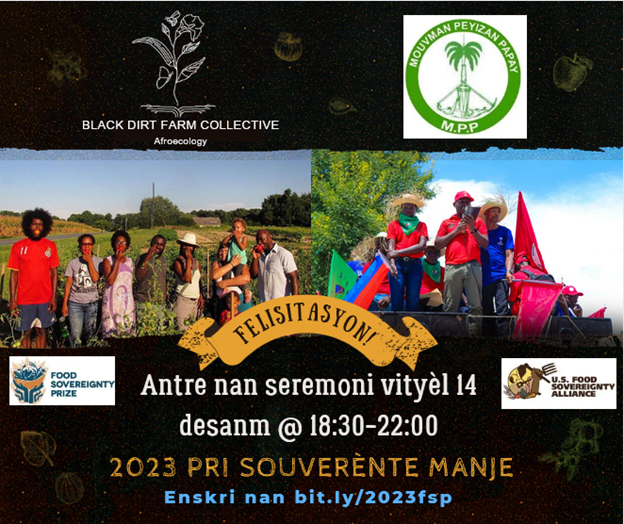
    Enskri isit la pou evènman vityèl ki te òganize pa
    Darnella Winston nan Federasyon Koperativ

    Sid yo Kounye a nan 15yèm ane li, Pri Souverènte Manje a bay chak ane tou pre Jounen Mondyal Manje a yon òganizasyon domestik ak entènasyonal k ap avanse souverènte alimantè – dwa tout pèp pou manje ki an sante ak kiltirèl ki apwopriye ki pwodui atravè metòd ekolojik ki bon ak dirab, ak dwa yo genyen pou defini sistèm manje, lapèch, ak agrikilti yo. Li kanpe kontrèman ak World Food Prize ki finanse ak antrepriz la, ki perpétuer mit ke sosyete a ka pwodui fason li soti nan grangou ak kriz klimatik la ak bioteknoloji ak entrain sentetik.

    US Food Sovereignty Alliance te bay pri souverènte alimantè a bay de òganizasyon eksepsyonèl, Black Dirt Farm Collective, ki sitiye nan Maryland, ak Mouvman Peyizan Papay (MPP), ki baze ann Ayiti. Prim sa a patikilyèman enpòtan pou MPP nan moman sa a, ki fèk selebre 50yèm anivèsè li nan mitan konfli politik kontinyèl, depresyon ekonomik, ak vyolans ann Ayiti, sa ki pouse yon anons Konsèy Sekirite Nasyonzini an pou voye fòs lame nan peyi a.

    Fèm Kolektif nan Pousyè Tè Nwa se yon kolektif kiltivatè, edikatè ak òganizatè ki soti nan bezwen pou sipòte ak pwoteje konesans agrè Nwa nan rejyon Mid-Atlantik Etazini an. Kolektif la goumen pou yon tranzisyon jis lè l sèvi avèk “Afwoekoloji” – koneksyon ki genyen ant agrè Nwa ak agwoekoloji – pou bati solisyon sistemik nan manje mondyal ak kriz agrikòl. Diskriminasyon rasyal te mennen nan retire sistematik kiltivatè Nwa Ameriken yo nan peyi a. Ant 1910 ak 1997, kiltivatè Nwa yo te pèdi apeprè 90% nan tè agrikòl yo te posede ansanm, e Depatman Agrikilti Ameriken an kounye a rapòte ke mwens pase 1% nan kiltivatè ameriken yo se Nwa. Black Dirt Farm Collective pran angajman pou reprann istwa agrè Nwa yo, pèdi richès jenerasyon yo, epi retounen nan peyi a.

    Shakara Tyler, yon kiltivatè jenerasyon retounen, edikatè ak òganizatè ak ko-fondatè Kolektif, te rezime youn nan prensip esansyèl li yo: “Si nou pa nouri kilti nou an, ki moun ki pral?”

    Mouvman Peyizan Papay (MPP, oswa Mouvman Peyizan Papaye) te etabli an 1973, ann amoni ak mouvman peyizan entènasyonal La Via Campesina depi ane 1990 yo, e li te grandi pou reprezante plis pase 60,000 manm. Mouvman an otorize travayè agrikòl nan zòn riral yo epi li konsantre sou souverènte alimantè pou reprann endepandans Ayiti kont enpòtasyon manje mondyal. Komite Prize a rekonèt travay MPP ap konbat kriz anviwònman an, imanitè ak grangou k ap kontinye ann Ayiti, ki vin pi mal ak eritaj kolonizasyon anrasinen yo, afèkte tè, chanjman klimatik, ak eksplwatasyon etranje sou kont sistèm manje lokal yo. MPP travay dirèkteman ak kiltivatè lokal yo pou ranfòse ekonomi manje lokal yo grasa agwoekoloji epi pou devlope rezistans anviwònman an atravè plante plizyè dizèn milyon pye bwa. Estrateji debaz enspire sa a rejte depandans kontinyèl Ayiti sou èd entènasyonal detanzantan an favè kontwòl kominote lokal yo.

    Lidè MPP Jusléne Tyresias di: “Lè nou te resevwa pawòl onè sa a pandan Kan Souverènte Alimantè nou an, 450 jèn lidè peyizan te lanse yon gwo rèl lajwa. “Atravè 50 ane istwa MPP a, peyizan Ayiti yo te pèsiste, non sèlman fè fas ak plizyè kriz tèt-sou, men plante grenn – literalman ak senbolikman – pou pèp nou an viv ak diyite, sekirite, ak souverènte.”

    Join nou pou tande istwa yo epi selebre efò yo pou reyalize souverènte manje! Yo pral rekonèt moun ki onore yo nan seremoni pri vityèl souverènte alimantè 2023 Jedi 14 desanm a 3:30 pm (PST), 4:30 pm (MST), 5:30 pm (CST), 6:30 pm (EST ak lè Ayiti).

    Enskripsyon gratis isit la

    ###

    Konsènan US Food Sovereignty Alliance

    US Food Sovereignty Alliance (USFSA) se yon alyans ki baze Ozetazini nan gwoup jistis manje, anti-grangou, travay, anviwònman, ki baze sou lafwa ak pwodiktè manje ki defann dwa a manje kòm yon dwa imen debaz epi travay pou konekte lokal nou an. ak lit nasyonal nan mouvman entènasyonal la pou souverènte manje. Alliance lan travay pou mete fen nan povrete, rekonstwi ekonomi manje lokal yo ak revandike kontwòl demokratik sou sistèm alimantè a, kwè ke tout moun gen dwa a manje ki an sante, ki apwopriye pou kiltirèl pwodui nan yon fason ekolojik ki bon. Aprann plis sou www.usfoodsovereigntyalliance.org

  • 2022 Food Sovereignty Prize Winners Announced!

    2022 Food Sovereignty Prize Winners Announced!

    Español abajo

    US Food Sovereignty Alliance (USFSA) Announces

    2022 Food Sovereignty Prize Winners & Virtual Ceremony

    Food Sovereignty Ghana  &
    Western Organization of Resource Councils (WORC)

    Join the ceremony on Thursday, October 13
    Register Here for the virtual event emceed by Malik Yakini of the Detroit Black Community Food Security Network

    Now in its 14th year, the Food Sovereignty Prize is given annually near World Food Day to a domestic and international organization advancing food sovereignty – the right of all peoples to access healthy and culturally appropriate food produced through ecologically sound and sustainable methods, and their right to define their food, fishery, and farming systems. It stands in contrast to the corporate-funded World Food Prize, which perpetuates the myth that society can produce its way out of hunger and the climate crisis with biotechnology and synthetic inputs.

    The 2022 honorees have fought for years against corporate control of the food system, defending sustainable farming and pasturing, healthy soils, and clean water, building community power, and advocating clean, renewable energy sources. (more…)

  • North Americans Join in Global Nyeléni Process | Los norteamericanos se unen al proceso global de Nyeléni

    North Americans Join in Global Nyeléni Process | Los norteamericanos se unen al proceso global de Nyeléni

    On April 5 and 12, the US Food Sovereignty Alliance (USFSA) organized two well-attended webinar consultations as part of the renewed Nyeléni process guided by the International Planning Committee for Food Sovereignty (IPC) an autonomous and self-organized global platform of small-scale food producers, rural workers organizations and community-based social movements whose goal is to advance Food Sovereignty. The IPC advocates for food sovereignty and agroecology at the Food and Agricultural Organization in Rome, Italy.  Nyeléni village (built for the event and named after a renowned Malian woman peasant leader) in Sélingué, Mali was the home of the February 2007 International Food Sovereignty Gathering of more than 500 representatives from 80 countries, an event that helped lead to the founding of the USFSA.

    zoom screen shot from 4-12The seventy or so people who participated in the North American Nyeleni consultation calls came from a wide variety of organizations and lived experiences ranging from rural to urban, food producers from up and down the food chain, as well as eaters, faith-based and worker-centered, youth and academics, local and national organizations, Indigenous, African American, Latinx and Anglo Americans.

    Many of us who took part in the April consultations found the experience to be uplifting and inspiring.  Following nearly three years of pandemic lockdowns and remote work, the opportunity to gather in breakout groups for an extended time to answer questions about our local, national and international food sovereignty organizing, turned out for many to be heart-warming and reassuring.  Hearing a diversity of takes on what the challenges, opportunities, and strategic approaches to the questions surrounding food justice in the context of our corporate-dominated food system, and the ways we are expanding space and power for true food sovereignty through anti-capitalist, anti-white supremacist, and radically feminist lenses as we organize and mobilize, was a big boost.  Hearing the level of deep understanding of the intersectionality of this struggle, and hearing the creative analyses of our fellow organizers, community leaders and experts on various components of the food advocacy ecosystem, we came away feeling mutually enriched and contentedly “jazzed.”

    mountain with figure of mother earthAs we ponder how our cosmovisions can come into greater focus in our day-to-day work of organizing, cultivating, clearing ground, planting, producing, mobilizing, harvesting, nourishing our communities, attending to crises with mutual aid and solidarity,  we wait expectantly in political, social, and cultural ecosystems heavy with limitations and adversarial trends and a deep sense of dread at the state of the world.  In the midst of the ecological crisis facing Mother Earth herself, against all odds, many of us came away from the consultation feeling more hopeful  in the knowledge that we do indeed represent the true path forward for humanity, and most importantly from a psychic and emotional space, that we are not alone, no matter how much the corporate media drum beat tells us we are powerless before the might of technology and physical and digitized forms of exclusion and manipulation.
    We are truly the change we have been waiting for.  If not us, who?  If not now, when?  We are on the move, people, truly, we are on the move.  Saving seed, feeding larger circles of our communities, putting more ground into harmonious productive use, chipping away at obstacles especially at local levels, and building a movement from the grassroots and grass-tops on up.

    When in a few weeks or months we see what the IPC process folks took away from the consultations from many regions of the world, and get to weigh in on that analysis, and as we look forward to gatherings much larger than these in order to build the next phase of strategic struggle in the world, we watch the weather, pray for the right amount of rain, keep in touch, and build our fabulous movements at an historic moment when, as Confucius once quipped: we are “condemned to live in interesting times.”

    Globalize Struggle!  Globalize Hope!

    16 May 2022


    Los norteamericanos se unen al proceso Nyeléni: la experiencia de la USFSA y sus aliados

    Los días 5 y 12 de abril, la Alianza para la Soberanía Alimentaria de los Estados Unidos (USFSA) organizó dos concurridos seminarios web como parte del renovado proceso de Nyeléni, guiado por el Comité Internacional de Planificación para la Soberanía Alimentaria (CIP), una plataforma mundial autónoma y autoorganizada de pequeños productores de alimentos, organizaciones de trabajadores rurales y movimientos sociales de base comunitaria cuyo objetivo es avanzar en la soberanía alimentaria. El CIP aboga por la soberanía alimentaria y la agroecología en la Organización de las Naciones Unidas para la Agricultura y la Alimentación en Roma, Italia.  La aldea de Nyeléni (construida para el evento y que lleva el nombre de una reconocida líder campesina maliense) en Sélingué, Malí, fue la sede del Encuentro Internacional de Soberanía Alimentaria de febrero de 2007, en el que participaron más de 500 representantes de 80 países, evento que contribuyó a la fundación del USFSA.

    Las cerca de setenta personas que participaron en las convocatorias de consulta de Nyeleni en América del Norte procedían de una gran variedad de organizaciones y experiencias vividas que iban desde lo rural a lo urbano, productores de alimentos de arriba a abajo de la cadena alimentaria, así como comedores, basados en la fe y centrados en los trabajadores, jóvenes y académicos, organizaciones locales y nacionales, indígenas, afroamericanos, latinoamericanos y angloamericanos.

    Muchos de los que participamos en las consultas de abril encontramos la experiencia edificante e inspiradora.  Después de casi tres años de bloqueos pandémicos y de trabajo a distancia, la oportunidad de reunirnos en grupos durante un tiempo prolongado para responder a preguntas sobre nuestra organización local, nacional e internacional de la soberanía alimentaria, resultó para muchos reconfortante y reconfortante.  Escuchar una diversidad de opiniones sobre los desafíos, las oportunidades y los enfoques estratégicos de las cuestiones relacionadas con la justicia alimentaria en el contexto de nuestro sistema alimentario dominado por las corporaciones, y las formas en que estamos ampliando el espacio y el poder para la verdadera soberanía alimentaria a través de lentes anticapitalistas, antiblancas supremacistas y radicalmente feministas mientras nos organizamos y movilizamos, fue un gran estímulo.  Al escuchar el nivel de comprensión profunda de la interseccionalidad de esta lucha, y al escuchar los análisis creativos de nuestros compañeros organizadores, líderes comunitarios y expertos en varios componentes del ecosistema de la defensa de los alimentos, salimos sintiéndonos mutuamente enriquecidos y felizmente “jazzed”.

    Mientras reflexionamos sobre cómo nuestras cosmovisiones pueden cobrar mayor protagonismo en nuestro trabajo diario de organizar, cultivar, limpiar el terreno, plantar, producir, movilizar, cosechar, alimentar a nuestras comunidades, atender a las crisis con ayuda mutua y solidaridad, esperamos expectantes en unos ecosistemas políticos, sociales y culturales cargados de limitaciones y tendencias adversas y con un profundo sentimiento de pavor por el estado del mundo.  En medio de la crisis ecológica a la que se enfrenta la propia Madre Tierra, contra todo pronóstico, muchos de nosotros salimos de la consulta sintiéndonos más esperanzados al saber que, efectivamente, representamos el verdadero camino a seguir por la humanidad y, lo que es más importante, desde un espacio psíquico y emocional, que no estamos solos, por mucho que el tambor de los medios de comunicación corporativos nos diga que somos impotentes ante el poder de la tecnología y las formas físicas y digitalizadas de exclusión y manipulación.

    Somos realmente el cambio que hemos estado esperando.  Si no somos nosotros, ¿quién?  Si no es ahora, ¿cuándo?  Estamos en movimiento, gente, realmente, estamos en movimiento.  Guardando semillas, alimentando a círculos más amplios de nuestras comunidades, poniendo más tierra en uso productivo armonioso, eliminando obstáculos, especialmente a nivel local, y construyendo un movimiento desde las bases y desde las cúpulas.

    Cuando dentro de unas semanas o meses veamos lo que la gente del proceso de la CIP sacó de las consultas de muchas regiones del mundo, y podamos opinar sobre ese análisis, y mientras esperamos reuniones mucho más grandes que éstas para construir la siguiente fase de la lucha estratégica en el mundo, observamos el tiempo, rezamos para que llueva lo suficiente, nos mantenemos en contacto y construimos nuestros fabulosos movimientos en un momento histórico en el que, como dijo Confucio una vez: “estamos condenados a vivir en tiempos interesantes”.

    ¡Globalizar la lucha!  ¡Globalizar la esperanza!

    16 de mayo de 2022

  • 2020 Food Sovereignty Prize – Ceremony on Dec. 9

    2020 Food Sovereignty Prize – Ceremony on Dec. 9

    2020 Food Sovereignty Prize Ceremony ~ December 9 at 11:00am eastern

    ~ Español abajo ~

    REGISTER for the Ceremony at https://bit.ly/FSP12th

    This year we honor the Somali Bantu Community Association of Maine and the All Nepal Peasants’ Federation with the 12th Annual Food Sovereignty Prize!


    The one-hour event will take place virtually on Wednesday, December 9, beginning 8:00am PST / 11:00am EST / 7:00pm EAT / 9:45pm NPT. Closed captioning and Spanish, Somali, and Nepali interpretation will be available on the Zoom platform. The ceremony will also be livestreamed on the USFSA Facebook page.

    The 2020 Prize recipients are recognized for their commitment to civil and human rights, including the right to food. The honorees exemplify the achievement of community well-being through food sovereignty, particularly during the coronavirus pandemic.

    As the COVID-19 pandemic adds 83–132 million people to the world’s hungry this year, the Food Sovereignty Prize highlights grassroots efforts meeting urgent needs while advancing transformative solutions. Organized by the US Food Sovereignty Alliance (USFSA), the Food Sovereignty Prize is announced on World Food Day. The Food Sovereignty Prize is recognized as a counterweight to the World Food Prize, which critics decry for its singular focus on food production based on Green Revolution approaches.

    As explained by Lisa Griffith of the National Family Farm Coalition, a USFSA member organization, “Even before the pandemic struck last winter, global hunger had risen by 60 million people over the past five years, with 750 million people experiencing severe food insecurity in 2019, while most commodity crops have reached record production levels. As COVID-19 spread around the globe, it was community efforts – not the industrialized food system – that distributed food and protected farm and food workers. The World Food Prize perpetuates the myth that an industrialized system can produce its way out of hunger when a just and sustainable food system is what is truly needed.”

    Photo credit: Sijie Yuan

    The Somali Bantu Community Association’s Liberation Farms have served as a lifeline of food and financial security to more than 200 refugee farmers whose communities are disproportionately hit by both COVID and hunger, while also serving the broader community, including provision of fresh, healthy foods to local schools.

    According to Jennifer Taylor of Lola’s Organic Farm in Georgia, also of the USFSA, “While leading the way in food systems transformation in Maine, the Somali Bantu Community Association has confronted both the pervasive structural racism exposed by the Black Lives Matter movement as well as inhumane immigration policies coupled with anti-immigrant sentiment. Particularly inspiring is SBCA’s new Little Jubba Central Maine Agrarian Commons, an innovative model of collective land ownership and farming, inspired by the traditional Somali ishkashito model of cooperative sharing.”

    Photo courtesy of ANFPa

    Standing at over two million members, the All Nepal Peasants’ Federation is also on the cutting edge of food systems transformation. Just as SBCA is working to dismantle racism in the food system and beyond, ANFPa is working to dismantle casteism, as well as sexism and ageism, with special branches dedicated to the empowerment of Dalits (“untouchables” in the caste system), women and youth. Recognizing the realization of human rights as essential to ending hunger, ANFPa has played an active role in Nepal’s democratization process, achieving the enshrining of food sovereignty in the country’s new constitution. Nepal is now one of several countries in the world to have adopted food sovereignty into law, and ANPFa has been leading national efforts on implementation. ANFPa has also been active in COVID relief efforts, including distribution of relief materials, coordinating with local governments on managing food supplies, and policy advocacy work. [See also this article from La Via Campesina]

    The event is free and open to all. Register at https://bit.ly/FSP12th by Tuesday, December 8.

    For more information, contact info@usfoodsovereigntyalliance.org

    ______________________________

    Ceremonia del Premio a la Soberanía Alimentaria 2020 ~ 9 de diciembre a las 11:00am del este

    INSCRIBASE en https://bit.ly/FSP12th

    Este año honramos a la Asociación de la Comunidad Bantú Somalí de Maine y a la Federación de Campesinos de todo Nepal con el 12º Premio Anual de Soberanía Alimentaria!

    Por favor, únase a la Alianza de Soberanía Alimentaria de EE.UU. para honrar a la Asociación Comunitaria Bantú de Maine y a la Federación de Campesinos de Todo Nepal con el 12º Premio Anual de Soberanía Alimentaria!

    El evento de una hora tendrá lugar virtualmente el miércoles 9 de diciembre, comenzando a las 8:00am PST / 11:00am EST / 7:00pm EAT / 9:45pm NPT. Los subtítulos y la interpretación en español, somalí y nepalí estarán disponibles en la plataforma del Zoom. La ceremonia también será transmitida en vivo en la página de Facebook de la USFSA.

    Los galardonados con el Premio 2020 son reconocidos por su compromiso con los derechos civiles y humanos, incluido el derecho a la alimentación. Los galardonados ejemplifican el logro del bienestar de la comunidad mediante la soberanía alimentaria, en particular durante la pandemia de coronavirus.

    Dado que la pandemia COVID-19 añade este año entre 83 y 132 millones de personas a los hambrientos del mundo, el Premio a la Soberanía Alimentaria pone de relieve los esfuerzos de las comunidades de base para satisfacer las necesidades urgentes al tiempo que se promueven soluciones transformadoras. Organizado por la Alianza para la Soberanía Alimentaria de los Estados Unidos (USFSA), el Premio a la Soberanía Alimentaria se anuncia el Día Mundial de la Alimentación. El Premio a la Soberanía Alimentaria se reconoce como un contrapeso al Premio Mundial de la Alimentación, que los críticos denuncian por su singular enfoque en la producción de alimentos basada en los planteamientos de la Revolución Verde.

    Como explicó Lisa Griffith, de la Coalición Nacional de Granjas Familiares, organización miembro de la USFSA, “Incluso antes de que se produjera la pandemia el invierno pasado, el hambre en el mundo había aumentado en 60 millones de personas en los últimos cinco años, y 750 millones de personas padecen una grave inseguridad alimentaria en 2019, mientras que la mayoría de los cultivos básicos han alcanzado niveles de producción sin precedentes. A medida que COVID-19 se fue extendiendo por todo el mundo, fueron los esfuerzos de la comunidad -no el sistema alimentario industrializado- los que distribuyeron los alimentos y protegieron a los trabajadores agrícolas y de la alimentación. El Premio Mundial de la Alimentación perpetúa el mito de que un sistema industrializado puede producir su salida del hambre cuando lo que realmente se necesita es un sistema alimentario justo y sostenible”.

    Crédito de la foto: Sijie Yuan

    Las granjas de liberación de la Asociación de la Comunidad Bantú Somalí han servido de salvavidas para la seguridad alimentaria y financiera de más de 200 agricultores refugiados cuyas comunidades se ven desproporcionadamente afectadas tanto por el COVID como por el hambre, y al mismo tiempo sirven a la comunidad en general, incluyendo el suministro de alimentos frescos y saludables a las escuelas locales.

    Según Jennifer Taylor, de la Granja Orgánica de Lola en Georgia, también de la USFSA, “Al tiempo que lidera la transformación de los sistemas alimentarios en Maine, la Asociación de la Comunidad Bantú Somalí se ha enfrentado tanto al penetrante racismo estructural expuesto por el movimiento Black Lives Matter como a las políticas de inmigración inhumanas unidas al sentimiento antiinmigratorio”. Particularmente inspirador es el nuevo Little Jubba Central Maine Agrarian Commons de la SBCA, un innovador modelo de propiedad colectiva de la tierra y de agricultura, inspirado en el tradicional modelo somalí ishkashito de compartir cooperativamente”.

    Foto cortesía de ANFPa

    Con más de dos millones de miembros, la Federación de Campesinos de Todo Nepal también está a la vanguardia de la transformación de los sistemas alimentarios. Al igual que la SBCA está trabajando para desmantelar el racismo en el sistema alimentario y más allá, la ANFPa está trabajando para desmantelar el sistema de castas, así como el sexismo y la discriminación por motivos de edad, con ramas especiales dedicadas al empoderamiento de los dalits (“intocables” en el sistema de castas), las mujeres y los jóvenes. Reconociendo que la realización de los derechos humanos es esencial para poner fin al hambre, la ANFPA ha desempeñado un papel activo en el proceso de democratización de Nepal, logrando la consagración de la soberanía alimentaria en la nueva constitución del país. Nepal es ahora uno de los varios países del mundo que han adoptado la soberanía alimentaria en su legislación, y la ANFPA ha estado dirigiendo los esfuerzos nacionales en materia de aplicación. El ANFPa también ha participado activamente en las actividades de socorro de COVID, incluida la distribución de materiales de socorro, la coordinación con los gobiernos locales en la gestión de los suministros de alimentos y la labor de promoción de políticas. [Ver también este artículo de La Vía Campesina]

    El evento es gratuito y está abierto a todos. Inscríbase en https://bit.ly/FSP12th antes del martes 8 de diciembre.

    Ver el anuncio del premio del Día Mundial de la Alimentación

    Para obtener más información, comuníquese con info@usfoodsovereigntyalliance.org.