|
Category: Corporations & Policies
Corporations, Policies
-

Join the People’s Mobilization Against the UN Food Systems Summit!
-
USFSA Statement in Defense of Agroecology and the Right to Food
Read and Download PDF
Ambassador Kip Tom,
On behalf of the U.S. Food Sovereignty Alliance (USFSA), we write to express our firm opposition to the content of your speech, titled “Innovation Imperative,” delivered during the USDA’s Agricultural Outlook Forum in February of this year.
Once again, we call on the U.S. government to immediately end such perverse hostility toward global governance spaces and stop imposing red lines within policy discussions dedicated to agroecology and the collective rights of peasants, farmers, and other people working in rural areas. We assert that, due to fervent support for corporate interests, the U.S. government’s representation to the UN Food and Agriculture Organization and the Committee on World Food Security neglects the needs and betrays the rights of workers and smallholder farmers in the U.S.
U.S. Food Sovereignty Alliance & the Right to Food
The USFSA organizes in the U.S. and internationally to achieve people’s food sovereignty: the right to democratically define and control our agri-food systems. Food sovereignty is our right to healthy, culturally appropriate food produced through socially just and ecologically sound methods. Grassroots and grassroots-support organizations in the USFSA include small- and medium-scale farmers, farmworkers, urban food chain workers, fishers, hunter-gatherers, urban gardeners, and supportive allies from academia and progressive policy institutions as well as anti-hunger, faith-based, and environmental NGOs.
Food sovereignty requires the democratization of society, genuine agrarian reform, and re-localization of agri-food systems. The USFSA promotes agroecology as a true solution that centers the rights of people and Mother Earth in just transitions away from extractive economics toward regenerative and solidarity economies of life characterized by ecological harmony and the social values of cooperation, caring, respect for cultural diversity, and deep democratic decision-making.
We advocate for realization of the basic human rights to food and water as recognized by Article 25 of the Universal Declaration on Human Rights and Article 11 of the International Covenant on Economic, Social, and Cultural Rights, which the U.S. signed decades ago but has yet to ratify. Since the development of the UDHR, the U.S. government has consistently ignored basic human rights and standards in the U.S., including the Right to Food and Right to Water. We denounce the U.S. government’s weaponization of food access abroad and undermining of international policy efforts to address global hunger and protect ecosystems on which the livelihoods of all people, particularly peasants and other people working in rural areas, depend.
Farmers Denounce U.S. Government Agri-Food Approach
The USFSA strongly denounces the U.S. government’s efforts over recent years to dismiss, co-opt, depoliticize, demonize, and actively discredit agroecology. We specifically contest the racist, imperialist attacks against agroecology and peasant communities in Africa featured in your speech delivered at the USDA Agricultural Outlook Forum.
Jennifer Taylor, a family farmer and Associate Professor at the Florida Agricultural and Mechanical University, owns and operates an organic farm in Georgia, and serves in leadership
positions within the USFSA. Named in honor of her grandmother who started farming as a sharecropper, Taylor’s farm produces USDA-certified organic fruits and vegetables for household consumption and local market sale. Reflecting on your speech, Taylor draws attention to how smallholder agroecology entails numerous alternatives to the extreme dependence on agrotoxins, labor exploitation, territorial expansion, and post-production processing of agribusiness. From her perspective, “Agroecological farming systems promote soil fertility, soil and water conservation, biodiversity, healthy environments, mitigate pest damage and climate change. Agroecological practices develop sustainable farming systems that benefit our communities by generating employment, providing essential services, and distributing healthy produce.”
Taylor notes what organic farmers reject, stating, “We support the avoidance of synthetic hormones and antibiotics, and we oppose the use of sewage sludge, irradiation, GMO/genetic engineering materials, and GMO agricultural strategies.” For social and ecological wellbeing, she explains, “Some of our key practices include: growing a healthy farm through gaining knowledge to support what grows best in our farm environment; building healthy soils, selecting organic seeds and transplants, integrating mulches, crop rotations, cover crops; compost use; enabling pollinator and beneficial insect habitats; selecting viable locally adapted varieties; and seed saving.” Taylor emphasizes, “Our agroecology practices and strategies are supported by the Organic Initiative of the Environmental Quality Incentives Program and other USDA programs, particularly through the Natural Resources Conservation Service.”
Jim Goodman, a retired dairy farmer from Wisconsin who currently serves as President of the National Family Farm Coalition, points out that in your speech to the USDA, which entailed several incorrect and misleading statements, you criticized practitioners and promoters of agroecology for “completely disavowing science” and allegedly being anti-capitalist, anti-trade, and disapproving of mechanization. Goodman also underscores that your alternative, the Green Revolution, “has shown to have played havoc with people’s lives and environment across the world.” Practitioners of agroecology believe that science and technology serve us best when research and development involve participatory, collaborative, and community-based processes that result in greater social equity, the restoration of ecosystems, and more sustainable food systems and trade.
He identifies one of your statements as highly significant. You claimed, “We believe that technologies need to include and be inclusive of all forms of agriculture, from organic to commercial, making sure that farmers are making the choices best matching their local context, their diets, their nutrition, and the resources they have available to them.” However, Goodman argues, “Most farmers in the world do not farm 20,000 acres like Mr. Tom, nor would they want to. They want to farm within their means, matching their local context and diets – like he said, but insincerely.”
Patti Naylor, who farms in Iowa alongside her partner George, attended the 46th Plenary Session of the Committee on World Food Security (CFS) last year, which included the kick-off of the UN Decade of Family Farming. She represented the USFSA and North American region of the Civil Society Mechanism. Reflecting on her interactions with you in Rome during your meeting with North American civil society organizations as well as your speech to the USDA this past February, Naylor indicates, “The conflict between the corporate model of agriculture – based solely
on profits – and agroecology – based on the human rights, the rights of peasants, the protection of nature, and food sovereignty – will determine the kind of world we will leave the next generations.” She contends, “Agroecology is the only choice that can support farmer livelihoods and meet the challenges of climate change, food insecurity, and environmental collapse.”
Moreover, Naylor argues, “Ambassador Tom’s disdain for agroecology reveals that he indeed has a minimal understanding of the concept of agroecology. It is not simply a set of farming practices but instead comes out of a people’s movement, one in which social commitments and political education make agroecology the pathway to food sovereignty. All of this is a threat to the power and influence of a global agrifood industry which demands that the Ambassador’s role at the FAO defend and expand its dominance. His task is becoming more and more difficult as the global health pandemic has revealed a fragile food supply chain, dependent on the exploitation of people and their labor as well as on the exploitation of nature.”
Conclusion and Demands
The USFSA strongly repudiates the USDA’s decades-long support for extractive, fencerow-to-fencerow agriculture under a get-big-or-get-out policy framework. We call your attention to research indicating that globally, smallholder farmers produce around 75% of the global food supply on less than 25% of arable land. Worryingly, small farms around the world continue to decrease in amount and size. The expansion of highly mechanized, input-dependent, and corporate-controlled plantation and contract agriculture gravely threatens the ability of rural communities to produce food for their households and local and regional markets.
Farmer bankruptcies, evictions, land grabs, and the hyper-exploitation of agricultural workers must end. As producer, civil society, and worker organizations, we urgently call for systemic changes to U.S. food and agriculture policy frameworks. We demand a Green New Deal, especially to combat the intensification of anthropogenic climate catastrophes which disproportionately affect poor people and racialized minorities living in sacrifice zones.
Blatant attacks on agroecology and democratic policy-making on this topic signal only the latest chapter in the U.S. government’s long history of selling out America’s rural and urban communities. We demand an end to U.S. domestic and foreign policy regimes that serve the profit-driven interests of powerful transnational corporations, as well as misinformation campaigns aimed at undermining the work of agroecology practitioners in educating the general public in favor of disseminating false data to continue to drive up profit margins for corporate agribusiness.. Human rights, social peace, environmental restoration, and the dramatic strengthening of community-based organizations should be fundamental to the political and economic goals of the U.S. government.
In conclusion, as previously expressed in our letter to you in October 2019 that was signed by almost 50 organizations, the U.S. government, a charter member of the UN, must use its standing in the world to support, not obstruct, agroecology policy processes in the CFS. Given the extreme urgency of the present moment which is defined by intersecting crises at the global level – absurd wealth inequalities, forced migration, anthropogenic climate catastrophes, the COVID-19 pandemic, and shocks within domestic economies and the world market – we sincerely urge you to promptly open lines of communication with civil society organizations involved in the CFS. We have the right to fully participate in processes that shape agri-food policy. The future of smallholder farming, food security, social justice, ecological resilience, and rural community wellbeing is truly at stake.
-
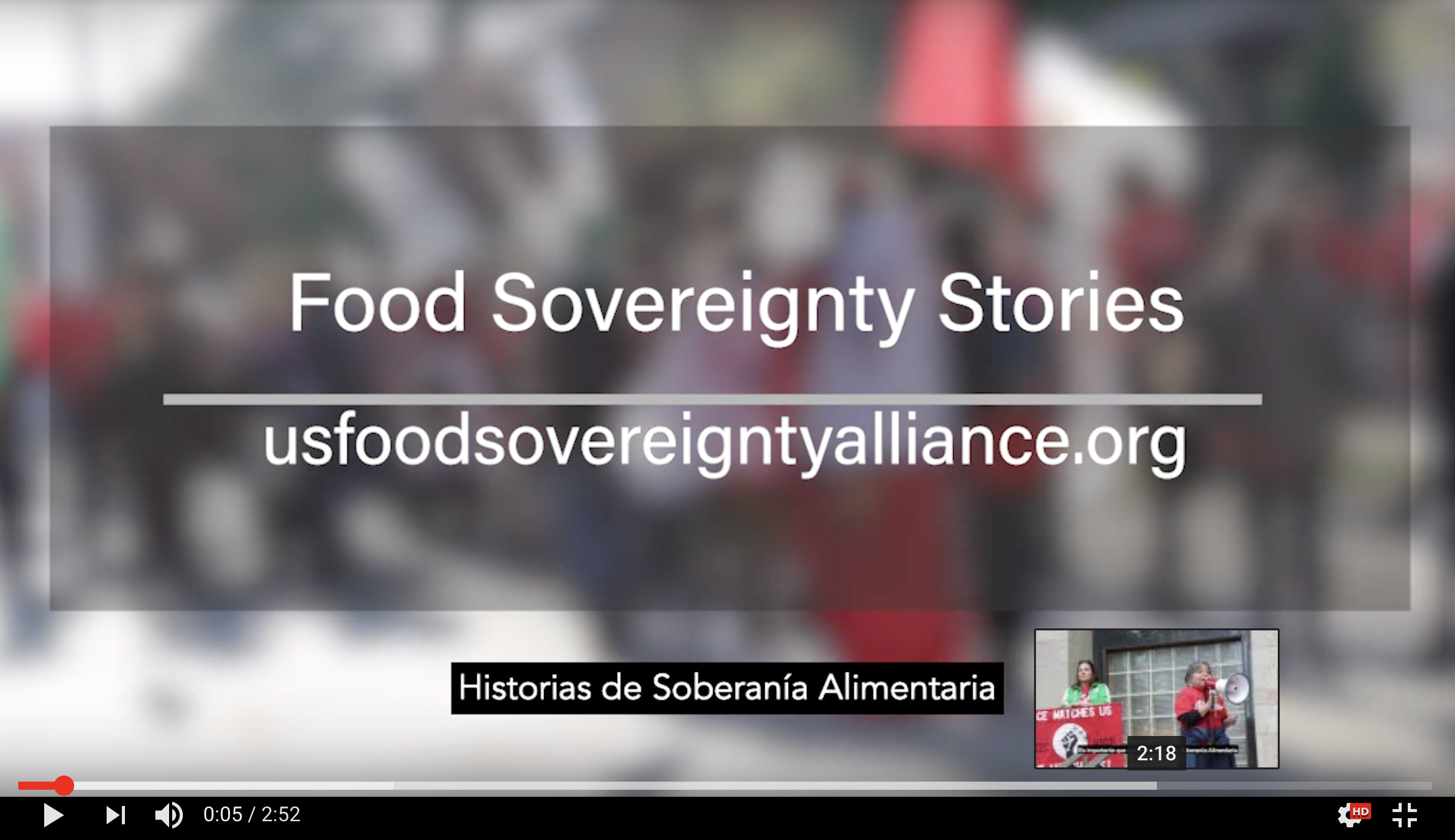
Fighting for a Democratic Food System: From South to North
A democratic food system: That’s how Joan Brady defines food sovereignty in action. Joan is a food producer in southern Ontario and is a member of the National Farmers Union of Canada and North America regional coordinator of La Via Campesina, the international social movement organization that popularized the term food sovereignty.
“Not only am I a farmer-producer,” Joan said during the US Food Sovereignty Alliance Assembly in Bellingham, Washington, in October 2018, “I am a leader within my community to build the alternative food system—one that recognizes and values the work that farmers do, that recognizes and values that citizens can choose what to eat and that they should be part of the decision making process.”
During the Assembly, Joan spoke passionately about her experiences as a hog farmer in Canada, and how it has informed her work to cultivate food sovereignty at home and internationally. She described a difficult environment that saw family hog farmers unable to make a living wage and turning to food banks as they felt cornered in the business. When she no longer saw a future in hog farming, Joan made the difficult decision to leave the industry and start over in 2006. She continues to produce food in a market-garden.
Joan connects the systemic challenges she faced while being forced out of the hog industry to the global agribusiness model that impacts small farmers and peasants around the world. This also informs her activism, which focuses on linking up struggles to advance food sovereignty as a alternative.
“I am very much a believer that the answer is within the group, that we as citizens—and especially as peasants and farmers and migrant workers and indigenous people and fisherfolk, who are in Via Campesina—we do have those answers,” she said.
Joan attended the US Food Sovereignty Alliance Assembly for the first time in 2018, and she said she was “blown away” by the cross-pollination between different movements and struggles, from urban agricultural projects in US inner cities to agroecology initiatives in rural areas in Latin America. She was also optimistic about the growing movement.
“This is a place where we link up with people who are passionate and who understand what food sovereignty is,” Joan said. “And they’re going places.”
Food Sovereignty Stories is a video series exploring what food sovereignty can look like for diverse social movements across the United States. Share this video and follow USFSA for updates!
-
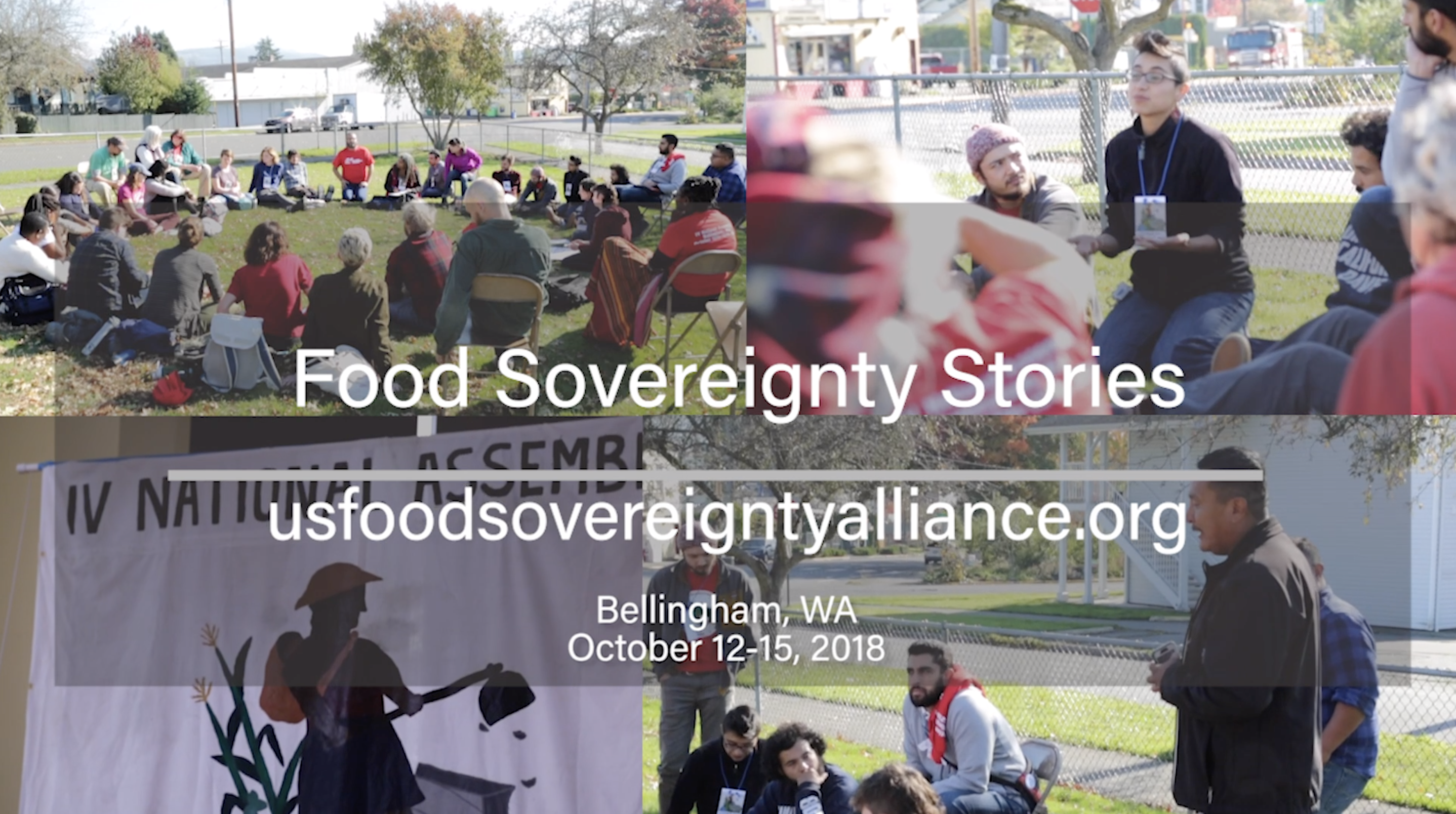
A Just Transition Calls for Indigenous Food Sovereignty
For the Black Mesa Water Coalition, food sovereignty is one part of a broader effort to transform Navajo and Hopi communities and their economies by drawing on traditional knowledge to build sustainable alternatives to fossil fuel dependence.
“The just transition for us really came from the need to transition away from a fossil fuel-based economy, which our tribe is heavily dependent on, with royalties from the exploitation of coal, gas, and other resources,” said Black Mesa Water Coalition member Robert Nutlouis during the US Food Sovereignty Alliance Assembly in Bellingham, Washington, in October 2018. “Our call for the Nation is to move away from that type of development towards a more sustainable, regenerative economy.”
The organization, based in Arizona, formed in 2001 to confront the impacts of coal mining in Navajo and Hopi communities and tackle issues around water, natural resources exploitation, and health. Among other work, its projects have included regenerative water catchment systems, leadership development initiatives, and a “Food Sovereignty Project” using dry land agricultural techniques to produce food on a five-acre community farm.
“Food sovereignty for our community is really looking at our own traditional knowledge and the wisdom that our ancestors had developed and left for us and is still carried by our elders,” said Robert. “Really going back and seeing what this knowledge and wisdom say to us about how to revive and rebuild our food system.”
The organization also works to build cultural awareness, including language preservation efforts and education around traditional seeds.
“There has to be a cultural shift from how we see things to how we interact with our environment,” Robert continued. “The land is sacred, the elements are sacred, and we have to understand it in that way.”
Sheldon Natoni, a youth member of the Black Mesa Water Coalition, added: “It kind of gives me comfort that I’m going through the right path and I’m not being part of the extractive economy. It’s a healing property for me to become more grounded in who I am as a Dene.”
Black Mesa Water Coalition received the US Food Sovereignty Alliance’s 2018 Food Sovereignty Prize in the domestic category, recognizing its work in reclaiming Indigenous food sovereignty. Food Sovereignty Stories is a video series exploring what food sovereignty can look like for diverse social movements across the United States. Share this video and follow USFSA for updates!