 The U.S. Food Sovereignty Alliance (USFSA) has released a new publication based on participatory research conducted by Grassroots International intern Alison Kaika, with editing support from Sara Mersha (Grassroots International), Saulo Araujo (WhyHunger), and Stephen Bartlett (Sustainable Agriculture of Louisville). The document synthesizes data collected through interviews with fifteen members involved in the Alliance since formation in 2010.
“Our History” serves two main purposes. First, USFSA members can utilize the publication as a tool for developing collective memory and shared strategies. New members will particularly benefit from understanding how the coalition changes over time and intersects with global partners as a regional process of the International Planning Committee for Food Sovereignty. Second, the USFSA seeks to increase membership and construct partnerships across socioeconomic sectors. For potential allies unfamiliar to social movements focused on food and agriculture, the results of this research project can function as an introduction to the struggle for food sovereignty in the U.S.
“Food sovereignty is the right of peoples to healthy and culturally-appropriate food produced through ecologically sound and sustainable methods, and their right to define their own food and agricultural systems.” Declaration of Nyéléni, 2007.
“Our History” begins by defining food sovereignty and highlighting La Via Campesina for presenting the concept at the World Food Summit (1996) as an alternative to neoliberal policies that strengthen industrial agribusiness and weaken the capacity of rural and urban peoples to defend and uphold basic human rights to the sources of life.
The food sovereignty agenda solidified in 2007 with the Declaration of Nyéléni, the culmination of the Forum for Food Sovereignty in Sélingué, Mali. Delegates from U.S.-based organizations initiated the U.S. Working Group on the Food Crisis to further the Forum’s momentum. Responding to the skyrocketing of food prices amid the 2007–2008 financial recession, activists around the world presented food sovereignty as a comprehensive set of transformative solutions to root causes of poverty, hunger, and the destruction of rural livelihoods.
Prior to officially launching in New Orleans on World Food Day, leaders of the Working Group on the Food Crisis produced the USFSA’s guiding documents during the People’s Movement Assembly on Food Sovereignty at the 2010 U.S. Social Forum. Founding members of the Alliance included: Agricultural Missions, Inc.; Community to Community Development; Food First; Food Chain Workers Alliance; Grassroots International; Maryknoll Office for Global Concerns; National Family Farm Coalition; Pesticide Action Network of North America; Presbyterian Hunger Program; and WhyHunger.
Working groups in the Alliance operate with local rootedness, global connections, and a focus on the cultivation of intersectionality by addressing: immigrant rights and fair trade; resource grabs and land reform; and defense of Mother Earth. Additional teams fulfill tasks related to fundraising, communications, assembly planning, and the Food Sovereignty Prize, an honoring of international and domestic groups that demonstrate application of the food sovereignty principles. Furthermore, USFSA members orchestrate agroecology learning exchanges and establish partnerships with, for example, the Climate Justice Alliance and Closing the Hunger Gap.
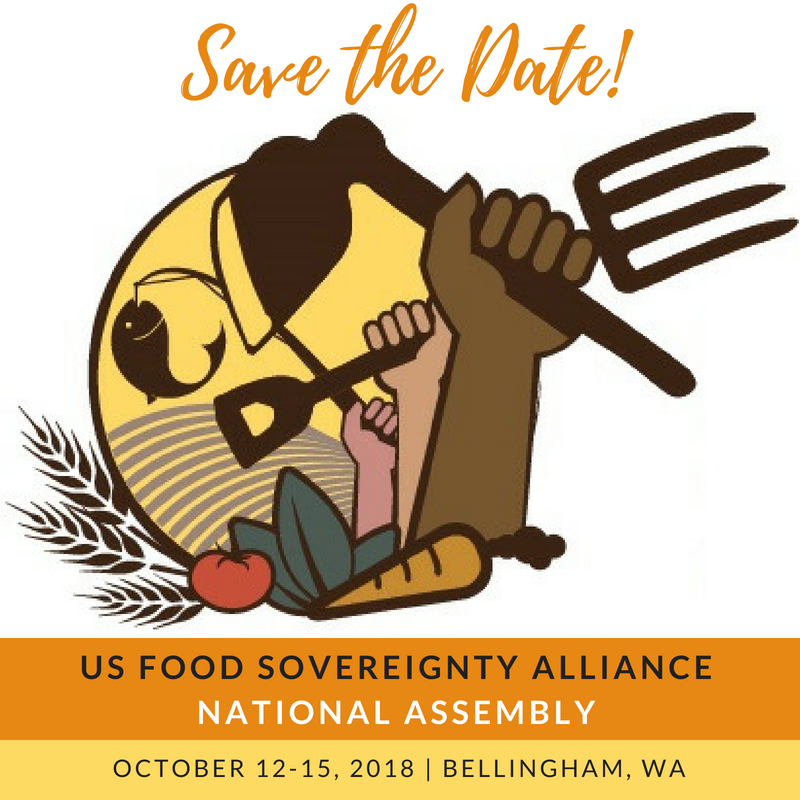
The USFSA has held three national assemblies – Oakland, CA (2011); Tampa Bay, FL (2013); and Des Moines, IA (2015) – for members to build relationships and common tactics through a dialogue of different ways of knowing. Anchored by C2C, the IV Membership Assembly in Bellingham, WA (October 12–15, 2018) will be the first national convergence since the regional restructuring that followed the III Assembly in Iowa. The USFSA’s coordination team transitioned to a model of representation based according to geographic regions – the Southeast; the Northeast; the Midwest; and the West Coast / Pacific Northwest – and reaffirmed their goal to continue fostering the leadership of grassroots organizations, women, and minorities.
The USFSA’s Youth Process formed in 2018 with the aim of increasing the participation and representation of young adults associated with grassroots and grassroots-support organizations across all regions of the Alliance. The emerging collective holds monthly conference calls in conjunction with political education grounded in readings and group discussion. Co-organizers of the Youth Process plan to facilitate youth-oriented training space during the IV Membership Assembly in Bellingham and coordinate programmatic initiatives following the national gathering.
For general inquiries or more information about the release of “Our History,” please contact Tyler Short (tylerlaminga (AT) gmail (DOT) com), a member of Sustainable Agriculture of Louisville and the USFSA’s Communications Team.

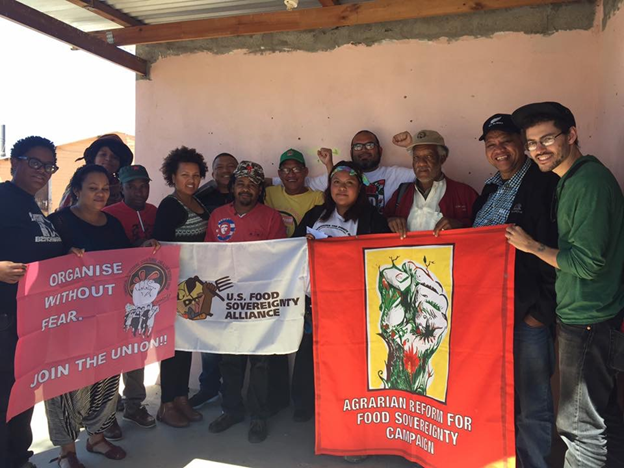
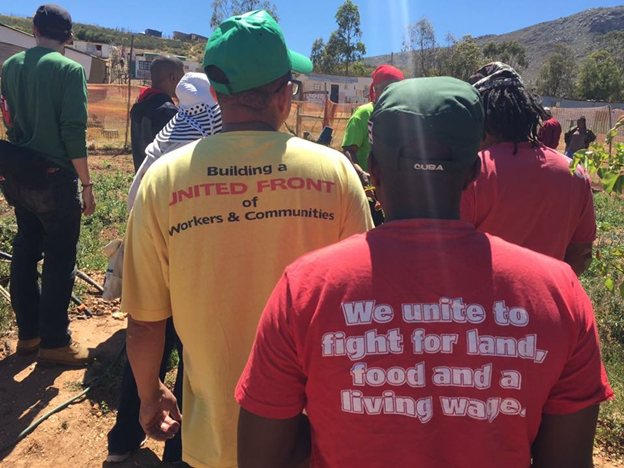
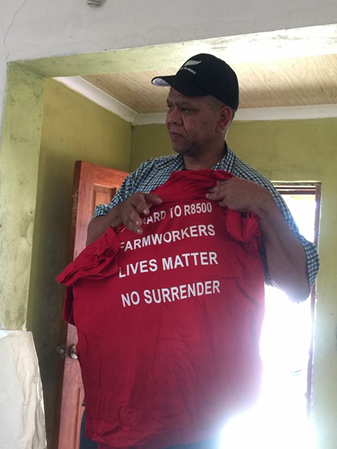 It is under these conditions that The Commercial, Stevedoring, Agricultural and Allied Workers Union (CSAAWU) which has been on the frontlines for over 10 years has had to organize. When the transfer of power occurred, there was an expectation that workers would benefit under a new government that was black led. Instead, only a certain few benefitted. Whereas in the past, farmworkers were hopeful that with the abolition of apartheid, that the government would be able to improve conditions, the condition under this new government remain the same. CSAAWU recognized that organizing with farmworkers needed to be deeper than just organizing in the workplace; they also have to organize in the community to respond to the numerous social inequalities that exist in the lives of farmworkers. The Union also organizes with immigrant workers who come from primarily Mozambique and Zimbabwe and face similar treatment as immigrants here in the United States such as wage theft and human trafficking by labor brokers.
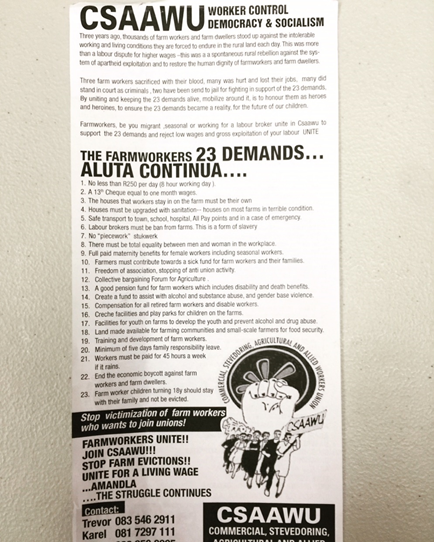 The issue of class was raised as well. From what I gathered from our conversations, in the past when the apartheid government was ruling, farmworkers felt that it was the racist government that was oppressing them. The “Boers” (White Farmers) were protected by the state and anytime workers threatened to organize or strike, they were immediately broken and arrested by the police. When Nelson Mandela became president of South Africa farmworkers felt that they were finally going to get justice. However instead of seeing their conditions improve, the farmworkers saw only the creation of a black and colored middle class that was not too interested in making sure that workers had economic gains. If anything, the black middle class drove a wedge at true solidarity between poor people and the new black leadership. In essence, the middle class was functioning to protect white supremacy by keeping the farmworkers down.