Category: Corporations & Policies

Corporations, Policies

  • Advisory: USFSA to Award Food Sovereignty Prize TONIGHT, October 10 5:30PT

    For Immediate Release – October 10, 2019

    US Food Sovereignty Alliance to Award Food Sovereignty Prize TONIGHT, October 10

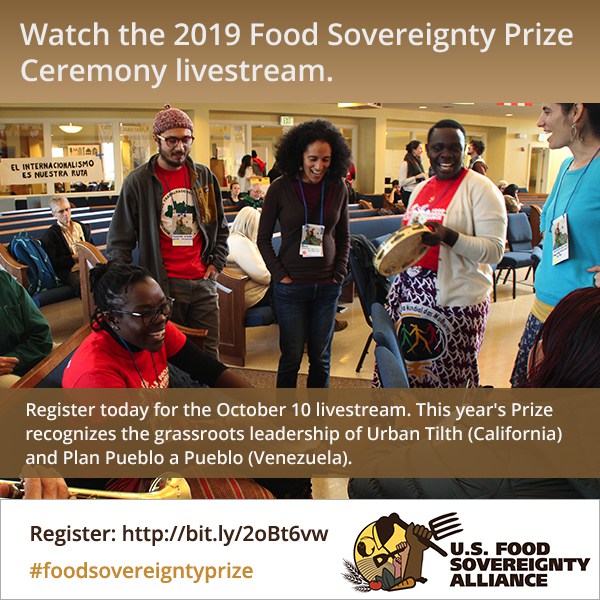
    FERGUSON, MO: The US Food Sovereignty Alliance (USFSA) will award the 2019 Food Sovereignty Prize to Urban Tilth (Richmond, CA) and Plan Pueblo a Pueblo (Plan People to People, Venezuela) this evening in Ferguson, Missouri. Interested press can view a livestream, and afterwards, a video of the ceremony at bit.ly/foodsovprize2019

    The Food Sovereignty Prize honors those committed to working for social change through collective action, and highlights those confronting oppression and corporate control over seeds, land, water, labor, knowledge, supply chains, and policy-making. 

    WHAT: 2019 Food Sovereignty Prize ceremony 

    WHO: US Food Sovereignty Alliance members, allies, and interested press

    WHEN: Tonight, October 10th at 5:30PT/ 8:30ET

    WHERE: A livestream of the Ferguson, Missouri ceremony at bit.ly/foodsovprize2019

    ###

    As a US-based alliance of food justice, anti-hunger, labor, environmental, faith-based, and food producer groups, the Alliance upholds the right to food as a basic human right and work to connect our local and national struggles to the international movement for food sovereignty. For more information, visit www.usfoodsovereigntyalliance.org.


  • Urban Tilth Awarded the 2019 Food Sovereignty Prize!

    Urban Tilth Awarded the 2019 Food Sovereignty Prize!

    The 2019 Food Sovereignty Prize (FSP) Ceremony will occur on October 10 as part of the USFSA’s Midwest region’s membership assembly in Ferguson, Missouri. This year’s awardees,Urban Tilth (Richmond, CA) and Plan Pueblo a Pueblo (Venezuela),  demonstrate the values and principles of food sovereignty through visionary, collective action to transform food production and distribution systems.   

    The narrative strategy collective of the USFSA aims to raise awareness and center our food sovereignty discourse around the critical perspectives and oppositional actions of our communities’ struggles against the extractive economy and false solutions promoted by corporations which claim to be raising people out of poverty, feeding the world, and addressing the global climate crisis. Aligned with the USFSA’s commitment to prioritize the leadership of grassroots member organizations, our communications collective intends to focus on the real, community-led solutions for a Just Transition toward a regenerative economy. We recognize that grassroots organizers – not corporations – are best positioned to know and eliminate social and environmental problems, and we affirm our belief that those most affected by poverty, hunger, and ecological collapse have the rights to self-determine their future, to tell their stories along the way, and fully participate in policy processes from the local to global levels.           

    This blog post republishes an online newsletter sent by Urban Tilth at the end of August 2019, in which they overview their work and extensively define food sovereignty. We encourage you to additionally read the 2019 FSP announcement and view the fourth Food Sovereignty Stories film that featured Urban Tilth’s Executive Director, Doria Robinson.  

    Urban Tilth opened their August newsletter by expressing gratitude to the USFSA for honoring the organization with the 2019 Food Sovereignty Prize in recognition of their efforts to build a more sustainable, healthy, and just food system in Richmond and elsewhere. They continued by writing:

    What is Food Sovereignty? 

    Food is part of the lives of every living being on Earth. It sustains us, nurtures or harms us. Food defines our cultures, shapes our identities. It can be a powerful catalyst for transforming our relationships to one another and to the planet. For Urban Tilth, access to healthy food also means that what we eat comes from whole ecosystems, from healthy soils, healthy water and healthy air, from the love of the earth, and from the precious life energy of people that grow it, distribute it and prepare it for our plates. 

    For Urban Tilth Food Sovereignty is having control over what goes into our bodies starting from the soil, water and air. Food Sovereignty means having the right to demand that the soil that grew our food was not stripped of life, then soaked in chemicals that drained to the rivers and bays killing the fish; that the air was not polluted with greenhouse gases by the machines that moved food thousands of miles across the globe so that we can have summer produce in winter. 

    Food Sovereignty means being able to determine that the food that sustains our lives will be produced without destroying the Earth we depend on, by people who will be treated with dignity, paid a fair wage for their labor or fair price for their produce and will not be poisoned in the process. 

    Food Sovereignty also means that even if you are poor, or even if you live in a city, you have the right to this kind of healthy, righteous food; that you do not have to be quiet and take whatever food-like-products end up in your corner store, or big box grocery – that is most likely also destroying your local economy, while barely employing people at a living wage. 

    Food Sovereignty means that we have the right, even as Landless peoples, to have a relationship with the land we come from; that we have the right to belong to a place; the right to admit interdependence; the right to be in relationship with land; the right to care deeply and the duty to protect the people, land, water and air that nurtures us.

    Since Urban Tilth was founded in 2005, our goal has been to transform the food system, especially how the current system impacts low income communities of color in Richmond and San Pablo, California. We are committed to intentionally hiring and training local residents, especially (but not exclusively) youth who struggle with food insecurity, housing insecurity, the criminal justice system, unemployment, and poor access to quality education, to lead in this transformative work. We believe we must liberate ourselves, no one can come into our community and do this kind of work for us. With home grown experts leading in every Urban Tilth initiative, we work together with our partners, allies and neighbors using many different strategies to create a healthy, just and sustainable food system, within a healthier and more self-sufficient community.” 

    Our Work

    “Over the past 14 years, we have transformed blighted public lands and grown healthy soil, healthy food and healthier people through our 7 School and Community Gardens and Farms. We have played a leadership role in the revitalization of the Richmond Greenway, by creating Greenway Community Gardens and the Edible Forest and helping to create and maintain the Unity Park project

    We also steward the beloved 1st Street Sol Community Garden in North Richmond and the productive AdamsCrest Farm in Richmond Heights.  

    Our most exciting project so far is the North Richmond Farm. We are transforming a neglected, publicly-owned property into a vibrant urban farm, Agricultural Park and Watershed Learning Center! The Future Farm will be a working urban farm with a greenhouse, shadehouse, hoop houses, a permanent farm stand where North Richmond residents can access fresh produce every day, a wash and pack facility, a community commercial kitchen, cooperative cafe, outdoor classrooms, amphitheater and meeting spaces. The farm is already slowly becoming a place for the community to come together to celebrate, learn and, of course, grow and eat healthy food. At The Farm Today, we host community build volunteer days, educational exchanges, organize community events, grow crops, build the soil, and pack our CSA boxes with love.

    Along with the work happening at our five community gardens and urban farms we also serve over 400 students from West Contra Costa School District by conducting educational programs and managing learning gardens at the Verde Elementary Partnership Garden, Richmond High School Urban Agriculture Academy, as well as host 40 youth each summer in our Summer Youth Apprentice Program, a 6 week intensive urban agriculture employment and training program that has run for the past 10 years.

    This year we are starting two new after-school programs at Richmond High School:  The Healing Movement and The Urban Watershed and Naturalists Club.

    Five years ago with inspiration from Brock Dolman at the Water Institute at Occidental Arts and Ecology Center we designed and launched our The Basins of Relations Watershed Restoration Technician Training Program where we train and employ young people from West Contra Costa County to become stewards of their watersheds, communities, and the creeks that run through them. 

    We are also leading the Wildcat Visioning Project, a campaign to create awareness about the need to improve the North Richmond Wildcat Creek trail to help reconnect the people who live in North Richmond with this vital waterway.

    Our Farm to Table CSA program, awarded Best of the East Bay in 2018, currently serves 168 members. It is supplied by Urban Tilth farms and local small, family and urban farms such as  First Generation Farmers and Frog Hollow Farm

    Our CSA provides chemical and pesticide free nutritious produce to low income families, seniors, disabled people, artists, and those reentering the community from incarceration through community subsidized memberships. Our aim is to use this project as an organizing strategy to begin forming a San Francisco Bay Area small farmers distribution cooperative. 

    We also provide our produce through Free Farm Stands and Pop-up Farm Stands. Our next step will be a Farmer’s Market at Unity Park. 

    At Urban Tilth we are proud of what we have accomplished so far. We appreciate our founder, Park Guthrie, our amazing staff and boards past and present, our allies (Movement Generation, Occidental Arts and Ecology Center, Supervisor John Gioia, the North Richmond MAC, Rich City Rides, Spiral Gardens, Cooperation Richmond, the Our Power Richmond Coalition, the Climate Justice Alliance, Community to Community, APEN, Annie’s Annuals, all our family in Kentucky, Alaska and Buffalo, CASFA, UC Extension, Noll and Tam, Kanchan, Josh, Sarick, Katie and Adele Ho and so many others), all our donors who understand the importance of funding the grassroots people directly so they can uplift their own communities and our many, many, many community volunteers, who make the continuation of our work possible. This honor is your honor and would not have been possible without your courageous and visionary hard work and loving support.

     With immense love and gratitude,

    Urban Tilth
     

  • Announcing the 2019 Food Sovereignty Prize Honorees

    Announcing the 2019 Food Sovereignty Prize Honorees

    Prepared by Tyler Short, Sustainable Agriculture of Louisville

    Introduction

    The U.S. Food Sovereignty Alliance is very excited to announce the winners of the 2019 Food Sovereignty Prize. Urban Tilth (Richmond, CA) is the domestic honoree, and Plan Pueblo a Pueblo (Plan People to People; Venezuela) is the international honoree.

    The eleventh annual Food Sovereignty Prize Ceremony will occur virtually on the evening of Thursday, October 10, anchored by the USFSA’s Midwest Region at their membership assembly in Ferguson, Missouri. Please keep an eye out in the coming weeks for a livestream registration link that includes the exact time of the event.   

    About the Prize

    The Food Sovereignty Prize (FSP) was first awarded in 2009 by the Community Food Security Coalition. The USFSA began to lead the initiative once the Coalition disbanded in 2013.  

    For the USFSA, awarding the Prize allows for expanding the Alliance’s public outreach through recognition of the inspirational efforts demonstrated by grassroots organizations and networks seeking to realize the right to people’s food sovereignty and the scaling of agroecology. The FSP spotlights honorees committed to struggling for social change through collective action, policy reform, cultivating global linkages, and centering the leadership of women, youth, poor people, and marginalized racialized groups. Furthermore, the FSP functions as an oppositional tool for developing a counter-narrative against industrial agribusiness, particularly the World Food Prize annually awarded to individuals who purportedly advance human development via alleged improvements to the quantity, quality, and availability of food.

    The FSP highlights how grassroots social movements confront corporate control over seeds, land, water, labor, knowledge, supply chains, and policy-making. The Prize calls attention to grassroots protagonists who persistently work toward ending poverty, localizing food systems, and democratizing politics to benefit farmers, fisherfolk, food chain workers, and consumers.

    While selecting the honorees, the 2019 FSP committee and National Coordination of the USFSA discussed the current U.S. political and economic context in which the gap between rich and poor widens, politicians contend for 2020 Presidential nominations, agri-food corporate mergers further consolidate markets, and family farmers and small-scale fishers continue to face bankruptcy and displacement. USFSA leaders understood the need to denounce the heightened risks faced by migrant families, poor communities of color, and indigenous peoples threatened by the U.S. government’s stricter border enforcement, ongoing immigration raids, intensified militarization of police, and privatization of public lands consisting of sacred ancestral sites. The USFSA also decided that the 2019 FSP should raise awareness about the U.S. government’s aggressive interventionist policies in Latin America and elsewhere.     

    Domestic Honoree: Urban Tilth

    Urban Tilth was founded in 2005 with the mission of building more sustainable, just, and healthy food systems in West Contra Coast County, California. In addition to coordinating two school gardens, the organization operates five community gardens and small urban farms for growing and distributing thousands of pounds of culturally-appropriate produce each year.

    The Community Supported Agriculture (CSA) of Urban Tilth supplies ten-pound boxes of fresh produce to local eaters every week throughout the year. The CSA provides affordable, seasonal food grown by the organization and procured through partner distributors. They also sell their pesticide-free produce at a weekly farm stand. As a co-founder of the Richmond Food Policy Council, Urban Tilth strives for legislative reform that ensures the viability of the regional agri-food economy and serves the interests of all local residents. Guaranteeing healthy food in public schools has been a priority as well as popular education on the importance of fresh fruits and vegetables for a well-balanced diet.  

    Doria Robinson, the Executive Director of Urban Tilth, serves as a co-coordinator of the USFSA’s Western region. Urban Tilth also participates on the steering committee of the Our Power Richmond Coalition, which is dedicated to achieving a Just Transition from extractivism toward a regenerative economy grounded in racial justice and governed by frontline community leadership. Furthermore, Urban Tilth is an active member of Climate Justice Alliance’s Food Sovereignty Working Group that has been developing a translocal strategy for eliminating the dependence of agri-food systems on fossil fuels and shifting away from the capitalist logic which prioritizes profit over people. Through CJA and the USFSA, Urban Tilth organizes around the vision of ending hunger and malnutrition and combating climate change by creating and defending regional, appropriately scaled, environmentally responsible, and socioeconomically just agri-food systems.   

    International Honoree: Plan Pueblo a Pueblo

    El Plan Socialista de Producción, Distribución, y Consumo de Alimentos Pueblo a Pueblo (The People to People Socialist Plan of Production, Distribution, and Consumption) started in 2015 with the establishment of a network to bridge rural-urban divides in Venezuela.  Plan Pueblo a Pueblo purchases fruits, vegetables, tubers, legumes, basic grains, meat, eggs, and sugar from small producers. Organizers distribute the food to urban consumers at prices more affordable than products sold in conventional markets like street vendors and stores.

    The grassroots-driven Plan has created an alternative to capitalist agribusiness that relies on imported food and seeds, the intense use of chemical inputs, and intermediary buyers. Guided by socialist and ecological principles, Plan Pueblo a Pueblo links rural producers and tens of thousands of urban consumers into a mutually beneficial system defined by solidarity, equity, democratic decision-making, the promotion of organic agricultural practices, and the recovery of native seed varieties. Food delivered by Plan Pueblo a Pueblo supplement items supplied through the government’s food distribution program called CLAP (Local Food Production and Provision Committees).

    U.S. sanctions and attempts to install a new President in Venezuela have imposed significant challenges for participants and organizers of Plan Pueblo a Pueblo. The weaponization of food by the U.S. government amounts to collective punishment against Venezuelans, 40,000 of who died between 2017 and 2018 as result of sanctions limiting access to live-saving medicine, medical equipment, food, and other basic imports. Plan Pueblo a Pueblo farmers face shortages of seeds, fertilizers, and tools due to the U.S.-led economic blockade and rising rates of inflation.

    Food sovereignty and socialist economic planning are key solutions for Plan Pueblo a Pueblo to ensure the human right to food and protection for the livelihoods of small-scale farmers. The network allies with the Bolivarian revolutionary government and works with partner organizations to rebuild seed reserves, produce organic fertilizer, acquire tools, bolster direct market relations, and lead political education trainings for rural and urban communities.


  • Food Sovereignty and Farm Justice: Jim Goodman of the National Family Farm Coalition

    Food Sovereignty and Farm Justice: Jim Goodman of the National Family Farm Coalition

    In this third short film in the #FoodSovereigntyStories series produced by Heather Gies and Colin Anderson, President of National Family Farm Coalition Jim Goodman shares his perspective on farm justice, a New Deal policy platform centered on protecting the wellbeing of farmers, consumers, and the environment.

    Take a look at @foodsovusa’s second #FoodSovereigntyStories video! Each month, @foodsovusa will release videos that share the unique meanings that #foodsovereignty takes in different communities and the principles that bind them together.