This post is written by Tyler Short of Sustainable Agriculture of Louisville, and is the second in a three part series. You can view part one here.
Introduction
At the USFSA’s IV National Membership Assembly in Bellingham, WA (October 12–15), the Alliance will award the 2018 Food Sovereignty Prize to Black Mesa Water Coalition and Organización Boricuá de Agricultura Ecológica de Puerto Rico. The ceremony will occur on Sunday, October 14 (5:30–7:30 PM Pacific). Please follow the USFSA’s Facebook page to view a livestream of the event.
This is the second post in a three-part series. Below, I spotlight Black Mesa Water Coalition (BMWC) and outline the Just Transition framework that underlies their restorative models of political economy.
Part One of this blog series offered a background to Just Transition and Climate Justice Alliance. Part Three will analyze the notion of Just Recovery, specifically in terms of the Food Sovereignty Brigades mobilized by Organización Boricuá de Agricultura Ecológica de Puerto Rico in the aftermath of Hurricane Maria last year.
Energy Democracy
How has BMWC applied a Just Transition framework to their environmental justice program among Diné (Navajo) and Hopi communities in northern Arizona?
The Coalition underscores that energy must be owned and controlled by communities, not large corporations. Since its formation almost twenty years ago, the organization has fought to stop the dig-burn-dump process of polluting industries that extract water, coal, oil, natural gas, and uranium from the region. In 2005 BMWC and their partners succeeded in shutting down the Mohave Generating Station, forcing the Black Mesa Mine and 273-mile slurry pipeline to close.
With solidarity from Our Power Communities organized through Climate Justice Alliance (there are currently seven total, including Black Mesa), BMWC has targeted the coal-powered Navajo Generating Station, which exploits water from the Navajo Aquifer and supplies energy to the 300-mile canal known as the Central AZ Project (CAP). The Coalitionargues that renewable sources can power CAP and provide energy for the estimated 18,000 Navajo and Hopi homes lacking electricity. In addition to calling for the Navajo Generating Station to shift entirely to solar energy, BMWC has pushed to reclaim former mine sites, install solar panels, and connect the new infrastructure to existing transmission lines.
Jihan Gearon, the Executive Director of BMWC, commented on the topic of funding for Just Transition projects during a panel discussion at the 2018 Protecting Mother Earth Conference in Nisqually, WA (June 28–July 1, 2018), “Money helps but can cause problems if you’re always chasing it.” The Coalitioncites the Navajo Green Economy Fund as a major achievement, although it has lacked proper support from the tribal government since the legislation passed in 2009. Legal interventions have proven successful as well; for example, the CA Public Utilities Commission’s 2013 decision to use revenues from the sale of sulfur dioxide allowances to create a revolving fund in support of renewable energy development.
Local employment remains a crucial problem for BMWC to address as they organize for visionary economic alternatives away from the extractive economy. The Coalition understands that workers need access to income-generating activities as part of the fair shift towards a green economy. BMWC advocates for a holistic approach that would create meaningful employment in renewable energy production and also revitalize traditional food and fiber production lifestyles.
Food Sovereignty
BMWC directs a Restorative Economy Program that emphasizes resistance to extractive production, simultaneously enabling locally-driven models that meet human needs and revive ancestral values rooted in ecologically-sound, culturally-appropriate practices.
The Navajo Wool Market Improvement Project directed by BMWC includes weaving workshops, trainings on increasing a herd, and demonstrations that involve shearing, sorting, and grading wool. By hosting an annual Wool Buy since 2012, the Coalition has contributed significantly to raising the incomes of traditional wool producers and processors, while strengthening intergenerational relationships for young practitioners to learn from elders and reproduce customs foundational to their place-based identities. BMWC’s objective to enhance the viability of small-scale wool production overlaps with the core purposes of their Food Sovereignty Project to ensure community wellbeing, reverse cultural erosion, and realize self-determination as indigenous peoples.
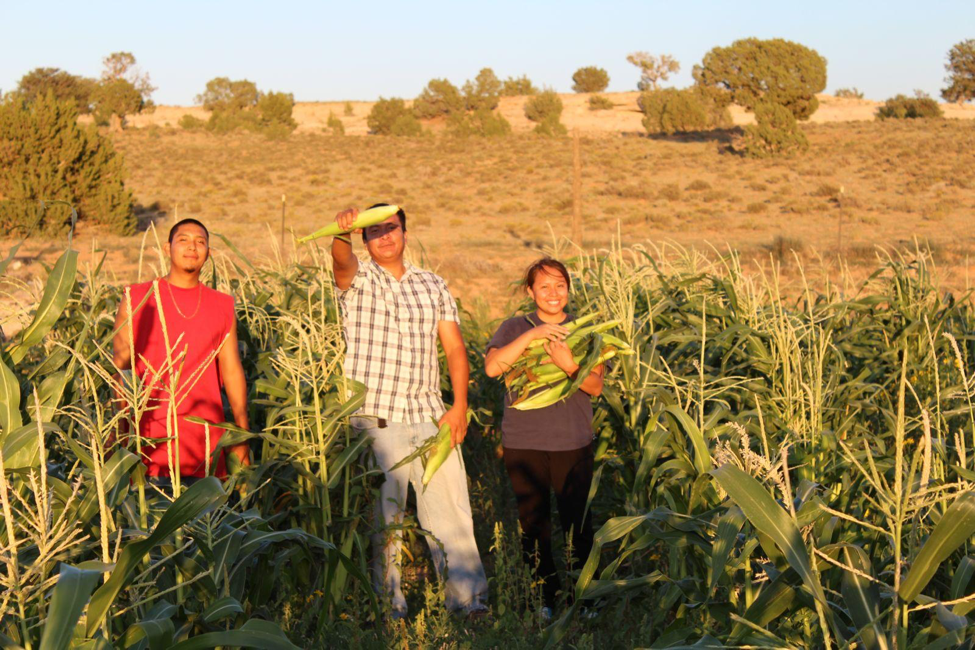
Roberto Nutlouis (middle) and others harvesting corn in 2012. Source: BMWC’s Facebook page
BMWC embraces food sovereignty as a platform for fighting to protect humans and other-than-human life from direct threats imposed by the structural forces of settler colonialism and capitalism. Based on a 2014 report, an alarming amount of Navajo Nation residents must drive hours to border-town stores off the reservation to access healthy and affordable food, which negatively affects reservation markets and undermines smallholder production for local consumption. BMWC promotes indigenous food sovereignty as a set of grassroots solutions to decommodify food and land, ending their use as weapons, while also creating a collective capacity to survive and enjoy the abundance of gifts from Mother Earth.
Leaders of the Coalition call for policies that would propagate and protect local food systems, mainly by redistributing land, removing barriers to obtain grazing permits, providing farmers’ access to credit, ending subsidies to agribusiness, and halting the biopiracy and contamination of native seeds. Roberto Nutlouis – the Restorative Economy Program Coordinator – facilitates popular education at a thirteen-acre community farm in Piñon, AZ, where BMWC affiliates learn about native plants, traditional cultivation techniques, watershed management, and cooking. The Coalition recently hosted its first annual Harvesting Our Kinship Festival (October 4–5, 2018), an educational celebration for honoring past struggles and inspiring young people to become agents of social change.
“After centuries of global plunder, the profit-driven, growth-dependent, industrial economy is severely undermining the life support systems of Mother Earth. An economy based on extracting from a finite system faster than the capacity of the Earth to regenerate will eventually come to an end… A Just Transition acknowledges Indigenous traditions that tell us that all economic activity must be rooted in an understanding and respect of our sacred relationships with Mother Earth and Father Sky… A Just Transition is our right to define our own food and indigenous agricultural systems. The right to food is sacred and cannot be constrained or recalled by colonial laws, policies and institutions.” Source: Indigenous Environmental Network’s Indigenous Principles of Just Transition
This post is authored by Tyler Short, Sustainable Agriculture Louisville. This post is part one in a three part series.
Introduction
The U.S. Food Sovereignty Alliance (USFSA) will honor the domestic and international recipients of the 2018 Food Sovereignty Prize – Black Mesa Water Coalition and Organización Boricuá de Agricultura Ecológica de Puerto Rico – at the IV National Membership Assembly in Bellingham, WA (October 12–15). The public award ceremony will occur in the evening of Sunday, October 14. Please register for the event here by Friday, October 5, or follow the USFSA’ Facebook page for a link to the livestream of the ceremony.
Leading up to the IV Assembly, I would like to highlight how the honorees apply the conceptual framework of Just Transition to their grassroots processes aimed at asserting democratic control over food and energy systems. I also hope to illuminate their participation in Climate Justice Alliance. In this first post of a three-part series, I will examine the meaning of Just Transition and provide an overview of how Climate Justice Alliance incorporates regenerative economics into its strategic mission.
Part Two will outline the history of Black Mesa Water Coalition and their current programmatic work to realize a Just Transition in the Southwest. Part Three will focus on the efforts of Organización Boricuá de Agricultura Ecológica de Puerto Rico in the struggle for a Just Recovery following Hurricane Maria, which struck the Caribbean in September 2017.
It Takes Roots to Cultivate Solutions: Background to Just Transition
Climate Justice Alliance (CJA) recently co-organizedthe Solidarity to Solutions Week (Sol2Sol; September 7–13) in Bay Area Ohlone territories alongside It Takes Roots partners from Grassroots Global Justice Alliance, Right to the City, and the Indigenous Environmental Network (IEN). Local organizations – such as Idle No More SF Bay, Urban Tilth, PODER, and the Asian Pacific Environmental Network – played vital roles in planning and leading the events. I attended Sol2Sol as a CJA delegate representing the USFSA.
During the week, hundreds of It Takes Roots delegates engaged in membership encuentros (encounters), local tours, and direct actions including street theatre, chants, speeches, and blockades outside of the Governors’ Climate and Forests Task Force meeting and Global Climate Action Summit (GCAS). It Takes Roots organized a contingent near the front of the March for Climate, Jobs, and Justice. The Sol2Sol Summit at La Raza Park provided space for It Takes Roots members to further amplify their visionary, community-led solutions to socio-ecological crises around the world. These were presented in opposition to corporate-driven false ‘solutions’ – for example: genetically-modified foods, carbon trading schemes like REDD+, and geoengineering – promoted by GCAS leaders. The four grassroots solutions advocated by It Takes Roots included: Just Transition; food sovereignty; energy democracy; and zero waste.
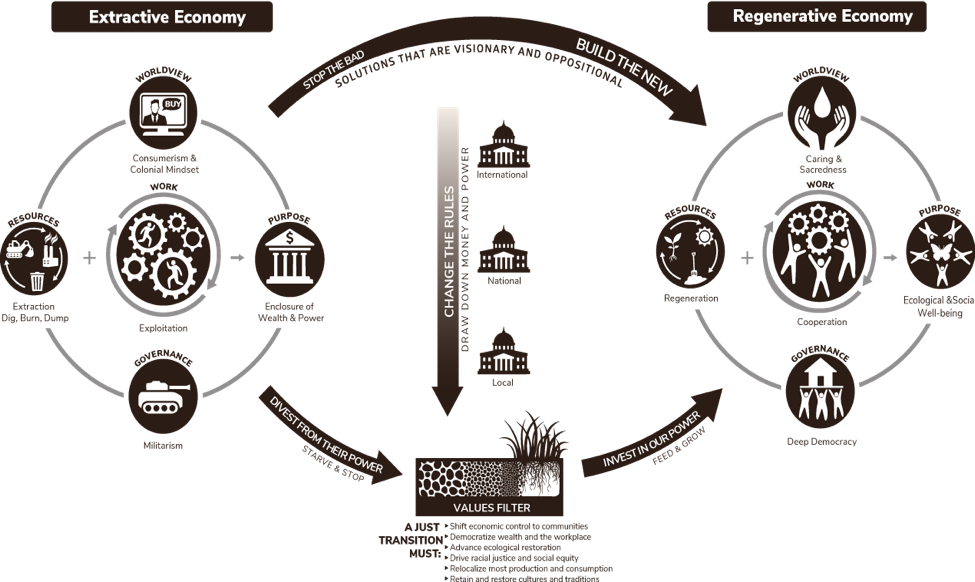
The figure below offers a visualization of a Just Transition. On the left, the Extractive Economy is characterized by militaristic governance, the dig-burn-dump process of exploiting sources of life, consumerist and colonial mindsets, and the enclosure of power and wealth into the hands of a few. On the right, the Regenerative Economy entails deep democratic governance, the regeneration of ecosystems, a worldview of caring and sacredness, and the purpose of attaining social and ecological wellbeing. Stopping the bad and building the new require strategic actions that range from policy-making to the enhancement of workplace democracy.
A Strategic Framework for a Just Transition. Source: Movement Generation’s zine From Banks and Tanks to Cooperation and Caring.
Trade unions and environmental justice organizations developed the concept of Just Transition about twenty years ago, merging labor and social movement theory with practice rooted within low-income and marginalized communities. In the context of discontinuing harmful economic activity, Just Transition originally centered on the need for workers of polluting industries to secure safe, dignified employment in the new, green economies.
Just Transition advocates have prioritized reparations to the peoples residing in sacrifice zones who most directly face the social and environmental costs of profit-driven extraction, such as forced displacement, pollution, and systemic poverty. As demonstrated by the Just Transition Alliance, coalition-building between workers, frontline communities, and fence-line communities has been fundamental to advancing a fair shift toward peaceful, healthy societies premised on respect for human rights and the rights of Mother Earth.
Uniting Communities for a Just Transition
After three years of deciding on a structure and vision, Climate Justice Alliance (CJA) launched in 2013 as a multi-racial, multi-sector coalition of nearly forty base-building frontline organizations and movement-support organizations dedicated to overcoming the root causes of climate change. Since then, their membership has increased to a total of sixty-seven participating organizations, alliances, and networks.
CJA has expanded the original definitions of Just Transition to embrace visions of transforming entire communities from militarized sites of extraction to economic of life. The Alliance’s Just Transition Principles coincide with many of the Indigenous Environmental Network’s Indigenous Principles of Just Transition. CJA promotes six interrelatedmeta-strategies to realize and defend Just Transitions:
In the Alliance’s earlier years, members mostly devoted their energies into the Our Power Campaign, a national and broad-based social force constituted by Our Power Communities. Members of the Our Power Campaign have engaged in research, political education, camp-style gatherings, and mass mobilizations with the common goal of ensuring that workers and frontline communities participate as primary stakeholders in policy-making and governance at all levels. The campaign’s main goals have revolved around uniting geographically-dispersed activists and collectively cultivating translocal strategies for the activation of fundamental, justice-centered shifts from extractive economies to localized, regenerative modes of production and distribution.
Inthe Our Power Plan: Charting a Path to Climate Justice (2015), CJA et al. affirms that the solutions needed to end the era of extreme energy arise from the resourcefulness, innovation, creativity, and determination of environmental justice communities, many of which interconnect due to histories of racialized and class-based oppression as well as legacies of successful organizing in defense of Mother Earth and communitarian values. CJA leaders underscore the imperative to enact comprehensive approaches that immediately stop pollution at source and uplift grassroots leadership. The Alliance’s strategic plan advocates for: renewable energy; clean water; agroecological food and fiber systems; durable housing; healthcare; public transportation; and zero waste.
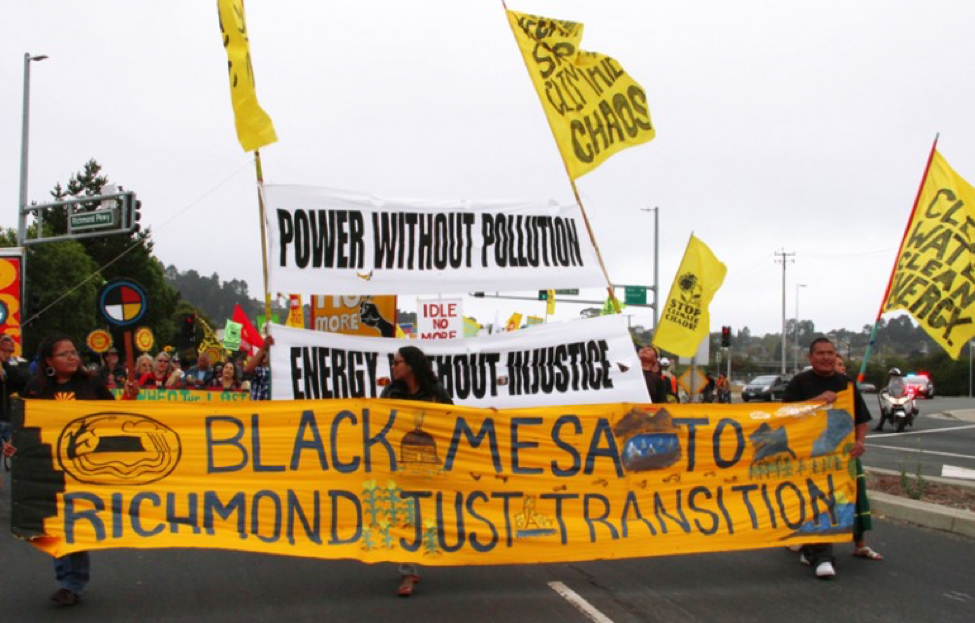
The steering committee of the Our Power Campaign identified Black Mesa, AZ, Detroit, MI and Richmond, CA as the pilot Hot Spots. Black Mesa Water Coalition anchored Our Power in Arizona. The Coalition hosted a training camp in 2013 for participants of the nascent collaboration to share skills and knowledge. The Ruckus Society assisted with the creation of action plans that expanded from past victories of Our Power members, and the Center for Story-based Strategy supported CJA to craft a grassroots narrative in the climate debate that communicates irresistible ideas about generating “power without pollution and energy without injustice.” By means of the Our Power Campaign, CJA has ultimately intended to establish a basis for federal legislation via Just Transition policy work at the local and state levels.
For Part Two of this blog series, I will shed light on how Black Mesa Water Coalition has advanced a Just Transition among Navajo and Hopi communities. In particular, I will provide examples of popular education pertaining to food sovereignty and legal victories that further their energy democracy agenda. The third part of this series will describe and analyze the Food Sovereignty Brigades mobilized by Organización Boricuá de Agricultura Ecológica de Puerto Rico in the aftermath of Hurricane Maria.
This post was updated on October 4 to clarify the difference between CJA’s Our Power Campaign and their working group project titled Reinvest in Our Power, which began more recently, functioning as part of the Reinvest in Our Power Network.
By Ivan Vazquez, Farmworker Association of Florida & Magha Garcia, Boricua Organization of Ecologic Agriculture of Puerto Rico with a special contribution by Anne Frederick, Hawaii Alliance for Progressive Action
History and Context
Hawaii’s diverse natural scenery, warm tropical climate, abundance of pristine beaches, oceanic surroundings, breathtaking landscapes and active volcanoes make it a popular destination for tourists, surfers, biologists, and volcanologists. But above all the natural beauty Hawaii has to offer, its people are what stand out for me, for they are warm, welcoming and resilient and they are the representation of Aloha Spirit, which is the coordination of mind and heart within each person. This spirit brings each person to the self. In this spirit, each person must think and emote good feelings to others. These attributes constitute the Hawaiian identity.
Hawaii is a volcanic archipelago situated in the north Pacific Ocean approximately 2200 miles away from the U.S main land. Hawaii has a rich history, culture and traditions and its people have a strong connection to the land. Historically, Hawaiians shared the stewardship of the land and it was everyone’s responsibility to care for it, just as it is the case for many other island inhabitants whose resources are limited. That changed in the 17th century, when Europeans began to settle in the islands and spread their ideas and philosophies and religion.
The state of Hawaii was the last state to join the union in August 21, 1959. However, this annexation still is seen with resentment by most native Hawaiians, since US troops invaded the sovereign kingdom of Hawaii, kidnapped their queen, banned the natives from speaking their native tongue, disrupted their farming practices, and almost wiped out their culture.
Hawaiians are wise and loving, and proud of the culture and traditions. during our visit there, Magha Garcia and I felt very welcomed and embraced by all the people we met. the locals proudly showed us their traditional foods such as, Poi and Ulu. Poi is a Hawaiian dish made from the fermented root of the taro, which is boiled then pounded to a paste. Ulu is Hawaiian variety of breadfruit. The traditional methods for preparing breadfruit is peeled then steamed or boiled, then pounded into paste that has the consistency and texture of mashed potatoes.
Last August, my colleague Magha and I participated in a learning exchange visit to Hawaii to understand the island’s past and present struggles. Also, this visit had the purpose to build and strengthen the relationships between the U.S. Food Sovereignty Alliance (USFSA) and organizations in the Hawaiian islands such as HAPA.
July 26th, 2018
This trip to Hawaii began July 26, 2018. This day was mostly for traveling, sleeping accommodations, registrations and general details of the conference. For more information of the agenda please visit: https://www.hawaii.edu/sustainability/saea-agenda-overview/
July 27th, 2018/ Day 1
In Camp Pālehua, our day started at 5:30 am as Magha and I, along with a very diverse group composed of around thirty-two people from different parts of the country, of various age groups, gender orientations, ethnicities and countries of origin gathered, together facing the the east as instructed by Dr. Manulani Aluli Meyer or Manu, as she likes to be called, to receive the sun as it rose from the horizon with the traditional Hawaiian sunrise chant called “E Ala E”. Manu beautifully directed the chanting in a harmonious way.
Ho’opuka E-Ka-La Ma Ka Hikina Ai, Ai, Ai. Ho’opuka e-ka-la ma ka hikina e Kahua ka’i hele no tumutahi Ha’a mai na’i wa me Hi’iaka Tapo Laka ika ulu wehiwehi Nee mai na’i wa ma ku’u alo Ho’i no’o e te tapu me na’ali’i e E ola makou a mau loa lae Eala, eala, ea. A ie ilei ie ie ie. He inoa no ma ka hikina
While singing this powerful chant, we were honoring the indigenous Hawaiians roots, acknowledging their ancestral lands and their connection to the natural elements. While we were singing, I instantly felt a strong connection and appreciation of the ancient indigenous traditions. It is no surprise that native Hawaiians were so attuned with nature. As we participated in this ceremony, we were convinced that this conference would be memorable.
Sunrise chant with Prof. Manulani Mayer (Photo by UHWO)
After the chatting and the offering ceremony, Manu talked about the importance of indigenizing the school system as an important step to phase out different aspects in our modern society, but primarily to affirm our current relationship with the land (Aina) as the source that supports all life. For a more detailed explanation, please click these following links here Mobilizing Sustainability in Education.
Once the sun was out, we were asked to walk to the dining room, which faced directly toward the Pacific Ocean. There we were served a lovely breakfast before heading to the University of Hawai‘i – West O‘ahu to participate in the 2018 Sustainable Agriculture Education Conference.
The Themes for this conference were:
Theme I -Decolonizing the Food System: Feeding ourselves
Theme II – Indigenous Knowledge, Power and Pedagogy
Theme III – Living Traditions, Living Economies: Towards Self- Determination, Resilience and Equity in our Food Systems
SAEA Conference opening at UHWO
The official opening of this conference started with students, aunties and uncles (terms of endearment to the elderly) singing E Hō Mai. This chant is used as a way to enter the mind into a state of sacred ceremony, thanking mother earth for its boundless supply of food for our body and appreciating the spirits of the elders for guiding us through this journey that we call life.
The chant (oli) is translated as: “Grant us knowledge from above The knowledge hidden in the chants Grant us these things.”
lyrics: E Hō Mai Ka ‘ike mai luna mai ē I nā mea huna no’eau O nā mele ē E hō mai, e hō mai, e hō mai ē
In a sense, this chant is calling upon their Hawaiian spirit guides, angels, and ancestors above to share their wisdom with the people to guide humankind on their path. This chant is a bridge to connect us and root us with our ancestors and our history.
Workshop “Ho’okua’āina” an educational project for children in Kailua, Hawaii (Photo by Magha)
July 28th/ Day 2
Hale
On this day, we visited a fascinating farm called Ka’ala Farm which serves a multipurpose complex: as an ancient agricultural farm, restoring and producing kalo as their Hawaiian ancestors did for centuries and as a Cultural Learning Center, where learning comes alive for thousands of school children in their hands-on science programs every year. It is a cultural kipuka, where Hawaiian traditions are practiced daily to make people and communities stronger.
Later in the afternoon, we presented our workshop entitled Political Education and the People’s Agroecology Process. Around 25 people participated in our workshop, where Magha and I explained the two most important components for USFSA’s movement: agroecology and food sovereignty. Most of our audience was familiar with those two terms. I explained how we as the USFSA and The Farmworkers Association of Florida (FWAF) are fighting to change the food system; FWAF at the grassroots level and the USFSA as a national level. Both organizations are working in one accord to end poverty, rebuild local food economies, and assert democratic control over the food system in order for people to have the right and access to healthy, culturally appropriate food, produced in an ecologically sound manner. We also illustrated how political education helps us shape our Alliance and amplifies our work.
July 29th/ Day 3
Ivan & Magha promoting the USFSA
Sunday was the closing day. We began this day as it is traditional in Hawaii – with a chant. We participated in plenary sessions, where the speakers summarized the highlights of the conference. All the speakers reiterated the main goals of this convening which are: first, to strengthen our communication between Hawaii and the mainland USA; second, to amplify the urgency of indigenizing our agriculture system in a way that creates a symbiotic relationship with the environment, meaning to protect our planet by becoming more self-sustainable; and lastly, to recognize the need to respect and honor farm workers, including by not exposing them to harmful chemicals and to adequately monetarily compensate their arduous labor with living wages that reflect their effort.
Later that day, we headed to the airport to fly to Kauai, as it was part of our visit to stay with our host Anne Frederick, Executive Director of the Hawai’i Alliance for Progressive Action (HAPA). Magha, Anne and I introduced ourselves we briefly stated who we are, what organization/alliances we represent and the type of work that we are involved in. We also engaged in meaningful conversations about agriculture, pesticides regulation, immigration, labor exploitation and among many other subjects.
July 30th/ Day 4
We visited and volunteered at Kumano I Ke Ala, a nonprofit taro farm located in Waimea on the west side of Kauai. There we met the program director, Kaina Makua, who explained to us the history of the organization and its mission. Kaina introduced us to his interns, a mixed group of around 12 boys and girls. The young people were eager to share their knowledge and experiences as Magha, Anne and I helped pull and cut vegetation to clear the water channel.
Kalo production pool at Kumano I Ke Ala in Makaweli Valley
Taro is locally known in Hawai’i as kalo. Kaina also explained to us that to Native Hawaiians, kalo is supreme in importance—it is defined in the Kumulipo, or Hawaiian Creation Chant, as the plant from which Hawaiians were formed. When the first voyagers arrived on the shores of the Hawaiian Islands many centuries years ago, kalo was one of the few sacred plants they carried with them.
July 31st / Day 5
On Tuesday, Magha and I met with Jeri DiPietro from Hawaii Seed. Jeri drove us around in her pickup truck to the west side of the island to witness the devastation that agrochemical test fields have made on the people’s health and the environment. Magha and I were shocked and indignant to see that the test fields are literally steps away from a school’s backyard where kids play during recess. Parents were in a difficult situation; they had to make a tough decision whether send the kids to school to learn or deprive them from their education. That is when the people began to organize themselves to demand the companies to cease operations. After a many meeting, rallies, marches and call the people won this battle and the rescued their children from the long lasting neurological effects that exposure to this chemical causes.
The Toxic Tour with Jeri DiPietro from Hawai’i Seed. View of the affected area by corporations in Kaua’i (Photo by Ivan)
In the evening, Jeri, Magha and I met at a local restaurant where we met up with the HAPA (Hawai’i Alliance for Progressive Action) Kauai team, including Fern Holland, Anne Frederick and HAPA’s board director, Gary Hooser. Jeri, Fern and Anne shared with us some important details on how they were able to mobilize people to take a stand against Monsanto to be able to win their latest policy victory, banning the neurotoxic pesticide, chlorpyrifos. Gary Hooser spent 8 years in the Hawaiʻi State Senate. Gary gave us some useful and insightful information about ways to maximize the advocacy work on pesticides and food sovereignty that we are doing in our particular areas and how to leverage our state legislature to gain political victories.
August 1st/Day 6
Magha, Anne and I visited Moloa’a Organica’a one of the largest organic farms in Kaua’i run by Ned Whitlock and his Marta Whitlock. Ned has always been a farmer even before moving to Hawaii from the continental US more than 20 years ago. Ned grew up in a farm in the Midwest and he always had a passion for farming which is shown in the quality of produce they harvest. Marta is originally from Chile, she migrated to the US over 20 years ago.
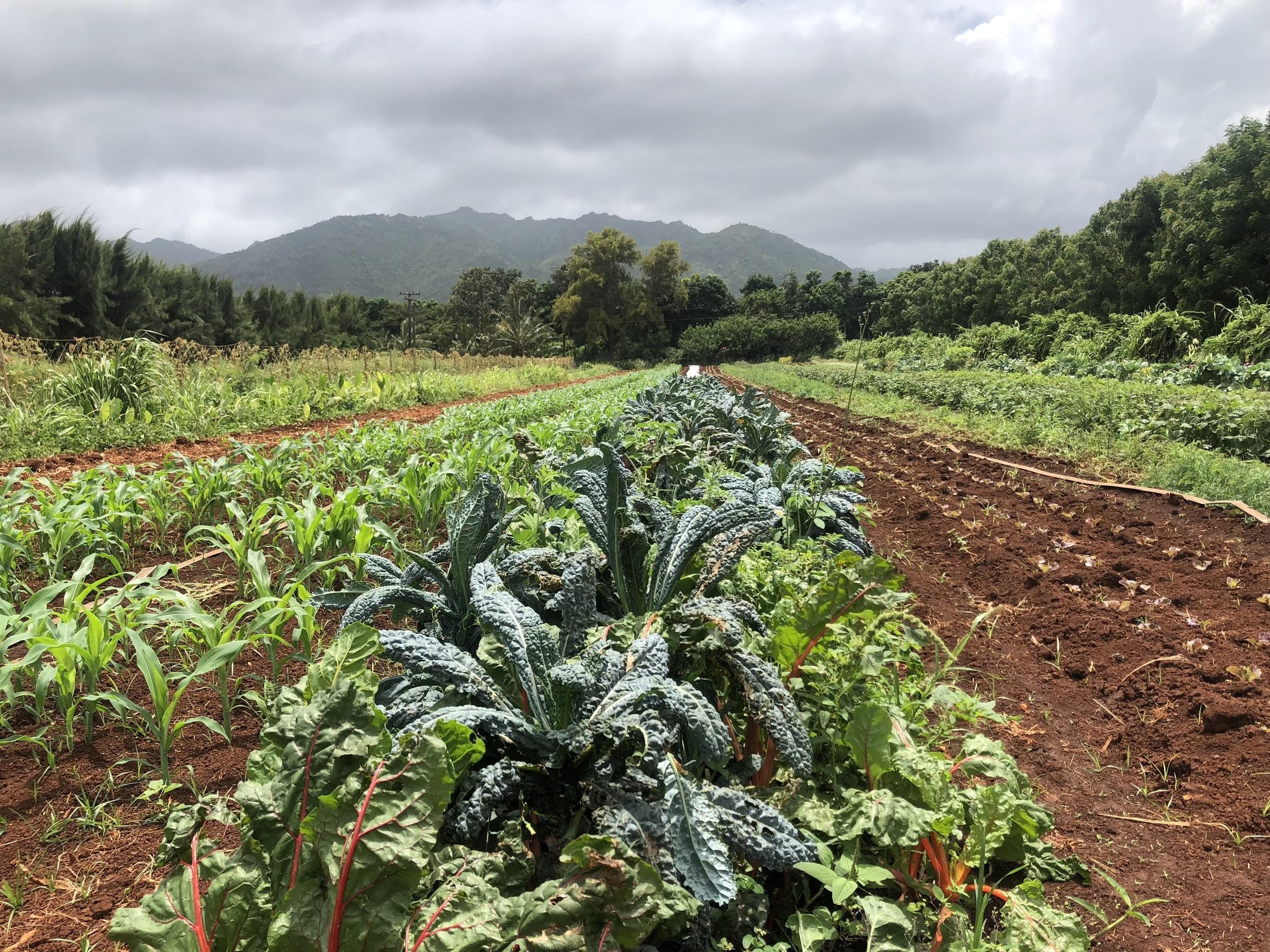
Moloa’a Organica (Photo by Ivan)
Ned and Martha happily shared the story of how they met and how after visiting Hawai’i they fell in love with the beautiful landscape and the decided to leave everything behind and embark in a new journey in Hawai’i to fulfill their dream of farming. They face many difficulties and adversity when they arrived but they were persistent and now their hard work is paying off, Ned and Martha are one of the largest organic growers for the islands of Hawai’i, where unfortunately most of the food is being imported but Ned and Martha are dedicated to make Hawai’i more self sustainable. They were both was very glad to show us around their family’s farm. They eagerly explained to us the process of how they make anaerobic compost which is submerging the food scraps in a covered water barrels and letting them decompose until the liquid is odorless and full of nutrients.
The Whitlocks certainly take great pride and responsibility for the food they grow and the stewardship of the land that is why they use agro ecological methods and they are committed to produce zero waste and provide locals with fresh ecologically responsible food has been their their farm’s mission.
Far back left-right Martha, Ned, Ivan; front left -right Anne and Magha. Volunteers at Waipa Foundation (Photo by Ivan)
August 2nd/Day 7
On Thursday, Magha, Anne and I visited Waipa Foundation. Waipa Foundation, for over 20 years, has worked with the community to manage the 1,600 acre ahupua’a of Waipa, located on the north shore of Kaua’i. Waipa is a place where folks can connect with the ‘aina (that which feeds us – the land and resources), and learn about Hawaiian local values and lifestyle through laulima (many hands working together). Waipa’s long history and commitment to connect people with the ‘aina has made this organization so successful and greatly treasured by the community.
The three of us had the pleasure to make poi alongside the locals and visitors that came from as far away as France and Japan and the United Kingdom. Poi is a Hawaiian dish made from the fermented root of the taro, which has been boiled and pounded to a paste. This dish is believed to have healing properties because of the high content of probiotics. In Hawaiian mythology Poi is sacred and it is believed to have been created as a result of the story of Hāloa that brings us to the beginnings of the Hawaiian people. Wākea, the skyfather, and Ho’ohōkūkalani, descendent of the celestial bodies, fell in love and together had a child. But the baby was stillborn, so the deities buried him on the side of their home – the side of the morning sunrise.
From that very spot where the gods buried their baby boy, a plant began to grow. This plant, whose heart-shaped leaf trembled in the breeze was the first kalo (taro) plant. The kalo plant was given the name “Haloanakalaukapalili” and he was loved.
Native Hawaiians are very protective of their Kalo they each family typically will only grow one variety of Kalo which most has been passed down from generation to generation. Native Hawaiians take pride in their kalo plant because it represent the knowledge that their ancestors have passed down from generation to generation.
August 3rd/ Day 8
For out last day in Kaua’i, Anne took Magha and me to a fish pond restoration project called Mālama Hulē‘ia. This project is run by a voluntary non-profit organization dedicated to improving key parts of the Nawiliwili Bay Watershed on Kaua‘i by eliminating an alien and highly invasive plant species and the reintroduction of native plants. We witnessed first hand the devastation that causes to the environment and the livelihood of natives occurred as a result of the irresponsible actions of corporations and the lack of government enforcement of environmental protections.
We commend this organization for endeavoring in the enormous task. We are very thankful for their commitment to the service of their community by restoring their ancestral way of life.
Conclusion
During our time in Hawai’i, we had the privilege to meet some of the most incredible people who are doing some some terrific work in their communities. Whether their work is through popular education, advocacy, grassroots organizing and civic engagement all those people have been necessary for Hawaii’s victory in banning chlorpyrifos. These people are brave warriors who are the resistance against capitalist agribusiness that prefer profit over people. These corporations are negligent about the negative impact that their bad agricultural practices have in the environment and the farmworkers. In addition to their mismanagement of the land farmworkers too often are not able make ends meet.
We commend Hawaiians for their extensive work and constant dedication to restore Hawai’i’s food sovereignty and ancient agroecological farming after centuries of colonialism. We are thankful for their bravery and we admire them as pioneers in the quest for a better world where farmworkers are treated with dignity not being forcibly exposed to deadly chemicals and poor working conditions; a world where mother earth is treated, honored, and revered, and not coerced to produce food that lacks nutritional value and where most of the food ends up being wasted, instead of going in the bellies of those who need it the most.
The U.S. Food Sovereignty Alliance (USFSA) is delighted to announce the recipients of the 2018 Food Sovereignty Prize. In the domestic category, Black Mesa Water Coalition will be honored for their commitment to restoring indigenous food sovereignty and uplifting youth leaders among Navajo and Hopi communities. Organización Boricuá de Agricultura Ecológica de Puerto Rico, the international honoree, will be recognized particularly for their mobilization of Food Sovereignty Brigades to assist farmers with recovery efforts in the aftermath of Hurricane Maria.
The tenth annual Food Sovereignty Prize Ceremony will take place in the evening of Sunday, October 14, as part of the USFSA’s IV National Membership Assembly in Bellingham, WA (October 12–15). The Assembly, anchored by Community to Community Development (C2C), will be the first national convergence since the Alliance transitioned to a regional structure following the III Assembly in 2015. Coordinators from each geographic area have organized regional assemblies this year – Southeast (April); Northeast (August); Midwest (August); and Northwest (September) – to mobilize members and allies toward the meeting in October. Please register for the IV Assembly, and follow the USFSA’s website and social media for regular updates.
About the 2018 Honorees
Black Mesa Water Coalition
Black Mesa Water Coalition (BMWC) formed as a student-led group in 2001 and has since evolved into an intergenerational, inter-ethnic organization based in Flagstaff, Arizona. BMWC utilizes green economic development and other proactive strategies to address the immediate and long-term needs of Navajo and Hopi communities. The Coalition promotes indigenous food sovereignty as a paradigm rooted in tribal elders’ accumulated knowledge and ways of knowing. They emphasize the importance of songs and ceremonies for remembering ancestral traditions and reversing cultural erosion. As part of its Navajo Restorative Economy Program and Food Sovereignty Project, BMWC directs food production and educational programs on a thirteen-acre community farm. Their dry-land farming strategy avoids the use of groundwater irrigation. Their aim is to adapt to natural landscapes by selectively choosing the production sites and constructing water catchment systems where needed, e.g. berms, canals, and spillways. BMWC has organized communities to declare Black Mesa a GMO-free zone, and the organization has been advocating for Navajo Nation-wide policy change that, according to Just Transition principles, promotes land and watershed restoration. The Coalition participates in the Indigenous Environmental Network as well as Grassroots Global Justice Alliance and Climate Justice Alliance.
Organización Boricuá
Organización Boricuá promotes food sovereignty and climate justice under extremely difficult neocolonial conditions in Puerto Rico, particularly the intensification of disaster capitalism following Hurricane Maria last year. Organización Boricuá has worked for almost three decades to support family farmers and expanding the agroecology movement on the island and abroad. In addition to resisting Monsanto’s presence on the island, Organización Boricuá has mobilized campaigns against the spraying of the Naled insecticide in response to the Zika virus, and through networking with farmers and other advocates of agroecology, they organize monthly work parties in solidarity with peasant communities. Their Food Sovereignty Brigades deserve specific recognition in the context of ongoing recovery efforts. Several USFSA members and partners have supported them following Hurricane Maria, mainly in terms of fundraising, gifting seeds, and sending delegates to engage in solidarity actions. Organización Boricuá is a member of Climate Justice Alliance, MAELA (Movimiento Agroecológico de América Latina y El Caribe), and La Via Campesina.
About the Food Sovereignty Prize
By awarding the Food Sovereignty Prize annually since 2013, the USFSA extends its network and continues to build solidarity with frontline organizations struggling to democratize food systems in the U.S. and abroad. Recipients of the Prize (first awarded in 2009 through the Community Food Security Coalition) demonstrate how another world is possible and that real solutions to social and ecological crises derive from popular power at the grassroots level, from those most impacted by the social costs and environmental impacts of industrial agribusiness. In addition to establishing global linkages, Prize honorees prioritize the leadership of marginalized food providers, including women, indigenous peoples, people of color, migrants, and youth.
The Food Sovereignty Prize presents a counter-narrative to the World Food Prize, an award founded by Norman Borlaug and annually given, since the 1980s, to individuals credited with achievements in improving the availability or quality of food in global market systems. The USFSA opposes the corporate-driven neoliberal ideology that underpins the World Food Prize’s glorification of the Green Revolution, which intensified dependence on genetically-modified seeds, synthetic fertilizers, and other chemical inputs and prompted a global shift to an oil-based economy, caused the loss of ninety percent of the Global South’s biodiversity, and forced the displacement of millions of peasants to urban slums, where they became a reserve army of labor.
While agribusinesses and philanthrocapitalists praise the 2018 World Food Prize winners – Dr. Lawrence Haddad and Dr. David Nabarro – for their efforts to increase national and global dialogue on the topics of maternal and child malnutrition, the USFSA awards this year’s Food Sovereignty Prize in honor of how BMWC and Organización Boricuá defend and scale-up people’s agroecology under the banner of food sovereignty. Utilizing a Just Transition framework, the domestic and international honorees offer viable pathways for ending poverty, hunger, and malnutrition following centuries of imperialism in the Southwest and Caribbean. The USFSA recognizes their work as grounded in ancestral wisdom and a spirit of resistance to domination and oppression. During the Food Sovereignty Prize Ceremony, the Alliance will amplify their struggles toward achieving truly sustainable agricultural and energy systems based on principles of ecological harmony, political-economic autonomy, and social justice.
Announcement written by Tyler Short, Sustainable Agriculture of Louisville