Author: USFSA

  • “Our History” A Background to the U.S. Food Sovereignty Alliance

    The U.S. Food Sovereignty Alliance (USFSA) has released a new publication based on participatory research conducted by Grassroots International intern Alison Kaika, with editing support from Sara Mersha (Grassroots International), Saulo Araujo (WhyHunger), and Stephen Bartlett (Sustainable Agriculture of Louisville). The document synthesizes data collected through interviews with fifteen members involved in the Alliance since formation in 2010.

    “Our History” serves two main purposes. First, USFSA members can utilize the publication as a tool for developing collective memory and shared strategies. New members will particularly benefit from understanding how the coalition changes over time and intersects with global partners as a regional process of the International Planning Committee for Food Sovereignty. Second, the USFSA seeks to increase membership and construct partnerships across socioeconomic sectors. For potential allies unfamiliar to social movements focused on food and agriculture, the results of this research project can function as an introduction to the struggle for food sovereignty in the U.S.

    “Food sovereignty is the right of peoples to healthy and culturally-appropriate food produced through ecologically sound and sustainable methods, and their right to define their own food and agricultural systems.” Declaration of Nyéléni, 2007.

    “Our History” begins by defining food sovereignty and highlighting La Via Campesina for presenting the concept at the World Food Summit (1996) as an alternative to neoliberal policies that strengthen industrial agribusiness and weaken the capacity of rural and urban peoples to defend and uphold basic human rights to the sources of life.

    The food sovereignty agenda solidified in 2007 with the Declaration of Nyéléni, the culmination of the Forum for Food Sovereignty in Sélingué, Mali. Delegates from U.S.-based organizations initiated the U.S. Working Group on the Food Crisis to further the Forum’s momentum. Responding to the skyrocketing of food prices amid the 2007–2008 financial recession, activists around the world presented food sovereignty as a comprehensive set of transformative solutions to root causes of poverty, hunger, and the destruction of rural livelihoods.

    Prior to officially launching in New Orleans on World Food Day, leaders of the Working Group on the Food Crisis produced the USFSA’s guiding documents during the People’s Movement Assembly on Food Sovereignty at the 2010 U.S. Social Forum. Founding members of the Alliance included: Agricultural Missions, Inc.; Community to Community Development; Food First; Food Chain Workers Alliance; Grassroots International; Maryknoll Office for Global Concerns; National Family Farm Coalition; Pesticide Action Network of North America; Presbyterian Hunger Program; and WhyHunger.

    Working groups in the Alliance operate with local rootedness, global connections, and a focus on the cultivation of intersectionality by addressing: immigrant rights and fair trade; resource grabs and land reform; and defense of Mother Earth. Additional teams fulfill tasks related to fundraising, communications, assembly planning, and the Food Sovereignty Prize, an honoring of international and domestic groups that demonstrate application of the food sovereignty principles. Furthermore, USFSA members orchestrate agroecology learning exchanges and establish partnerships with, for example, the Climate Justice Alliance and Closing the Hunger Gap.

    The USFSA has held three national assemblies – Oakland, CA (2011); Tampa Bay, FL (2013); and Des Moines, IA (2015) – for members to build relationships and common tactics through a dialogue of different ways of knowing. Anchored by C2C, the IV Membership Assembly in Bellingham, WA (October 12–15, 2018) will be the first national convergence since the regional restructuring that followed the III Assembly in Iowa. The USFSA’s coordination team transitioned to a model of representation based according to geographic regions – the Southeast; the Northeast; the Midwest; and the West Coast / Pacific Northwest – and reaffirmed their goal to continue fostering the leadership of grassroots organizations, women, and minorities.

    The USFSA’s Youth Process formed in 2018 with the aim of increasing the participation and representation of young adults associated with grassroots and grassroots-support organizations across all regions of the Alliance. The emerging collective holds monthly conference calls in conjunction with political education grounded in readings and group discussion. Co-organizers of the Youth Process plan to facilitate youth-oriented training space during the IV Membership Assembly in Bellingham and coordinate programmatic initiatives following the national gathering.

    For general inquiries or more information about the release of “Our History,” please contact Tyler Short (tylerlaminga (AT) gmail (DOT) com), a member of Sustainable Agriculture of Louisville and the USFSA’s Communications Team.
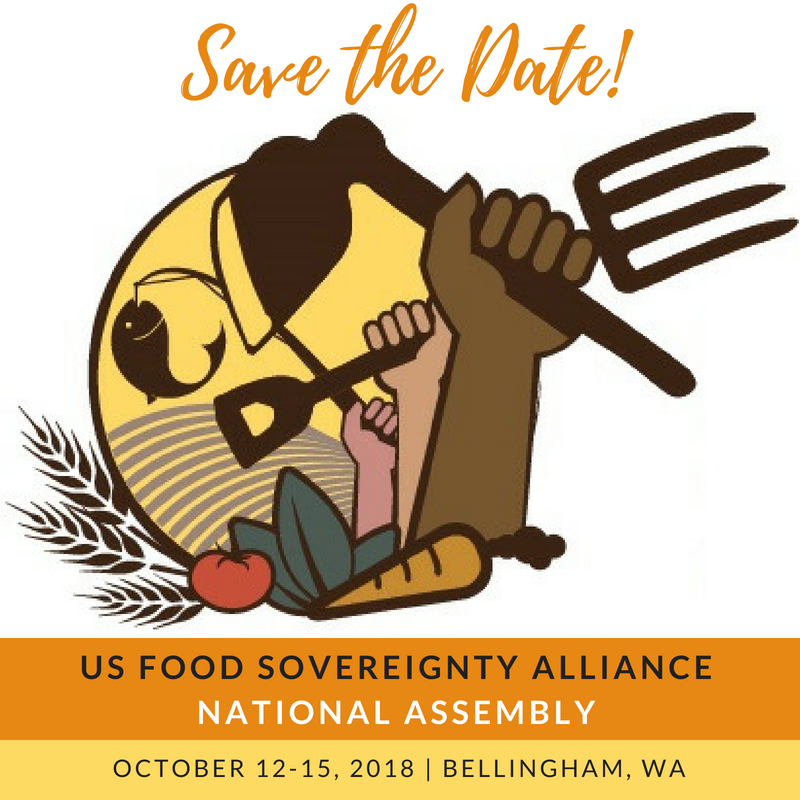
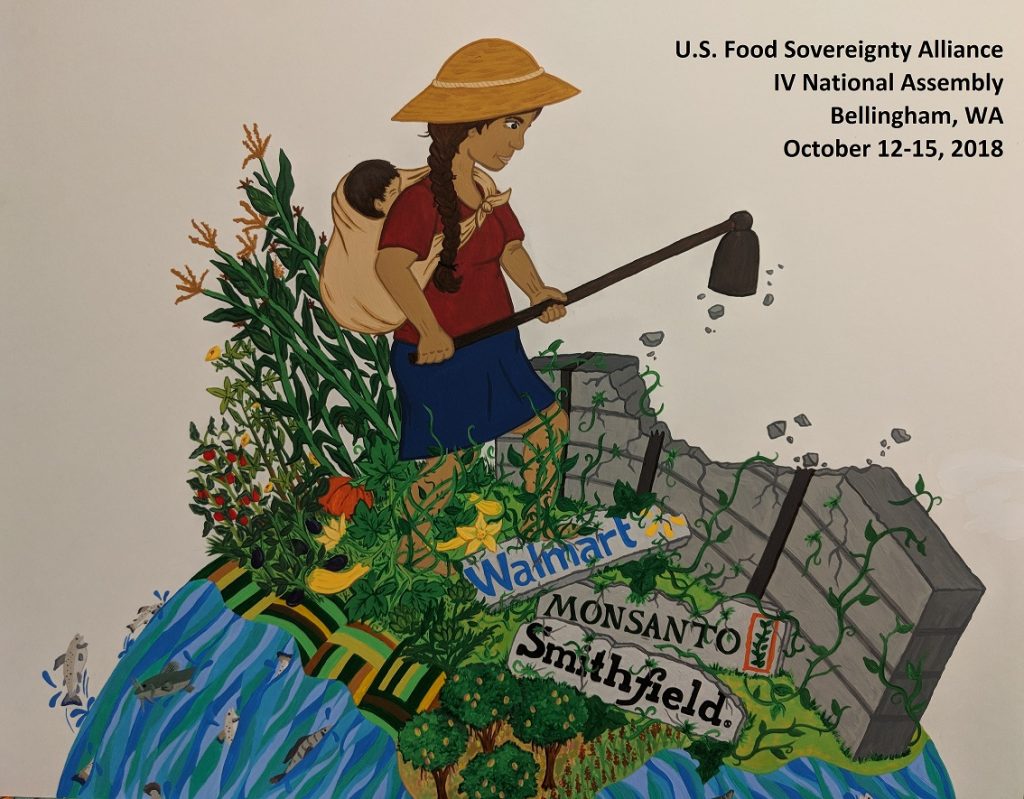
     

  • USFSA organizing its IV National Assembly

    USFSA organizing its IV National Assembly

    Our food is being used as a weapon, and we are living in a political moment that demands coordinated action.

    Currently, we are seeing how political borders are being used to attack workers and families. Whether it’s the more than 500,000 people who were cut from the food stamp program over the last 3 years, the fact that four of the six largest agribusiness corporations have merged, or that farmers across the country are losing their lands while food chain workers are working under exploitative and dangerous conditions, and often fear deportation.

    We must continue to dream of a better world and work to build a new food system. We need a system that respects communities and human rights and nourishes rather than ravages the land. That system is based on food sovereignty, the human right to food, and the rights of Mother Earth.

    On October 12 – 15, 2018, grassroots organizations, activists, faith-based community, scholars, union members, farmers and fisherfolk, and other food chain workers from around the US and the world will converge on Bellingham, WA, for the IV National Assembly of the US Food Sovereignty Alliance (USFSA). The Assembly will provide a space to learn about food sovereignty, share struggles and collective wins, and build solidarity.

    The USFSA has a goal of bringing together as many people as possible in a World Social Forum style gathering that will encompass a range of panels, political education, arts and other cultural exchanges to pave the way for stronger political action in the United States. The space will be an opportunity for mutual learning. Please stay tuned for information on how to submit a proposal for a panel, registration, and more. Together, we’ll deepen relationships across sectors and geographies to build a path for community liberation and reclaim our food system.

    The Assembly will also include the 2018 Food Sovereignty Prize awards ceremony honoring movements in the US and internationally. Lauded as an alternative to the World Food Prize, the Food Sovereignty Prize champions real solutions to hunger and is recognized by social movements, activists and community-based organizations around the world.

    Please save the date and sign up (or follow us on Facebook or Twitter) to get the latest updates on the organizing and registration process. If you are interested in participating in the planning of the Assembly, please email info (at) usfoodsovereigntyalliance (dot) org.

  • Saad Dagher Talks Agroecology

    By Paul Molyneaux, Northwest Atlantic Marine Alliance. Paul is one of the USFSA regional coordinators for the Northeast Region.


    The term “agroecology” grew out of early 20th Century iterations like Girolamo Aziz’s “agriculture ecology” (1956), which were used to describe a more holistic approach to farming that utilized the best of the old an the new, both technically and philosophically.

    “I learned about it from Pierre Rabhi,” says Saad Dagher, who after decades of field work runs an educational farm, The Humanistic Farm-Ma’azouza. “He came to Palestine, and I went to see him. I was in the north of France and his secretary called and said he had a half hour for me. He was in the south of France. I traveled for twelve hours to talk to him for half an hour, but of course it turned into five.”

    It turned into five because Dagher did not go empty handed. He carried with him years of observation and a commitment to what he calls, “the deeper philosophy of agroecology.”

    “It’s a revolutionary philosophy with linkages to food sovereignty,” says Dagher.  to When I first started talking about it twenty years ago, my colleagues, the university trained agronomists attacked me. Now they ask me to come teach.”

    Dagher begins with the soil. “I talk a lot about soil health,” he says. “We have to think differently about the soil. It is much more than a vessel that holds the roots of the plants and supplies minerals.” Dahger has combined the soil building techniques of Jon Jeavons, who promotes ample use of compost, a deep loosening of the soil, and intensive planting to increase soil health and productivity, with traditional Palestinian farming methods.

    “I talk about water,” says Dagher. “We only get fifteen percent of our available water because Israel controls it. But agroecology uses less water because the soil holds it. We use mulch,” he says. “It’s funny when I started talking about mulch some people thought I meant the plastic. No. We get the straw.”

    “I also talk about maintaining biodiversity in the soil and in our seeds. I Palestine we have lost our cucumber, which we could grow without irrigation, the same for our watermelon. We need to get them back.”

    Dagher sees agroecology as a tool for liberation. “All these connect with food sovereignty. Agroecology could be for us what the spinning wheel was for Gandhi,” he says, refferring to Mahatma Gandhi encouraging Indians to spin their own cloth in order to confront the English system of domination.

    At the same time, interest in Agroecology is growing exponentially, and Dagher is concerned than in popularizing the concept organizations like the United Nations Food and Agriculture Organization (FAO) will lose touch with the philosophy that he believes defines agroecology.

    To reach an understanding of that philosophy, Dagher includes the history of agroecology. He talks about how Palestinian people practiced agroecology before the word existed. “We used to grow olives and figs and grapes together,” he says. “And we planted wheat in between. Then we would have a meal in winter of wheat and olive oil that we would scoop up with dried figs. In winter we ate that.” He goes on to give other examples of companion planting. “We would plant basil among the tomatoes, peppers and eggplants. It would improve the flavor of these and mask their scent so that insects would get confused and not find them.”

    “I am writing a book,” he says. “Agroecology the Palestian Way.” Dagher believes that capturing the essentials of agroecology in books, articles and other media will help keep the movement on its true path. “If we write it down, talk about what it is, we can keep it from being corrupted,” Dagher says. “We can keep it connected to its deeper philosophy, which I can talk a lot about, but in one word, it is Freedom.” Dagher has adopted an image of an open hand as the symbol for agroecology with each digit representing the movement’s vital aspects. “First you have the thumb, which represents the people who practice agroecology,” he says. “Then you have knowledge, which is free. And then you have rainwater, which is free. And then the sunlight, which is free, and finally the hay and straw that grows freely, and which we need for mulch.”

  • USFSA organizes three Regional Assemblies

    The US Food Sovereignty Alliance is organizing four regional assemblies in preparation to its IV National Assembly that will be held in Bellingham, WA from October 12-15. To Pre-register for the National Assembly, click here.

    The dates for the regional assemblies are:

    Southeast Region: April 8th

    Northeast Region: August 9th-10th

    Mid-West Region: August 24th thru 26th

    If you are a USFSA member, ally organization or if your community/collective are interested in participating, please contact the regional coordinators for your region.

    Southeast Region:

    Ivan Vazquez, Farmworker Association of Florida – ivanvazkez90fl (at) gmail

    Northeast Region:

    Kathia Ramirez, Farmworker Support Center – kramirez (at) cata-farmworkers (dot) org

    Paul Molyneux, Northwest Atlantic Marine Alliance – moly213 (at) gmail (dot) com

    Mid-West Region:

    Stephen Bartlett, Sustainable Agriculture Louisville – estebanbartlett (at) gmail

    John Peck, Family Farm Defenders – familyfarmdefenders (at) yahoo