Author: USFSA

  • Farmworkers Resist and Organize: Connected Struggles for Farmworker Justice in South Africa and the US

    By Edgar Franks, Organizer with Community to Community Development in Bellingham, WA

    Second in the South Africa-US Agroecology Exchange Article Series
    image


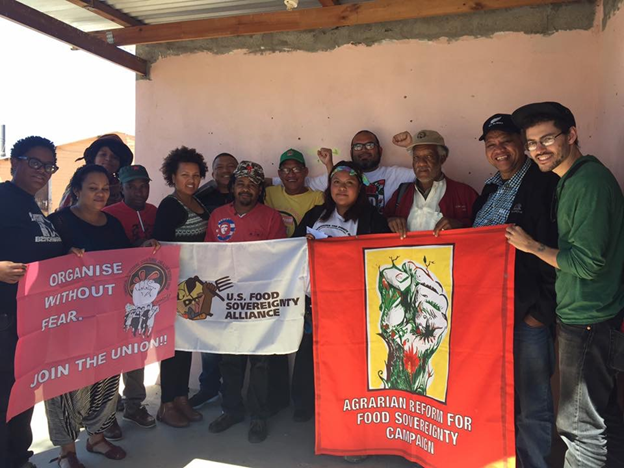
    This past October I was part of the delegation sent by the US Food Sovereignty Alliance to South Africa. The delegation is part of a process to connect with groups throughout Africa with US-based Food Sovereignty groups to build an international analysis on the food system and to be in solidarity with one another.
    During the 11 days our delegation was in South Africa, we were able to meet with many organizations throughout different regions, each with their unique struggles. Our delegation was small but represented many different sectors within the food system, including farmworkers, Black farmers, and immigrants; we all brought our own area or expertise to the trip and complimented each other well.
    Even though every place we visited we learned a lot and were impacted by the amount of work and organizing that was happening, I want to share about the exchange that we had with the farmworkers in Robertson in the Western Cape.
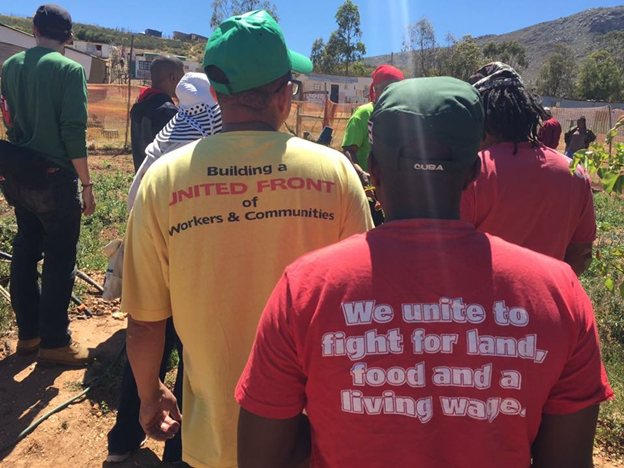
    image-2

    Personally, I was able to connect to the farmworker struggle in the Western Cape, as there was a familiarity with the way issues and conditions were discussed. The analysis that was shared resonated with me profoundly considering that farmworkers here in the United States are also going through the same exploitation.

    At Community to Community in Washington, we try to recognize that the struggle for farmworker justice is not limited to the workplace. Farmworkers’ lives are complex and have many intersections which is why we know that in order to achieve our goals – especially when it comes to transforming the food system – that we must go beyond just fighting for union contracts. Food Sovereignty for farmworkers also means being recognized as humans who are capable of leading ourselves. That is why we also organize for immigrant rights, climate justice, women’s rights, and food sovereignty.

    In South Africa, farm workers are some of the most marginalized. Conditions in their workplace or community have not changed much. Even as South Africa has transitioned from the apartheid government that had ruled since the late 1940s into a Black led government headed by the African National Congress, economic justice has not reached the farm workers. Even though there are thousands of farmworkers, less than 4% are unionized. Workers face precarious conditions having to deal with labor brokers, abusive supervisors, physical violence, and sexual harassment. These conditions reached a boiling point in 2012 when thousands of workers organized a strike but were then repressed by the police.
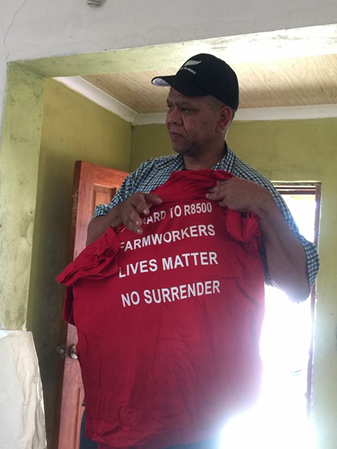
    image-3It is under these conditions that The Commercial, Stevedoring, Agricultural and Allied Workers Union (CSAAWU) which has been on the frontlines for over 10 years has had to organize. When the transfer of power occurred, there was an expectation that workers would benefit under a new government that was black led. Instead, only a certain few benefitted. Whereas in the past, farmworkers were hopeful that with the abolition of apartheid, that the government would be able to improve conditions, the condition under this new government remain the same. CSAAWU recognized that organizing with farmworkers needed to be deeper than just organizing in the workplace; they also have to organize in the community to respond to the numerous social inequalities that exist in the lives of farmworkers. The Union also organizes with immigrant workers who come from primarily Mozambique and Zimbabwe and face similar treatment as immigrants here in the United States such as wage theft and human trafficking by labor brokers.

    CSAAWU partners with Mawubuye, which is a land rights movement. Recognizing that the path for freedom from exploitation is for farmworkers to have their own land and not have to sell their labor for exploitative wages. There was a period of hope under the new government in 1994 when there were talks to redistribute formerly white owned lands back to black people. The goal was that by 2018 to have 30% of land that was owned by whites to be redistributed back to black people, but currently only 5% of land has been redistributed.

    Out of the 2012 farmworker strike there was a list of 23 demands which came out of a series of dialogues. Among the principal concerns is receiving a just wage. The farmworkers are asking for no less than 250 Rand for an 8-hour work day, which is almost equivalent to $16 in the US. Many of the workers are picking oranges for corporations like Dole, and in grape vineyards for wines that are for export to Europe and in some part of the United States. Hardly any of the fruits or vegetables picked are for local markets.
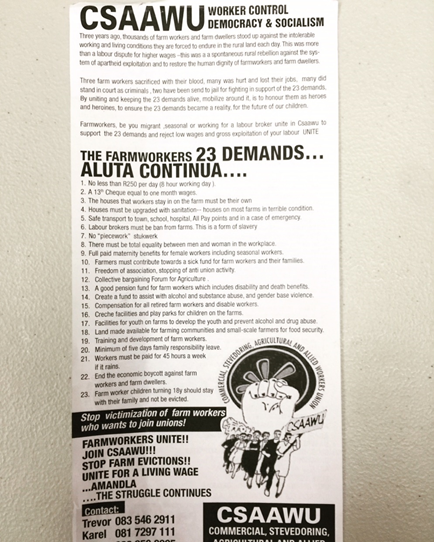
    image-4The issue of class was raised as well. From what I gathered from our conversations, in the past when the apartheid government was ruling, farmworkers felt that it was the racist government that was oppressing them. The “Boers” (White Farmers) were protected by the state and anytime workers threatened to organize or strike, they were immediately broken and arrested by the police. When Nelson Mandela became president of South Africa farmworkers felt that they were finally going to get justice. However instead of seeing their conditions improve, the farmworkers saw only the creation of a black and colored middle class that was not too interested in making sure that workers had economic gains. If anything, the black middle class drove a wedge at true solidarity between poor people and the new black leadership. In essence, the middle class was functioning to protect white supremacy by keeping the farmworkers down.

    Looking at the list of demands, they are almost exactly the same to the demands of US based farmworkers. Seeing the demands and hearing the stories clearly pointed to how systemic racism and poverty are built in to the agricultural industry. Workers in South Africa and in the US are facing a similar system of oppression. Whether it is getting paid by piece rate or not having kids in the fields, these are the same issues you see at any farm around the world. It is going to take a global farmworkers movement to transform the system and shift it away from the exploitative one that exists right now, to one that is humane and just. Food Sovereignty means that workers get to determine their conditions at work and in their community and that you can’t only have justice at the workplace, that you must also have justice in your community.

  • Restoring my Indigeneity: Reflections on South Africa Agroecology Exchange by a Queer Black Urban Farmer

    Article by Dean Jackson
    First in the South Africa-US Agroecology Exchange Article Series
    Dean Jackson is Executive Director of Hilltop Urban Gardens in Tacoma, Washington

    In October I was honored to join seven other delegates on a US-South Africa Agroecology and Food Sovereignty Learning Exchange. As a Black queer and non-binary person who is working to remember and restore my Indigeneity through the work I do in community and at Hilltop Urban Gardens, this trip held both personal and organizational meaning for me. My ancestors were forcibly removed from their homelands. The intergenerational trauma from that displacement and subsequent horrors and enslavement, Jim Crow Laws, sharecropping, and into modern day anti-Blackness, modern day displacement through gentrification and the ongoing fight against white supremacy and white nationalism stay in my consciousness as I work to live my life for liberation and freedom. In 2017 I also committed to find Black joy and healing justice practices. This was my first trip to Africa and off the North American continent, and Hilltop Urban Garden’s first opportunity to connect with other food sovereignty and agroecology farmers internationally. I brought this all with me as I left Seattle-Tacoma International airport with my friend Xolotl Edgar Franks from Community to Community Development. I also brought the intention of coming open and ready to be filled with all that our South African comrades had to share with us.

    Our first visit was to Sibhale Community Food Project in Soweto. SCFP grows food that is used for meals at the health clinics and shared with some of the families that visit the clinic. We met with the Project Coordinator, Calvin Moloto Makgaila. Calvin also helps people grow food at their homes and teaches children about the importance of nutrition. Since HUG does similar work in our community, I felt a special connection to Calvin’s work with SCFP. He’s an awesome agroecologist! We are staying connected through social media and I expect that we will nurture and grow our relationship in the coming years. Hilltop Urban Gardens holds an annual Beloved Community – Food Sovereignty Day of Action in our neighborhood in honor of Dr. Martin Luther King Jr’s vision of radical transformation. This year we will be raising some cash for SCFP.

    Sibahle Community Food Project – Calvin Moloto Makgaila


    Untitled

    That same day we visited the Greenhouse Project in downtown Johannesburg. One of the things I learned is that after apartheid supposedly legally ended, and Black* people started moving into the cities, there was massive white flight from the city center of Johannesburg. (Sound familiar?) There are now many areas where white folks still own buildings, but have disinvested financially. Because economic apartheid still continues, these largely all Black areas are in a great struggle. (Sound familiar?) Forty percent of the country is unemployed. I also learned that much like the United States, the best land was given to white settlers and Indigenous communities were forcibly removed to the poorest lands in the country.

    I don’t claim that in 11 days I understand much. I got brief snapshots. My goal is to share what I learned and witnessed and, in some cases, give my analysis. I was surprised at the many similarities between post-civil rights era US and post-apartheid era South Africa. There’s much more to learn, process, and share.

    *I’m using Black like we do in the US. It includes Black/African and Colored people which are the racial designations in South Africa.


  • MEDIA ADVISORY: Launch of Article Series on South Africa-US Agroecology Exchange


    Media Contact: Simone Adler, Organizing Director, Community Alliance for Global Justice | simone@cagj.org | 215-873-4672

    International Agroecology Exchange – Reflections from the US Delegation to South Africa

    Article Series November 2017 through January 2018


    2017 South Africa-US Agroecology Exchange

    In October 2017, seven delegates from the US representing farmworker and African-American farmer organizations participated in the second South Africa-US Agroecology Exchange. For 10 days, the delegates visited the provinces of Gauteng, Limpopo, and the Western Cape to meet with small farmers, farmworkers, Agroecologists, and organizers in the Food Sovereignty movement. Together they learned and exchanged social, political, and technical aspects of Agroecology. The 2017 Agroecology Exchange was co-organized by US Food Sovereignty Alliance members WhyHunger (NY), Community Alliance for Global Justice (WA), and Farmworker Association of Florida, and South Africa-based Surplus Peoples Project. (Please read this press release for more background and see photos from the Exchange.)

    Article Series

    Starting in November and ending in January, members of the delegation will author a series of articles reflecting on different aspects of the Exchange. They will share how their trip to South Africa shaped new ideas, tactics, connections, and other means of continued engagement in the global Food Sovereignty movement, and how they’re bringing these insights to their local organizing.

    The series will also include perspectives on Agroecology in South Africa after learning from on-the-ground practitioners involved in organizations including Surplus Peoples Project, Mopani Farmers Association, African Centre for Biodiversity, Ithemba Farmers Association, the Commercial, Stevedoring, Agricultural and Allied Workers Union, Mawubuye, Trust for Community Organization and Education, Rural Legal Centre, and others.

    Article Series Calendar

    All articles will be published on the US Food Sovereignty Alliance website (www.usfoodsovereigntyalliance.org) on the following Wednesdays:

    1. November 29: Dean Jackson, Hilltop Urban Gardens (Tacoma, WA)
    2. December 6: Edgar Franks, Community to Community Development (Bellingham, WA)
    3. December 13: Alsie Parks, Southeastern African American Farmers Organic Network (New Orleans, LA)
    4. January 3: Shalon Jones & Ben Burkett, of Mississippi Association of Cooperatives (Mississippi)
    5. January 10: Kathia Ramirez, The Farmworker Support Committee (New Jersey)
    6. January 17: Justina Ramirez, Farmworker Association of Florida

    Please help distribute these necessary analyses on the importance of Agroecological Farming!

    Agroecology is an agricultural method based on the traditional knowledge of those who cultivate the land. Its practice is critical to addressing hunger, cooling the planet, and increasing communities’ access to basic resources such as land, water and seeds. The increased corporatization of agriculture in Africa and the US sidelines small-and-medium sized family farmers in service to increased profits for agribusiness. The South Africa-US Agroecology Exchanges exists to directly confront this trend and to exchange experiences, tools, and strategies for resistance and to strengthen the Food Sovereignty movement.

    ###

  • Agroecology Community Leaders Travel to South Africa for Learning Exchange

    Agroecology Community Leaders Travel to South Africa for Learning Exchange

    FOR IMMEDIATE RELEASE

    Media Contacts:
    Simone Adler, Organizing Director, Community Alliance for Global Justice |simone@cagj.org | 215-873-4672
    Corbin Laedlein, Global Linkages Program Coordinator, WhyHunger |corbin@whyhunger.org+27 064 738 4703 (South Africa)

    Agroecology Community Leaders Travel to South Africa for Learning Exchange

    SEATTLE, WA October 10, 2017 – Today a delegation of seven African American, Latinx, and Mexican farmers and farmworkers from the US arrive in Johannesburg, South Africa to participate in the second South Africa-US Agroecology Exchange. For 10 days, the delegates will travel around urban and rural South Africa to meet with small farmers, farmworkers, Agroecologists, and organizers in the Food Sovereignty movement to learn and exchange social, political, and technical aspects of Agroecology.

    Agroecology is an agricultural method based on the traditional knowledge of those who cultivate the land. Its practice is critical to addressing hunger, cooling the planet, and increasing communities’ access to basic resources such as land, water and seeds. The purpose of the Agroecology Exchanges is to build transnational ties among Agroecologists and grassroots organizations in order to strengthen the global food sovereignty movement. In addition to exchanging Agroecological practices, participants will engage in political education through collective analysis of major agricultural issues facing the US and South Africa and refine strategies to stop the growth and influence of international agribusiness, land loss, and land dispossession.

    The 2017 Agroecology Exchange was co-organized by US Food Sovereignty Alliance members WhyHunger (NY), Community Alliance for Global Justice (WA), and Farmworker Association of Florida, and South Africa-based Surplus Peoples Project. The idea arose from the 2014 Africa-US Food Sovereignty Strategy Summit in Seattle which brought together African and US-based family farmer and community-based organizations and international networks to deepen solidarity and shared analysis of current public and private interventions in African agriculture, most notably by the Bill and Melinda Gates Foundation.  The first Exchange in 2015 brought two South Africans to the US, where they shared experiences with urban farmers in NYC and Detroit, visited farms in Iowa and California, met African immigrant farmers and Indigenous Mexican farmworkers in Washington, and participated in the Black Urban Growers Conference and the US Food Sovereignty Alliance National Assembly.  They returned to South Africa re-invigorated and supported in new ways through the transnational alliances that were formed.

    The 2017 delegation represents a range of experiences in Agroecology and small-scale urban and rural farming, community organizing, and leading movements at the intersections of Racial, Climate, and Food Justice. Participating are Ben Burkett and Shalon Jones of Mississippi Association of Cooperatives, Justina Ramirez of Farmworker Association of Florida, Alsie Parks of Southeastern African American Farmers Organic Network, Kathia Ramirez of New Jersey-based The Farmworker Support Committee, Edgar Franks of Community to Community Development in Bellingham, Washington, and Dean Jackson of Hilltop Urban Gardens in Tacoma, Washington. Corbin Laedlein of WhyHunger is joining as technical support and a lead organizer of the Exchange.

    The delegation will visit Johannesburg, Limpopo, Capetown, Citrusdale, Roberston, and rural areas, with host organizations: Surplus Peoples Project, Mopani Farmers Association, African Centre for Biodiversity, Ithemba Farmers Association, Mawubuye Woman’s Groups, Trust for Community Organization and Education, Rural Legal Centre, and others.

    The exchange is taking place in the context of increased corporatization of agriculture in Africa and the US. The biotech industry, the Gates Foundation, and World Bank have aligned with governments to advance profit-driven agendas favoring corporate agribusiness over small-and-medium sized family farmers. With the threat of the six largest agribusiness corporations merging (Monsanto, Syngenta and others), it is especially important to share experiences, tools, and strategies for resistance and Food Sovereignty.  Follow the US Food Sovereignty Alliance on Facebook (@USFoodSovAlliance) and at usfoodsovereigntyalliance.org for updates.

    ###