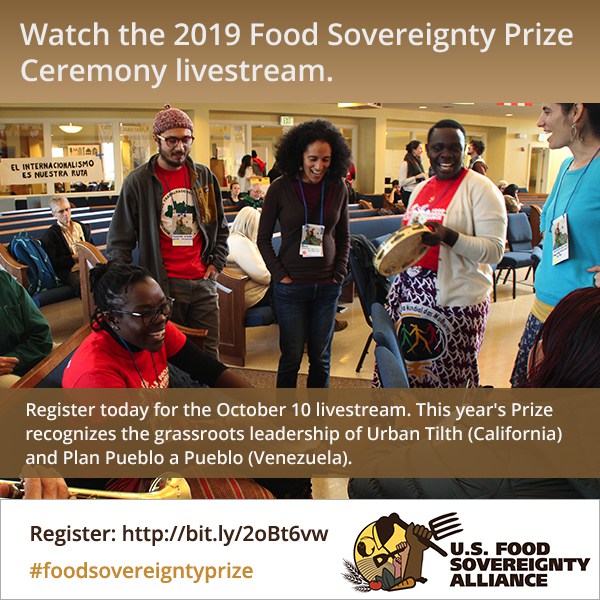
The 2019 Food Sovereignty Prize (FSP) Ceremony will occur on October 10 as part of the USFSA’s Midwest region’s membership assembly in Ferguson, Missouri. This year’s awardees,Urban Tilth (Richmond, CA) and Plan Pueblo a Pueblo (Venezuela), demonstrate the values and principles of food sovereignty through visionary, collective action to transform food production and distribution systems.
The narrative strategy collective of the USFSA aims to raise awareness and center our food sovereignty discourse around the critical perspectives and oppositional actions of our communities’ struggles against the extractive economy and false solutions promoted by corporations which claim to be raising people out of poverty, feeding the world, and addressing the global climate crisis. Aligned with the USFSA’s commitment to prioritize the leadership of grassroots member organizations, our communications collective intends to focus on the real, community-led solutions for a Just Transition toward a regenerative economy. We recognize that grassroots organizers – not corporations – are best positioned to know and eliminate social and environmental problems, and we affirm our belief that those most affected by poverty, hunger, and ecological collapse have the rights to self-determine their future, to tell their stories along the way, and fully participate in policy processes from the local to global levels.
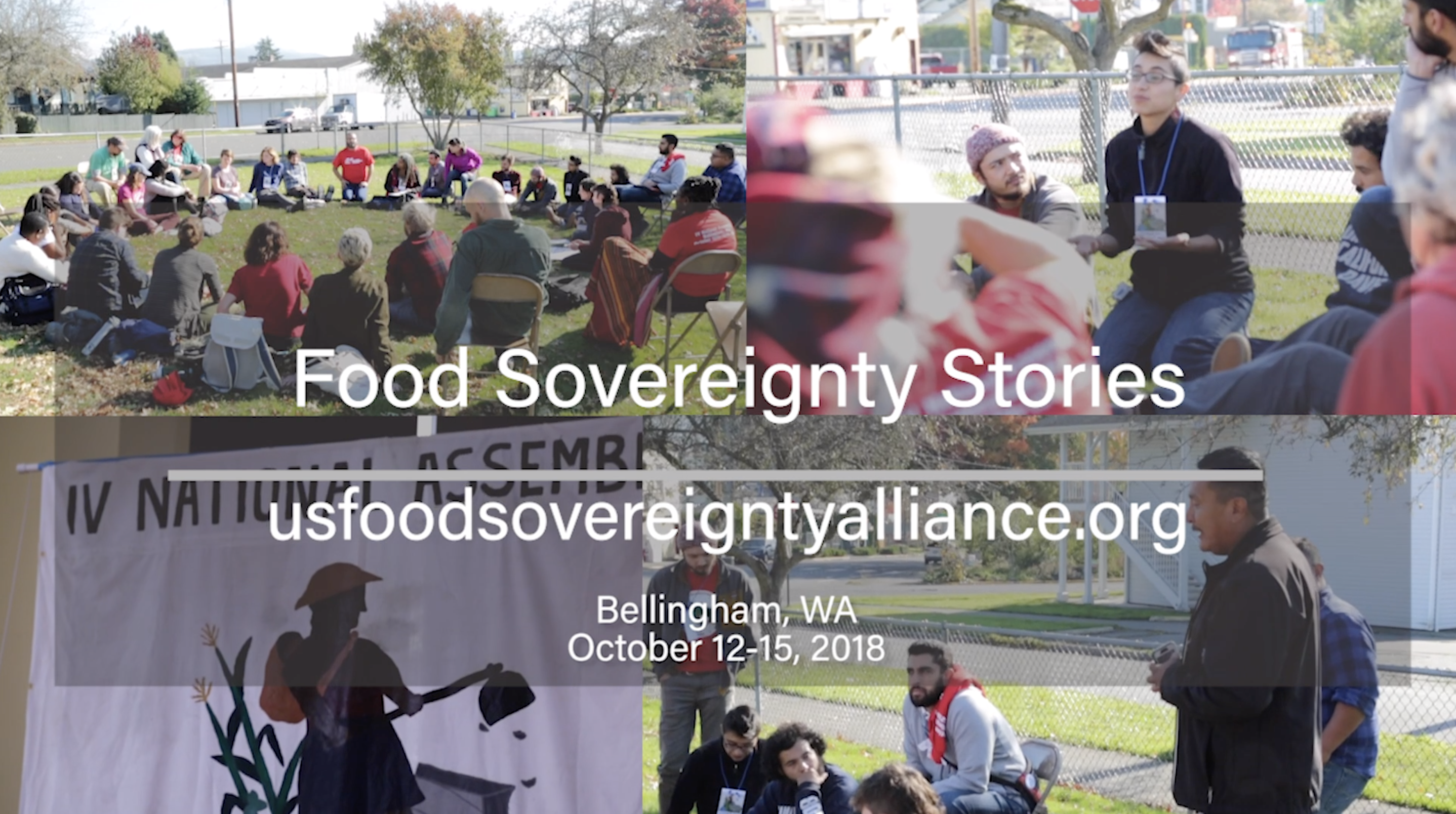
This blog post republishes an online newsletter sent by Urban Tilth at the end of August 2019, in which they overview their work and extensively define food sovereignty. We encourage you to additionally read the 2019 FSP announcement and view the fourth Food Sovereignty Stories film that featured Urban Tilth’s Executive Director, Doria Robinson.
Urban Tilth opened their August newsletter by expressing gratitude to the USFSA for honoring the organization with the 2019 Food Sovereignty Prize in recognition of their efforts to build a more sustainable, healthy, and just food system in Richmond and elsewhere. They continued by writing:
What is Food Sovereignty?
Food is part of the lives of every living being on Earth. It sustains us, nurtures or harms us. Food defines our cultures, shapes our identities. It can be a powerful catalyst for transforming our relationships to one another and to the planet. For Urban Tilth, access to healthy food also means that what we eat comes from whole ecosystems, from healthy soils, healthy water and healthy air, from the love of the earth, and from the precious life energy of people that grow it, distribute it and prepare it for our plates.
For Urban Tilth Food Sovereignty is having control over what goes into our bodies starting from the soil, water and air. Food Sovereignty means having the right to demand that the soil that grew our food was not stripped of life, then soaked in chemicals that drained to the rivers and bays killing the fish; that the air was not polluted with greenhouse gases by the machines that moved food thousands of miles across the globe so that we can have summer produce in winter.
Food Sovereignty means being able to determine that the food that sustains our lives will be produced without destroying the Earth we depend on, by people who will be treated with dignity, paid a fair wage for their labor or fair price for their produce and will not be poisoned in the process.
Food Sovereignty also means that even if you are poor, or even if you live in a city, you have the right to this kind of healthy, righteous food; that you do not have to be quiet and take whatever food-like-products end up in your corner store, or big box grocery – that is most likely also destroying your local economy, while barely employing people at a living wage.
Food Sovereignty means that we have the right, even as Landless peoples, to have a relationship with the land we come from; that we have the right to belong to a place; the right to admit interdependence; the right to be in relationship with land; the right to care deeply and the duty to protect the people, land, water and air that nurtures us.
Since Urban Tilth was founded in 2005, our goal has been to transform the food system, especially how the current system impacts low income communities of color in Richmond and San Pablo, California. We are committed to intentionally hiring and training local residents, especially (but not exclusively) youth who struggle with food insecurity, housing insecurity, the criminal justice system, unemployment, and poor access to quality education, to lead in this transformative work. We believe we must liberate ourselves, no one can come into our community and do this kind of work for us. With home grown experts leading in every Urban Tilth initiative, we work together with our partners, allies and neighbors using many different strategies to create a healthy, just and sustainable food system, within a healthier and more self-sufficient community.”
Our Work
“Over the past 14 years, we have transformed blighted public lands and grown healthy soil, healthy food and healthier people through our 7 School and Community Gardens and Farms. We have played a leadership role in the revitalization of the Richmond Greenway, by creating Greenway Community Gardens and the Edible Forest and helping to create and maintain the Unity Park project.
We also steward the beloved 1st Street Sol Community Garden in North Richmond and the productive AdamsCrest Farm in Richmond Heights.
Our most exciting project so far is the North Richmond Farm. We are transforming a neglected, publicly-owned property into a vibrant urban farm, Agricultural Park and Watershed Learning Center! The Future Farm will be a working urban farm with a greenhouse, shadehouse, hoop houses, a permanent farm stand where North Richmond residents can access fresh produce every day, a wash and pack facility, a community commercial kitchen, cooperative cafe, outdoor classrooms, amphitheater and meeting spaces. The farm is already slowly becoming a place for the community to come together to celebrate, learn and, of course, grow and eat healthy food. At The Farm Today, we host community build volunteer days, educational exchanges, organize community events, grow crops, build the soil, and pack our CSA boxes with love.
Along with the work happening at our five community gardens and urban farms we also serve over 400 students from West Contra Costa School District by conducting educational programs and managing learning gardens at the Verde Elementary Partnership Garden, Richmond High School Urban Agriculture Academy, as well as host 40 youth each summer in our Summer Youth Apprentice Program, a 6 week intensive urban agriculture employment and training program that has run for the past 10 years.
This year we are starting two new after-school programs at Richmond High School: The Healing Movement and The Urban Watershed and Naturalists Club.
Five years ago with inspiration from Brock Dolman at the Water Institute at Occidental Arts and Ecology Center we designed and launched our The Basins of Relations Watershed Restoration Technician Training Program where we train and employ young people from West Contra Costa County to become stewards of their watersheds, communities, and the creeks that run through them.
We are also leading the Wildcat Visioning Project, a campaign to create awareness about the need to improve the North Richmond Wildcat Creek trail to help reconnect the people who live in North Richmond with this vital waterway.
Our Farm to Table CSA program, awarded Best of the East Bay in 2018, currently serves 168 members. It is supplied by Urban Tilth farms and local small, family and urban farms such as First Generation Farmers and Frog Hollow Farm.
Our CSA provides chemical and pesticide free nutritious produce to low income families, seniors, disabled people, artists, and those reentering the community from incarceration through community subsidized memberships. Our aim is to use this project as an organizing strategy to begin forming a San Francisco Bay Area small farmers distribution cooperative.
We also provide our produce through Free Farm Stands and Pop-up Farm Stands. Our next step will be a Farmer’s Market at Unity Park.
At Urban Tilth we are proud of what we have accomplished so far. We appreciate our founder, Park Guthrie, our amazing staff and boards past and present, our allies (Movement Generation, Occidental Arts and Ecology Center, Supervisor John Gioia, the North Richmond MAC, Rich City Rides, Spiral Gardens, Cooperation Richmond, the Our Power Richmond Coalition, the Climate Justice Alliance, Community to Community, APEN, Annie’s Annuals, all our family in Kentucky, Alaska and Buffalo, CASFA, UC Extension, Noll and Tam, Kanchan, Josh, Sarick, Katie and Adele Ho and so many others), all our donors who understand the importance of funding the grassroots people directly so they can uplift their own communities and our many, many, many community volunteers, who make the continuation of our work possible. This honor is your honor and would not have been possible without your courageous and visionary hard work and loving support.
With immense love and gratitude,
Urban Tilth