Author: USFSA

  • World March for Women: Linking Struggles from Across the Globe

    World March for Women: Linking Struggles from Across the Globe

    Sophie Ogutu is a feminist human rights activist who works with the Kenyan chapter of the World March of Women, an international feminist movement fighting to eradicate the causes of gender violence and poverty. 

    The World March of Women also embraces food sovereignty as a fundamental human right, with a particular focus on women.

    Women not only disproportionately bear the burden of hunger, they also at the foundation of the world’s food system. In sub-Saharan Africa, women produce up to 80 percent of all food, according to the UN Food and Agricultural Organization. At a global level, women produce more than half of all food grown.

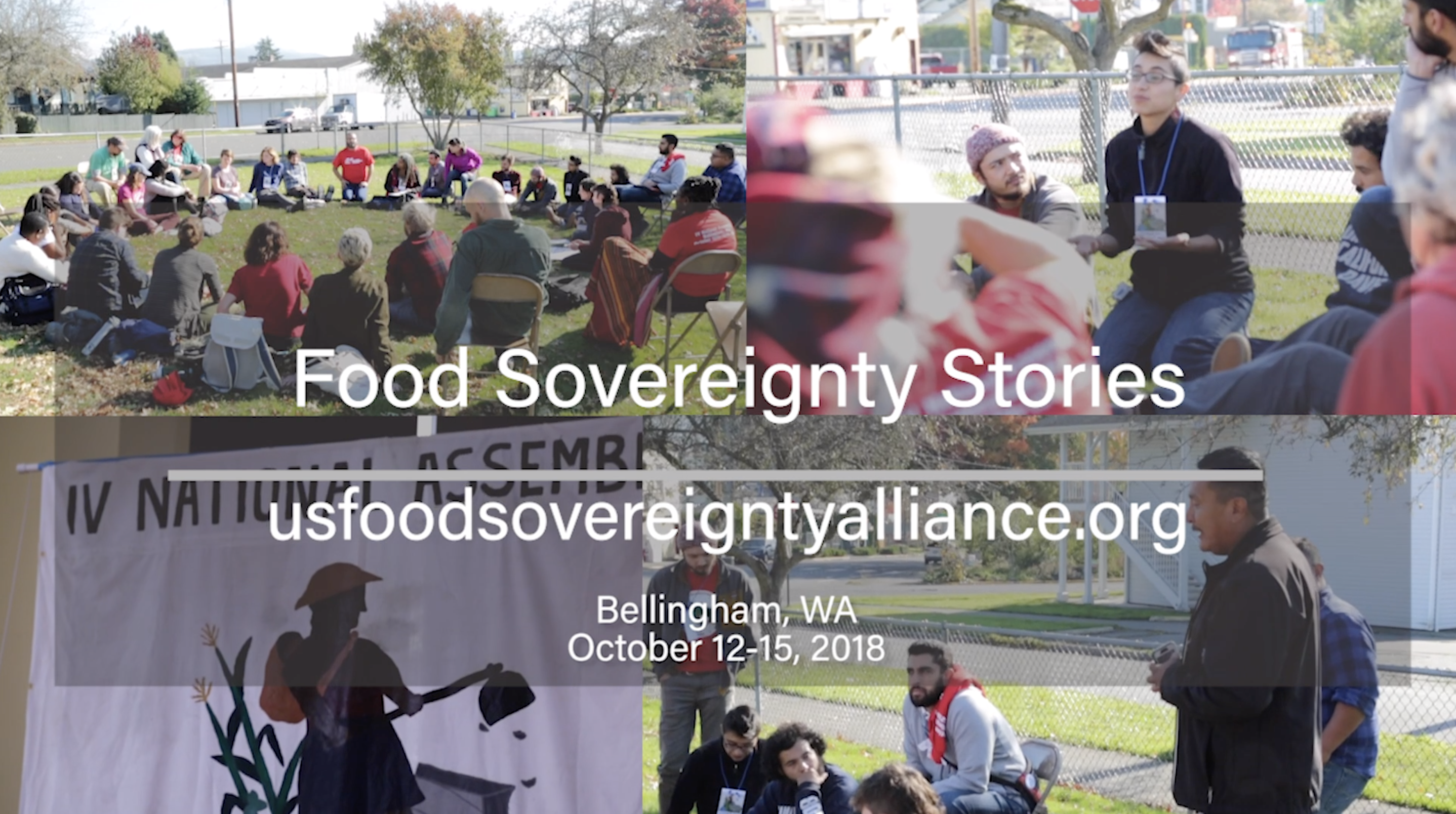
    For Sophie, linking up struggles across the globe is a powerful part of her work. “I think it is very important that we were part of this because we were able to look at how our comrades from other parts of the world are dealing with their struggles and are making change,” she said during the US Food Sovereignty Alliance Assembly in Bellingham, Washington, in October 2018, which she attended with another activists from the World March of Women Kenya.

    “It’s a platform of strategy, it’s a platform of building our synergies. It’s a platform where we know that when we bring our minds together, we are facing a global struggle right now that we are all in,” she added.

    Sophie shared that she was struck by the stories she heard at the assembly of so many local communities facing food security challenges. “Coming here in the USA and seeing a lot of people also hungry in a very fast-growing economy country breaks my heart, but it also gives me a lot of hope when I see so many people to discuss and address those issues,” she said. “Without hope we have nothing.”

    She stressed that the alternatives that movements like the USFSA and the World March of Women strive to build are global in nature, calling for joining forces across borders. “We cannot do it in solitude,” she said. “For us, being here really strengthens and helps us to build this together.”

    Food Sovereignty Stories is a video series exploring what food sovereignty can look like for diverse social movements across the United States. Share this video and follow USFSA for updates! 

  • Fighting for a Democratic Food System: From South to North

    Fighting for a Democratic Food System: From South to North

    A democratic food system: That’s how Joan Brady defines food sovereignty in action. Joan is a food producer in southern Ontario and is a member of the National Farmers Union of Canada and North America regional coordinator of La Via Campesina, the international social movement organization that popularized the term food sovereignty.

    “Not only am I a farmer-producer,” Joan said during the US Food Sovereignty Alliance Assembly in Bellingham, Washington, in October 2018, “I am a leader within my community to build the alternative food system—one that recognizes and values the work that farmers do, that recognizes and values that citizens can choose what to eat and that they should be part of the decision making process.”

    During the Assembly, Joan spoke passionately about her experiences as a hog farmer in Canada, and how it has informed her work to cultivate food sovereignty at home and internationally. She described a difficult environment that saw family hog farmers unable to make a living wage and turning to food banks as they felt cornered in the business. When she no longer saw a future in hog farming, Joan made the difficult decision to leave the industry and start over in 2006. She continues to produce food in a market-garden.

    Joan connects the systemic challenges she faced while being forced out of the hog industry to the global agribusiness model that impacts small farmers and peasants around the world. This also informs her activism, which focuses on linking up struggles to advance food sovereignty as a alternative.

    “I am very much a believer that the answer is within the group, that we as citizens—and especially as peasants and farmers and migrant workers and indigenous people and fisherfolk, who are in Via Campesina—we do have those answers,” she said.

    Joan attended the US Food Sovereignty Alliance Assembly for the first time in 2018, and she said she was “blown away” by the cross-pollination between different movements and struggles, from urban agricultural projects in US inner cities to agroecology initiatives in rural areas in Latin America. She was also optimistic about the growing movement.

    “This is a place where we link up with people who are passionate and who understand what food sovereignty is,” Joan said. “And they’re going places.”

    Food Sovereignty Stories is a video series exploring what food sovereignty can look like for diverse social movements across the United States. Share this video and follow USFSA for updates!
  • Accessing Land for Sustainable Agriculture and Cultural Identity for Somali Bantu Immigrant Communities

    Accessing Land for Sustainable Agriculture and Cultural Identity for Somali Bantu Immigrant Communities

    The Somali Bantu Community Association works to build food justice and food sovereignty in Maine by creating opportunities for members of the Somali Bantu refugee community to grow healthy, organic, and culturally-appropriate food in Lewiston and Auburn.

    In the process, the organization aims to increase food security in the refugee community, as well as provide economic opportunities for farmers.

    “In our organization, most of the people who we serve are dependent on food stamps. When you have food stamps, you don’t have the luxury of going to any aisle and shopping. Healthy food was an issue for us,” said Muhidin Libah, executive director of the Somali Bantu Community Association (SBCA), during the US Food Sovereignty Alliance Assembly in Bellingham, Washington, in October 2018.

    “Our organization decided to come up with this program where we help people access land and produce their own healthy food,” Muhidin added. “Our goal is to help people get overall protein and everything from their own work, including cheese, milk, eggs, and vegetables.”

    For Muhidin and the SBCA, this kind of self-determination of producing food by and for the Somali Bantu refugee community is “food justice in action” and the foundation of food sovereignty. The organization operates Liberation Farms, a program that offers farmers access to a tenth of an acre of land to grow food for their families and communities.

    As the organization grows, farmers also have access to economic opportunities by selling excess produce at local markets.

    “We put 135 families into the field,” Muhidin said, explaining the organization’s expansion from just 20 farmers in 2014.

    “We are producing more than we can consume, so we are now accessing markets; we are selling,” he added. “And now people are getting healthy food, and at the same time, selling their produce, which is creating some income. We are fighting economic problems in that way.”

    Aside from food justice work, the SBCA also offers cultural and youth programming, immigration and translation support services, conflict resolution initiatives, and medical outreach in the community, among other programs.

    Bantu people are an ethnic minority group in Somalia who faced discrimination at the hands of major Somali clans during the civil war, forcing Bantus to flee to refugee camps in Kenya. Some 12,000 Bantus resettled in the United States. Today, 3,000 live in Lewiston, Maine, according to SBCA.

    Food Sovereignty Stories is a video series exploring what food sovereignty can look like for diverse social movements across the United States. Share this video and follow USFSA for updates!

  • A Just Transition Calls for Indigenous Food Sovereignty 

    A Just Transition Calls for Indigenous Food Sovereignty 

    For the Black Mesa Water Coalition, food sovereignty is one part of a broader effort to transform Navajo and Hopi communities and their economies by drawing on traditional knowledge to build sustainable alternatives to fossil fuel dependence.

    “The just transition for us really came from the need to transition away from a fossil fuel-based economy, which our tribe is heavily dependent on, with royalties from the exploitation of coal, gas, and other resources,” said Black Mesa Water Coalition member Robert Nutlouis during the US Food Sovereignty Alliance Assembly in Bellingham, Washington, in October 2018. “Our call for the Nation is to move away from that type of development towards a more sustainable, regenerative economy.” 

    The organization, based in Arizona, formed in 2001 to confront the impacts of coal mining in Navajo and Hopi communities and tackle issues around water, natural resources exploitation, and health. Among other work, its projects have included regenerative water catchment systems, leadership development initiatives, and a “Food Sovereignty Project” using dry land agricultural techniques to produce food on a five-acre community farm. 

    “Food sovereignty for our community is really looking at our own traditional knowledge and the wisdom that our ancestors had developed and left for us and is still carried by our elders,” said Robert. “Really going back and seeing what this knowledge and wisdom say to us about how to revive and rebuild our food system.”

    The organization also works to build cultural awareness, including language preservation efforts and education around traditional seeds. 

    “There has to be a cultural shift from how we see things to how we interact with our environment,” Robert continued. “The land is sacred, the elements are sacred, and we have to understand it in that way.”

    Sheldon Natoni, a youth member of the Black Mesa Water Coalition, added: “It kind of gives me comfort that I’m going through the right path and I’m not being part of the extractive economy. It’s a healing property for me to become more grounded in who I am as a Dene.” 

    Black Mesa Water Coalition received the US Food Sovereignty Alliance’s 2018 Food Sovereignty Prize in the domestic category, recognizing its work in reclaiming Indigenous food sovereignty. Food Sovereignty Stories is a video series exploring what food sovereignty can look like for diverse social movements across the United States. Share this video and follow USFSA for updates!