Author: USFSA

  • Member of the Month ~ Food In Neighborhoods Community Coalition

    [Español abajo] — Thanks to member organization, Community Alliance for Global Justice, for creating this first Alliance member profile!

    This month, we learn about the Food in Neighborhoods Community Coalition (FIN) whose mission is to build a just, healthy, and sustainable food system in Louisville, Kentucky.

    What led you and your organization to food sovereignty work?

    The Food in Neighborhoods Community Coalition centers equity and justice as the basis of everything we do, and we believe that those closest to the pain know their situation and the needed solutions best. We are a grassroots coalition composed of food justice and health equity activists, urban agriculturalists, farmers, citizen foresters, business owners, educators, cooperative extension and city employees, among others.

    FIN was around since the early 2000s but became an independent community coalition in 2012. One of our goals was to establish a community food policy council in Louisville, KY. We collaborated with the Mayor’s office for a short period of time, until disbanding the body due to attempts from local government to impose job creation priorities, rather than the food and farm justice focus desired by the council. Since these early experiences of FIN, we have continued to expand our membership and network of allies, particularly by strengthening FIN’s working groups such as the Urban Agriculture Coalition, Policy Action, and the Land Access and Protection group.

    We believe that food sovereignty is about democratizing and decentralizing the decisions that shape our food system. Along with our commitment to center Black and brown people and low-income people, our commitment to be inclusive, non-hierarchical, participatory and to address the structures that harm and oppress all bring us to embrace and work toward food sovereignty.

    What does food sovereignty mean to you and your organization?

    We are building a more equitable and sustainable local-regional food system. Specifically, we are creating a Food Vision 2030 strategic plan for the city that will be guided into reality by a community-driven Greater Louisville Food Council. The reality of food sovereignty that we are working toward prioritizes people – ensuring everyone has affordable, culturally appropriate and healthy food, guaranteeing that food providers are valued and fairly compensated, bringing providers and consumers closer together so they can make joint decisions and thereby putting more control into the hands of local people.

    The construction of food sovereignty requires a shift away from the industrial, extractive, and harmful food system that benefits powerful and distant corporations. FIN’s grassroots organizing and policy advocacy work aims to build local and democratic control, social justice, and ecological resilience. We see food sovereignty as a unifying concept for collective action toward meeting peoples’ needs, celebrating our resistance, and restoring ecosystems for the good of all.

    How can the rest of USFSA support and be in solidarity with your work?

    We are eager to learn from others about cooperative economics and programs that are effective and can magnify our individual, small-scale impacts. We also want to figure out best practices for rebuilding local-regional food webs that benefit those currently most neglected and hurt by the current corporate-driven food system.

    What are your hopes for USFSA in the coming year(s)?

    Regarding inter-organizational communication with global groups through the International Relations collective, connecting with the US Food Sovereignty Alliance could allow us to expand our horizons in terms of supporting national and global outreach strategies and informing our local work.


    [Español]

    Gracias a la organización miembro Alianza Comunitaria por la Justicia Global por crear este primer perfil de miembro de la Alianza. Este mes, conocemos la Coalición Comunitaria Alimentos en los Barrios (FIN), cuya misión es construir un sistema alimentario justo, sano y sostenible en Louisville, Kentucky.


    ¿Qué les llevó a usted y a su organización a trabajar por la soberanía alimentaria?

    La Food in Neighborhoods Community Coalition centra la equidad y la justicia como base de todo lo que hacemos, y creemos que quienes más cerca están del dolor son quienes mejor conocen su situación y las soluciones necesarias. Somos una coalición de base compuesta por activistas de la justicia alimentaria y la equidad sanitaria, agricultores urbanos, granjeros, silvicultores ciudadanos, empresarios, educadores, cooperativistas de extensión y empleados municipales, entre otros.

    FIN existía desde principios de la década de 2000, pero se convirtió en una coalición comunitaria independiente en 2012. Uno de nuestros objetivos era establecer un consejo de política alimentaria comunitaria en Louisville, KY. Colaboramos con la oficina del alcalde durante un breve periodo de tiempo, hasta que se disolvió el organismo debido a los intentos del gobierno local de imponer prioridades de creación de empleo, en lugar del enfoque de justicia alimentaria y agrícola deseado por el consejo. Desde estas primeras experiencias de FIN, hemos seguido ampliando nuestra membresía y red de aliados, en particular mediante el fortalecimiento de los grupos de trabajo de FIN, como la Coalición de Agricultura Urbana, Acción Política y el grupo de Acceso y Protección de la Tierra.

    Creemos que la soberanía alimentaria consiste en democratizar y descentralizar las decisiones que conforman nuestro sistema alimentario. Junto con nuestro compromiso de centrarnos en la gente negra y morena y en las personas con bajos ingresos, nuestro compromiso de ser inclusivos, no jerárquicos, participativos y de abordar las estructuras que perjudican y oprimen a todos nos lleva a abrazar y trabajar por la soberanía alimentaria.

    ¿Qué significa la soberanía alimentaria para usted y su organización?

    Estamos construyendo un sistema alimentario local y regional más equitativo y sostenible. En concreto, estamos creando un plan estratégico Visión Alimentaria 2030 para la ciudad, que se hará realidad gracias a un Consejo Alimentario del área metropolitana de Louisville impulsado por la comunidad. La realidad de la soberanía alimentaria por la que estamos trabajando da prioridad a las personas: garantizar que todo el mundo disponga de alimentos asequibles, culturalmente apropiados y saludables, garantizar que los proveedores de alimentos sean valorados y justamente compensados, acercar a proveedores y consumidores para que puedan tomar decisiones conjuntas y, de este modo, poner más control en manos de la población local.

    La construcción de la soberanía alimentaria requiere alejarse del sistema alimentario industrial, extractivo y dañino que beneficia a corporaciones poderosas y distantes. El trabajo de organización de base y de defensa de políticas de FIN tiene como objetivo construir el control local y democrático, la justicia social y la resiliencia ecológica. Vemos la soberanía alimentaria como un concepto unificador para la acción colectiva encaminada a satisfacer las necesidades de los pueblos, celebrar nuestra resistencia y restaurar los ecosistemas por el bien de todos.

    ¿Cómo puede el resto de USFSA apoyar y solidarizarse con vuestro trabajo?

    Estamos ansiosos por aprender de otros sobre economía cooperativa y programas que sean eficaces y puedan magnificar nuestros impactos individuales a pequeña escala. También queremos descubrir las mejores prácticas para reconstruir redes alimentarias locales y regionales que beneficien a los más desatendidos y perjudicados por el actual sistema alimentario corporativo.

    ¿Qué espera de la USFSA en los próximos años?

    En lo que respecta a la comunicación interorganizativa con grupos globales a través del colectivo de Relaciones Internacionales, la conexión con la Alianza por la Soberanía Alimentaria de Estados Unidos podría permitirnos ampliar nuestros horizontes en términos de apoyo a las estrategias de divulgación nacionales y globales y de información para nuestro trabajo local.

  • Register for the Food Sovereignty Prize Ceremony Now!

    Register for the Food Sovereignty Prize Ceremony Now!

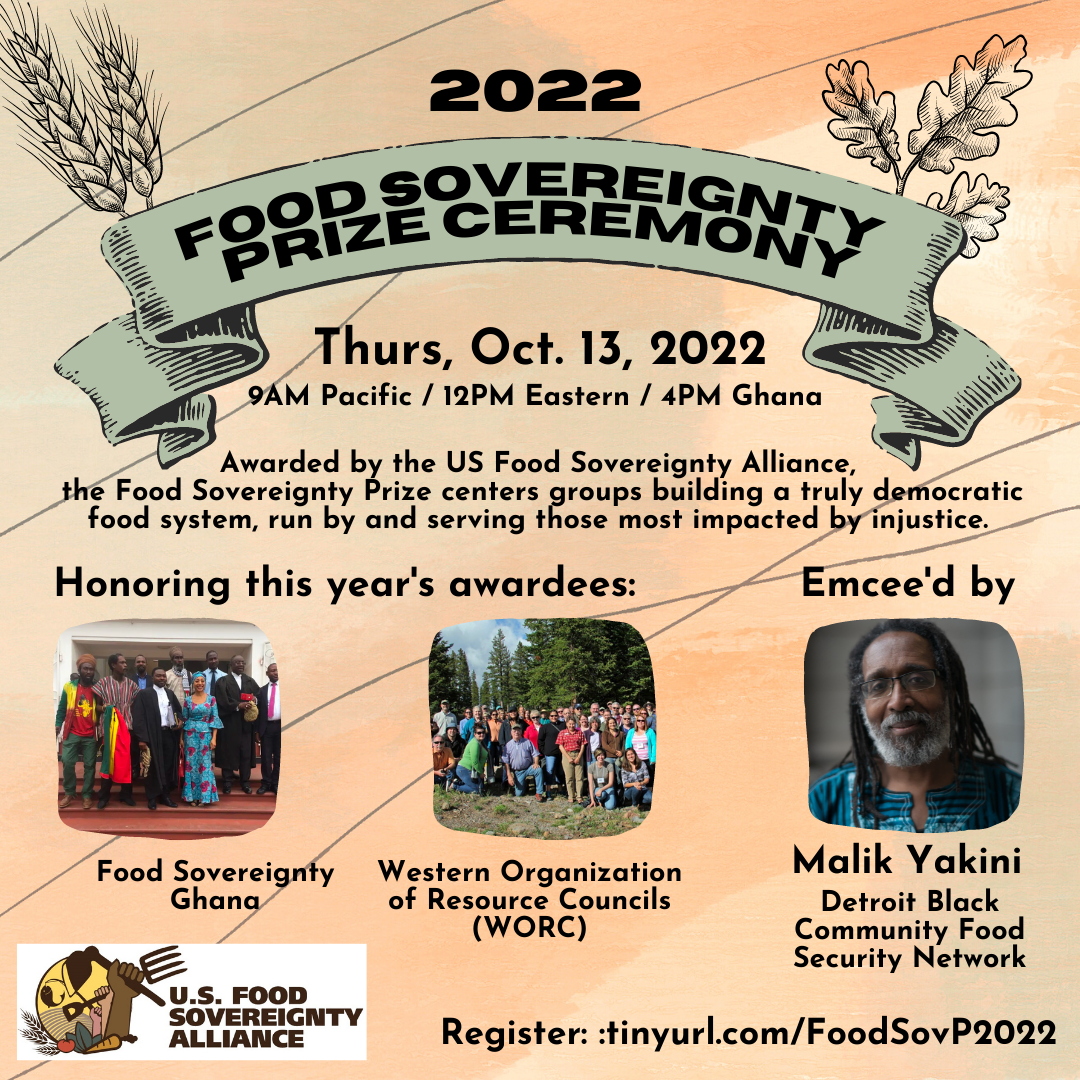
    Register here, plan a watch party, and share this invite with others! graphic with info about the ceremony

    The USFSA is a co-sponsor of the Food Week of Action and the Prize Ceremony is a featured event during the week of October 10-17.

    See the Food Week of Action map and other virtual events listed here.
    M
    ore information on the Food Week of Action webpage

  • PRESS RELEASE: Food Sovereignty Prize Highlights Solutions to Worsening Hunger Crisis

    FOR IMMEDIATE RELEASE (español abajo)

    Contact: Antonio Tovar, National Family Farm Coalition
    Phone:  202-543-5675 (office); 954-260-4287 (cell)
    Email: antonio@nffc.net

    Prize Highlights Solutions to Worsening Hunger Crisis

    14th Annual Food Sovereignty Prize honors Western Organization of Resource Councils and Food Sovereignty Ghana


    WASHINGTON, DC, Oct. 5, 2022— With recent spikes in food, fuel, and fertilizer prices raising alarms of intensifying hunger globally, food and farm advocates are calling for lasting solutions to a food system in crisis.

    “This is the third food price crisis in fifteen years, pointing to an urgent need for system-wide change. This year’s Food Sovereignty Prize winners are paving the way toward a food system that’s democratically controlled and grounded in ecological principles,” said Alivia Moore of Eastern Woodlands Rematriation, a member of the US Food Sovereignty Alliance (USFSA) and last year’s recipient of the Prize.

    The 2022 Food Sovereignty Prize, sponsored by the USFSA, is going to the Western Organization of Resource Councils (WORC) and Food Sovereignty Ghana.

    Recognized internationally, the Food Sovereignty Prize serves as a counterweight to the World Food Prize initiated by Norman Borlaug, the controversial “father of the Green Revolution.” According to Darnella Winston of the Mississippi Association of Cooperatives, also of the USFSA, “Food and farm advocates initiated the Food Sovereignty Prize fourteen years ago to challenge the Green Revolution model espoused by the World Food Prize. Today, there is mounting evidence of the failures of this model.”

    Organizers of the Food Sovereignty Prize say that Food Sovereignty Ghana exemplifies vital alternatives to the Green Revolution being pushed on the African continent by the Bill and Melinda Gates-funded Alliance for a Green Revolution for Africa (AGRA) and others. Last month, AGRA announced that it would be dropping “Green Revolution” from its name, in response to increased backlash over its failure to deliver positive outcomes for African farmers. Rather than reducing hunger, AGRA and related initiatives have fostered dependency on the multinational corporations backing the initiative.

    According to Anne Maina of the Biodiversity and Biosafety Association of Kenya, who served on the 2022 Food Sovereignty Prize selection committee, “The Green Revolution model has made local agriculture dependent on imports, diverting the hard-to-find dollar that would have addressed a myriad of other needs.”

    By contrast, Food Sovereignty Ghana promotes alternatives grounded in agroecology, ancestral knowledge, and community autonomy. A major focus of the group’s efforts has been on seeds, including legal challenges against genetically modified crops and the criminalization of farmers for seed-saving practices.

    According to Edwin Baffour of Food Sovereignty Ghana, “this international award comes at a moment of reflection for us on the past decade and the contributions we have made to encourage and inspire responsible policy making which will benefit human health, animal life, and the environment.”

    Policies that put the rights of corporations over those of farmers and communities are also being challenged within the US. According to Kathryn Bedell, Chair of WORC’s Agriculture and Food Campaign team and a rancher from western Colorado, “Ranchers like myself cannot exist without healthy soil, clean water, natural grasslands, and fair markets. Today, a small handful of international corporations dominates the food supply, controls our markets, and has undue influence on food policy. Organizations like WORC help us form a broader movement to fight for the policies we need for economic and environmental sustainability.”

    WORC and Food Sovereignty Ghana will be recognized at a virtual ceremony held on October 13, 2022, at 12:00 PM Eastern Time/4:00 PM Ghanaian Time. The ceremony is free and open to the public, with simultaneous English-Spanish interpretation provided. Registration is required. The virtual ceremony will be anchored by an in-person reception in Washington, DC. Further information is available at www.usfoodsovereigntyalliance.org.

    ###

    About the US Food Sovereignty Alliance: The US Food Sovereignty Alliance (USFSA) is a US-based alliance of food justice, anti-hunger, labor, environmental, faith-based and food producer groups that upholds the right to food as a basic human right and works to connect our local and national struggles to the international movement for food sovereignty. The Alliance works to end poverty, rebuild local food economies and assert democratic control over the food system, believing that all people have the right to healthy, culturally appropriate food produced in an ecologically sound manner. Learn more at www.usfoodsovereigntyalliance.org


    PARA PUBLICACIÓN INMEDIATA

    Contacto: Antonio Tovar
    Teléfono: 954-260-4287 or 202-543-5675
    Correo electrónico: antonio@nffc.net

    El premio destaca las soluciones a la creciente crisis de hambre

    El 14º Premio Anual a la Soberanía Alimentaria honra a la Organización Occidental de Consejos de Recursos y a la Soberanía Alimentaria de Ghana


    WASHINGTON, DC, 5 de octubre de 2022 – Con las recientes alzas de los precios de los alimentos, el combustible y los fertilizantes que hacen sonar las alarmas de la intensificación del hambre en todo el mundo, los defensores de los alimentos y sus productores agrícolas piden soluciones duraderas para un sistema alimentario en crisis.

    “Esta es la tercera crisis en los precios de los alimentos en quince años, lo que apunta a la necesidad urgente de un cambio en todo el sistema. Los ganadores del Premio a la Soberanía Alimentaria de este año están allanando el camino hacia un sistema alimentario controlado democráticamente y basado en principios ecológicos”, dijo Alivia Moore de Eastern Woodlands Rematriation, miembra de la Alianza por la Soberanía Alimentaria de Estados Unidos (USFSA) y ganadora del premio del año pasado.

    El Premio a la Soberanía Alimentaria 2022, patrocinado por la USFSA, es para la Western Organization of Resource Councils (WORC) y Food Sovereignty Ghana.

    Reconocido internacionalmente, el Premio a la Soberanía Alimentaria sirve de contrapeso al Premio Mundial de la Alimentación iniciado por Norman Borlaug, el controvertido “padre de la Revolución Verde”. Según Darnella Winston de Mississippi Association of Cooperatives, también de la USFSA, “Los defensores de la alimentación y la agricultura iniciaron hace catorce años el Premio a la Soberanía Alimentaria para cuestionar el modelo de la Revolución Verde propugnado por el Premio Mundial de la Alimentación. Hoy en día, hay muchas pruebas de los fracasos de este modelo”.

    Los organizadores del Premio a la Soberanía Alimentaria afirman que la Soberanía Alimentaria de Ghana es un ejemplo de alternativas vitales contra una segunda Revolución Verde impulsada por la Alianza para una Revolución Verde para África (AGRA por sus siglas en inglés), financiada por Bill y Melinda Gates y otras entidades. El mes pasado, AGRA anunció que dejaría de llamarse “Revolución Verde”, en respuesta a las crecientes protestas por su incapacidad para obtener resultados positivos para los agricultores africanos. En lugar de reducir el hambre, AGRA y las iniciativas relacionadas han fomentado la dependencia a las empresas multinacionales que respaldan la iniciativa.

    Según Anne Maina, de la Asociación de Biodiversidad y Bioseguridad de Kenia, que formó parte del comité de selección del Premio a la Soberanía Alimentaria 2022, “El modelo de la Revolución Verde ha hecho que la agricultura local dependa de las importaciones, desviando los limitados fondos que habrían servido para atender otras necesidades”.

    Por el contrario, Food Sovereignty Ghana promueve alternativas basadas en la agroecología, el conocimiento ancestral y la autonomía comunitaria. Uno de los principales objetivos del grupo es la defensa de las semillas autóctonas, incluyendo los desafíos legales contra los cultivos modificados genéticamente y la criminalización de los agricultores por sus prácticas de conservación de semillas.

    Según Edwin Baffour, de Soberanía Alimentaria Ghana, “Este premio internacional llega en un momento de reflexión para nosotros sobre la última década y la contribución que hemos hecho para fomentar e inspirar la elaboración de políticas responsables que beneficiarán la salud humana, la vida animal y el medio ambiente.”

    Las políticas que anteponen los derechos de las empresas a los de los agricultores y las comunidades también están siendo cuestionadas dentro de los EE. UU. Según Kathryn Bedell, presidenta del equipo de la Campaña de Agricultura y Alimentación de WORC y ganadera del oeste de Colorado, dice que “Los ganaderos como yo no podemos existir sin un suelo sano, agua limpia, praderas naturales y mercados justos. Hoy en día, un pequeño puñado de empresas internacionales domina el suministro de alimentos, controla nuestros mercados y tiene una influencia indebida en la política alimentaria. Organizaciones como WORC nos ayudan a formar un movimiento más amplio para luchar por las políticas que necesitamos para la sostenibilidad económica y medioambiental.”

    WORC y Soberanía Alimentaria Ghana serán reconocidas en una ceremonia virtual que se celebrará el 13 de octubre de 2022, al mediodía hora del este/4 PM hora de Ghana. La ceremonia es gratuita y abierta al público, con interpretación simultánea inglés-español. Es necesario inscribirse. La ceremonia virtual se completará con una recepción en persona en Washington, DC. Puede obtener más información en www.usfoodsovereigntyalliance.org.

    ###

    Acerca de la Alianza por la Soberanía Alimentaria de EE.UU: La Alianza por la Soberanía Alimentaria de Estados Unidos (USFSA) es una alianza con sede en Estados Unidos de grupos de justicia alimentaria, lucha contra el hambre, laborales, medioambientales, religiosas y de productores de alimentos que defiende el derecho a la alimentación como un derecho humano básico y trabaja para conectar nuestras luchas locales y nacionales con el movimiento internacional por la soberanía alimentaria. La Alianza trabaja para acabar con la pobreza, reconstruir las economías alimentarias locales y afirmar el control democrático sobre el sistema alimentario, ya que cree que todas las personas tienen derecho a alimentos sanos y culturalmente apropiados producidos de forma ecológica. Más información en www.usfoodsovereigntyalliance.org.

  • 2022 Food Sovereignty Prize Winners Announced!

    2022 Food Sovereignty Prize Winners Announced!

    Español abajo

    US Food Sovereignty Alliance (USFSA) Announces

    2022 Food Sovereignty Prize Winners & Virtual Ceremony

    Food Sovereignty Ghana  &
    Western Organization of Resource Councils (WORC)

    Join the ceremony on Thursday, October 13
    Register Here for the virtual event emceed by Malik Yakini of the Detroit Black Community Food Security Network

    Now in its 14th year, the Food Sovereignty Prize is given annually near World Food Day to a domestic and international organization advancing food sovereignty – the right of all peoples to access healthy and culturally appropriate food produced through ecologically sound and sustainable methods, and their right to define their food, fishery, and farming systems. It stands in contrast to the corporate-funded World Food Prize, which perpetuates the myth that society can produce its way out of hunger and the climate crisis with biotechnology and synthetic inputs.

    The 2022 honorees have fought for years against corporate control of the food system, defending sustainable farming and pasturing, healthy soils, and clean water, building community power, and advocating clean, renewable energy sources. (more…)